

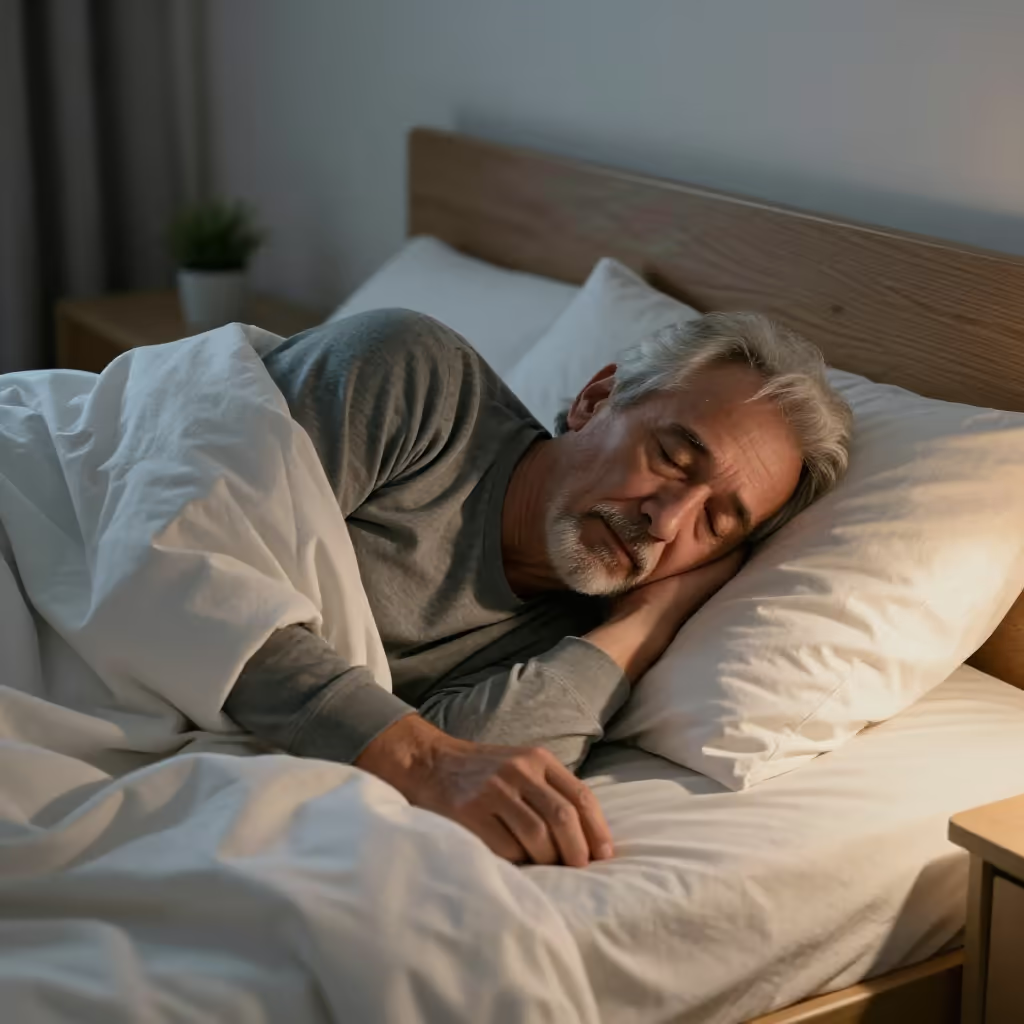
schlafen
to sleep
To be in the state of sleep in order to recover physically and mentally.
EXAMPLE
Nach dem langen Arbeitstag wollte ich nur noch schlafen.
After the long workday, I only wanted to sleep.
to sleep
Loading your saved state.
to sleep
To be in the state of sleep in order to recover physically and mentally.
Nach dem langen Arbeitstag wollte ich nur noch schlafen.
After the long workday, I only wanted to sleep.

to sleep with someone
A euphemistic way of saying to have sexual intercourse.
In der Serie wird angedeutet, dass die beiden Hauptfiguren miteinander geschlafen haben.
In the series, it is implied that the two main characters slept with each other.

to be asleep
Colloquial for being inattentive or not paying attention.
Hast du im Unterricht geschlafen? Der Lehrer hat das gerade erklärt.
Were you asleep in class? The teacher just explained that.

to fall asleep
Describes the numb, tingling feeling in a body part, often when the blood supply has been briefly interrupted.
Nach dem langen Sitzen ist mir das Bein eingeschlafen.
After sitting for so long, my leg fell asleep.
to lie dormant
Figurative for being present unused or hidden; a potential that has not been activated.
In dieser alten Idee schläft noch immer ein großes Potenzial.
There is still great potential lying dormant in this old idea.
The verb 'schlafen' (to sleep) always forms the perfect tense with the auxiliary verb 'haben' (to have). It is not a verb of motion, even if you move while sleeping.
Ich habe heute Nacht sehr gut geschlafen.
I slept very well last night.
To describe the quality of sleep, 'schlafen' (to sleep) is often combined with adverbs like 'tief' (deeply), 'fest' (soundly), 'gut' (well), 'schlecht' (badly), or 'lange' (for a long time).
Wegen des Lärms habe ich die ganze Nacht schlecht geschlafen.
Because of the noise, I slept badly all night.
In the euphemistic meaning for sexual intercourse, the preposition 'mit' (with) is crucial. The structure is always 'mit jemandem schlafen' (to sleep with someone).
Sie fragte ihn direkt, ob er mit ihrer Freundin geschlafen habe.
She asked him directly whether he had slept with her friend.
The meaning 'to be inattentive' is very colloquial. It is often used as a rhetorical question to point out someone's lack of attention.
Schläfst du? Ich habe dich etwas gefragt!
Are you asleep? I asked you something!
When a body part becomes numb, German uses the separable verb 'einschlafen' (to fall asleep) with the auxiliary verb 'sein' (to be). The person this happens to is in the dative.
Mir ist beim Fernsehen der Fuß eingeschlafen.
My foot fell asleep while I was watching TV.
In the figurative meaning of unused potential, 'schlafen' (to sleep / to lie dormant) is often used with the preposition 'in'. The structure is 'in etwas/jemandem schläft ein Potenzial/Talent' (potential/talent lies dormant in something/someone).
In diesem jungen Spieler schläft ein großes Talent.
There is great talent lying dormant in this young player.
to stay overnight
Schlafen refers to the actual state of sleep. Übernachten, on the other hand, refers to the entire stay overnight away from one’s own home and emphasizes the location. When talking about sleep itself, use schlafen; for the stay, use übernachten.
Im Hotel konnte ich trotz des Straßenlärms kaum schlafen.
Despite the traffic noise, I could barely sleep at the hotel.
Wegen des späten Termins werde ich heute im Hotel übernachten.
Because of the late appointment, I will stay overnight at the hotel tonight.