

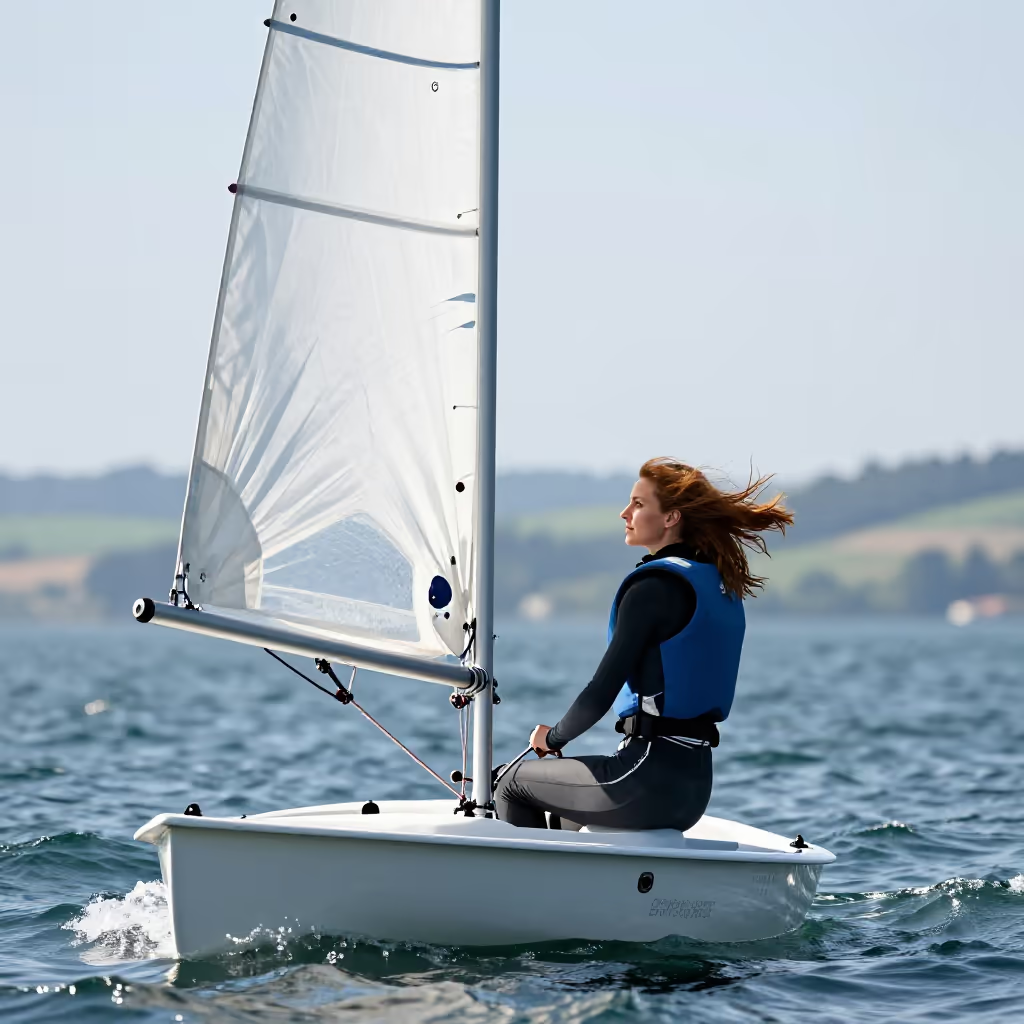
segeln
to sail
To move on water in a sailboat or sailing ship using wind power.
EXAMPLE
Im Sommer fahren wir oft an den See, um zu segeln.
In summer, we often go to the lake to sail.
to sail
segeln – segelte – hat gesegelt
Loading your saved state.
to sail
To move on water in a sailboat or sailing ship using wind power.
Im Sommer fahren wir oft an den See, um zu segeln.
In summer, we often go to the lake to sail.

to glide
To move gently and smoothly through the air, like a bird or a leaf in the wind.
Der Adler breitete seine Flügel aus und segelte majestätisch am Himmel.
The eagle spread its wings and glided majestically across the sky.
| ich | segle segele |
|---|---|
| du | segelst |
| er/sie/es | segelt |
| wir | segeln |
| ihr | segelt |
| sie | segeln |
| ich | segelte |
|---|---|
| du | segeltest |
| er/sie/es | segelte |
| wir | segelten |
| ihr | segeltet |
| sie | segelten |
| ich | habe gesegelt |
|---|---|
| du | hast gesegelt |
| er/sie/es | hat gesegelt |
| wir | haben gesegelt |
| ihr | habt gesegelt |
| sie | haben gesegelt |
| du | segle! segele!, segel! |
|---|---|
| ihr | segelt! |
| Sie | segeln Sie! |
| ich | hatte gesegelt |
|---|---|
| du | hattest gesegelt |
| er/sie/es | hatte gesegelt |
| wir | hatten gesegelt |
| ihr | hattet gesegelt |
| sie | hatten gesegelt |
| ich | werde segeln |
|---|---|
| du | wirst segeln |
| er/sie/es | wird segeln |
| wir | werden segeln |
| ihr | werdet segeln |
| sie | werden segeln |
| ich | segele segle |
|---|---|
| du | segelst seglest |
| er/sie/es | segele segle |
| wir | segeln |
| ihr | segelt seglet |
| sie | segeln |
Used for reported speech.
| ich | segelte |
|---|---|
| du | segeltest |
| er/sie/es | segelte |
| wir | segelten |
| ihr | segeltet |
| sie | segelten |
Used for wishes and “would”.
| infinitive | segeln |
|---|---|
| with zu | zu segeln |
| present participle | segelnd |
| past participle | gesegelt |
Since 'segeln' (to sail) describes movement, the perfect tense is always formed with the auxiliary verb 'sein' (to be), not with 'haben' (to have). This is a common mistake.
Wir sind letztes Jahr über den Atlantik gesegelt.
We sailed across the Atlantic last year.
The verb 'segeln' (to sail) is derived directly from the noun 'das Segel' (sail). A sail is the large piece of cloth on a ship that catches the wind.
Der Wind blies kräftig in die Segel.
The wind blew strongly into the sails.
When sailing on water, the prepositions 'auf' with dative (where?) or 'über' with accusative (to where? across which surface?) are often used.
Am Wochenende segeln wir auf dem Bodensee.
At the weekend, we're sailing on Lake Constance.
In the figurative meaning of gliding, the subject is usually something light that moves elegantly through the air. Typical subjects are 'ein Vogel' (a bird), 'ein Blatt' (a leaf), or 'eine Feder' (a feather).
Ein einzelnes Herbstblatt segelte langsam vom Baum.
A single autumn leaf glided slowly down from the tree.
to drive / ride
Fahren can describe a trip by sailboat in general and focuses on the means of transport or the journey. Segeln more specifically refers to moving with the help of sails and wind. When this type of movement is important, segeln is the better choice.
Am Samstag segeln wir bei gutem Wind zur Nachbarinsel.
On Saturday, we’re sailing to the neighboring island in good wind.
Am Samstag fahren wir mit dem Segelboot zur Nachbarinsel.
On Saturday, we’re taking a sailboat to the neighboring island.