


spannen
to stretch / tighten
To pull something tight or stretch it so that it is under tension.
EXAMPLE
Er spannte ein Seil zwischen den beiden Bäumen.
He stretched a rope between the two trees.
to stretch / tighten / peep
Loading your saved state.
to stretch / tighten
To pull something tight or stretch it so that it is under tension.
Er spannte ein Seil zwischen den beiden Bäumen.
He stretched a rope between the two trees.

to feel tight
Describes the feeling when clothing is too tight and presses against the body.
Nach dem üppigen Essen spannt meine Hose am Bund.
After the heavy meal, my pants feel tight around the waistband.

to keep someone in suspense
To intentionally leave someone uncertain for a long time and thereby create curiosity or tension.
Sag schon, was passiert ist, und spann mich nicht so auf die Folter!
Come on, tell me what happened, and don't keep me in suspense like this!
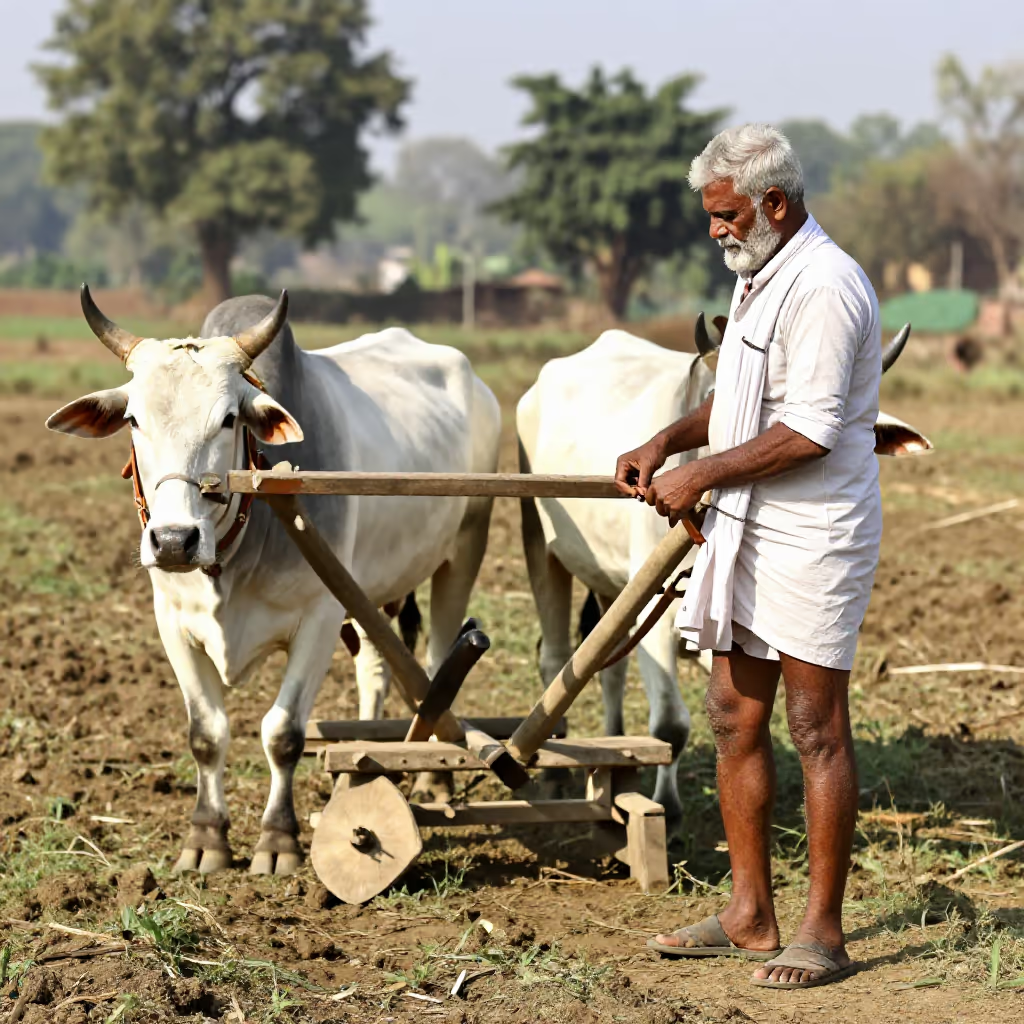
to harness
To hitch a draft animal, such as a horse or an ox, to a cart or plow.
Der Kutscher spannte die Pferde vor die Kutsche.
The coachman harnessed the horses to the carriage.

to peep
Colloquial for secretly observing people in private situations; to spy voyeuristically.
Der Nachbar wurde angezeigt, weil er angeblich in die Fenster gespannt hat.
The neighbor was reported because he had allegedly been peeping into the windows.
The verb 'spannen' is the root of the noun 'die Spannung' (tension, suspense) and the adjective 'spannend' (exciting). All of these words have the basic idea of tension or tightness.
Die Spannung vor dem Finale war riesig.
The tension before the final was enormous.
The past participle 'gespannt' is very often used as an adjective and means 'curious' or 'eager with expectation'. The preposition used with it is 'auf' with the accusative.
Ich bin gespannt, wie die Geschichte ausgeht.
I'm curious to see how the story ends.
In the meaning 'straff ziehen' (to pull tight), 'spannen' is often combined with things that can be stretched. Typical examples are: 'ein Seil spannen' (to stretch a rope), 'ein Netz spannen' (to spin/stretch a net), 'eine Feder spannen' (to cock/tension a spring), or 'die Muskeln anspannen' (to tense the muscles).
Die Spinne hat ihr Netz zwischen den Ästen gespannt.
The spider stretched its web between the branches.
When clothing is too tight, the item of clothing is the subject of the sentence. Often 'an' or 'am' plus dative is used to indicate where it presses.
Das neue Hemd spannt an den Schultern.
The new shirt feels tight at the shoulders.
The idiom 'jemanden auf die Folter spannen' (to keep someone in suspense) is a fixed unit. The person being made curious is always in the accusative.
Nun sag schon, wer gewonnen hat! Spann mich nicht auf die Folter!
Come on, tell us who won! Don't keep me in suspense!
In the meaning 'heimlich beobachten' (to observe secretly), 'spannen' is a colloquial word with a strongly negative and derogatory meaning.
Es ist strafbar, Leute in ihren Wohnungen zu bespannen.
It is illegal to spy on people in their apartments.
to press / hug
When clothing is too tight, both verbs can describe an unpleasant feeling. “Spannen” focuses more on the fabric being taut over a broad area, while “drücken” emphasizes pressure on a specific part of the body. Use “spannen” when clothing feels tight overall and “drücken” when it presses in one particular place.

Die neue Hose spannt an den Oberschenkeln, obwohl sie an der Taille gut sitzt.
The new trousers feel tight around the thighs, even though they fit well at the waist.
Der neue Schuh drückt an den Zehen, obwohl er am Fuß sonst gut sitzt.
The new shoe presses against my toes, even though it fits well everywhere else.