


die Sprache
language
A system of words, grammar, and sounds used for communication by the people of a country or region.
EXAMPLE
Sie spricht fließend drei verschiedene Sprachen.
She speaks three different languages fluently.
language
Loading your saved state.
language
A system of words, grammar, and sounds used for communication by the people of a country or region.
Sie spricht fließend drei verschiedene Sprachen.
She speaks three different languages fluently.

speech
A person's ability to speak.
Nach dem Unfall verlor er vorübergehend die Sprache.
After the accident, he temporarily lost his speech.

to bring up
To mention a topic or put it up for discussion.
Ich werde das Problem bei der nächsten Teamsitzung zur Sprache bringen.
I will bring up the problem at the next team meeting.

language / style
The particular style of writing or speaking used by a person or in a specific field.
Der Dichter ist für seine bildhafte und poetische Sprache bekannt.
The poet is known for his vivid and poetic language.

language
A formal system of commands and rules for creating computer programs (programming language).
Für die Webentwicklung lernen viele die Sprache JavaScript.
For web development, many people learn the language JavaScript.
'Die Sprache' (language) is the noun related to the verb 'sprechen' (to speak). This connection is fundamental: language is the system we use to speak.
Er spricht so leise, dass ich ihn kaum verstehe.
He speaks so quietly that I can hardly understand him.
The word '-sprache' (-language) forms the second part of many important nouns. Examples include 'Muttersprache' (native language), 'Fremdsprache' (foreign language), 'Fachsprache' (technical/specialized language), or 'Umgangssprache' (colloquial language).
Englisch ist für viele Menschen die erste Fremdsprache, die sie lernen.
For many people, English is the first foreign language they learn.
When referring to a specific language such as German or English, the verbs 'lernen' (to learn), 'sprechen' (to speak), 'verstehen' (to understand), and 'beherrschen' (to master) are often used.
Um eine Sprache fließend zu beherrschen, muss man viel üben.
To master a language fluently, you have to practice a lot.
The meaning 'ability to speak' is often recognized by certain verbs. It is typically used when someone loses or regains this ability, for example in 'die Sprache verlieren' (to lose one's speech) or 'die Sprache wiederfinden' (to regain one's speech).
Nach dem Schock hatte er für einen Moment die Sprache verloren.
After the shock, he lost his speech for a moment.
The expression 'etwas zur Sprache bringen' (to bring something up) means to mention a topic. The topic being mentioned is always in the accusative.
Er hat seine Bedenken in der Sitzung zur Sprache gebracht.
He brought up his concerns in the meeting.
When 'Sprache' (language/style) means a style, there is often an adjective before it that describes this style. Examples are 'einfache Sprache' (simple language), 'formelle Sprache' (formal language), 'bildhafte Sprache' (vivid/figurative language), or 'technische Sprache' (technical language).
Der Autor ist für seine klare und einfache Sprache bekannt.
The author is known for his clear and simple language.
tongue
Sprache is the neutral term for the communication system of a country or region. Zunge can refer to the same language in a figurative, elevated style. In factual statements, Sprache is the usual choice; Zunge fits better in literary or ceremonial texts.
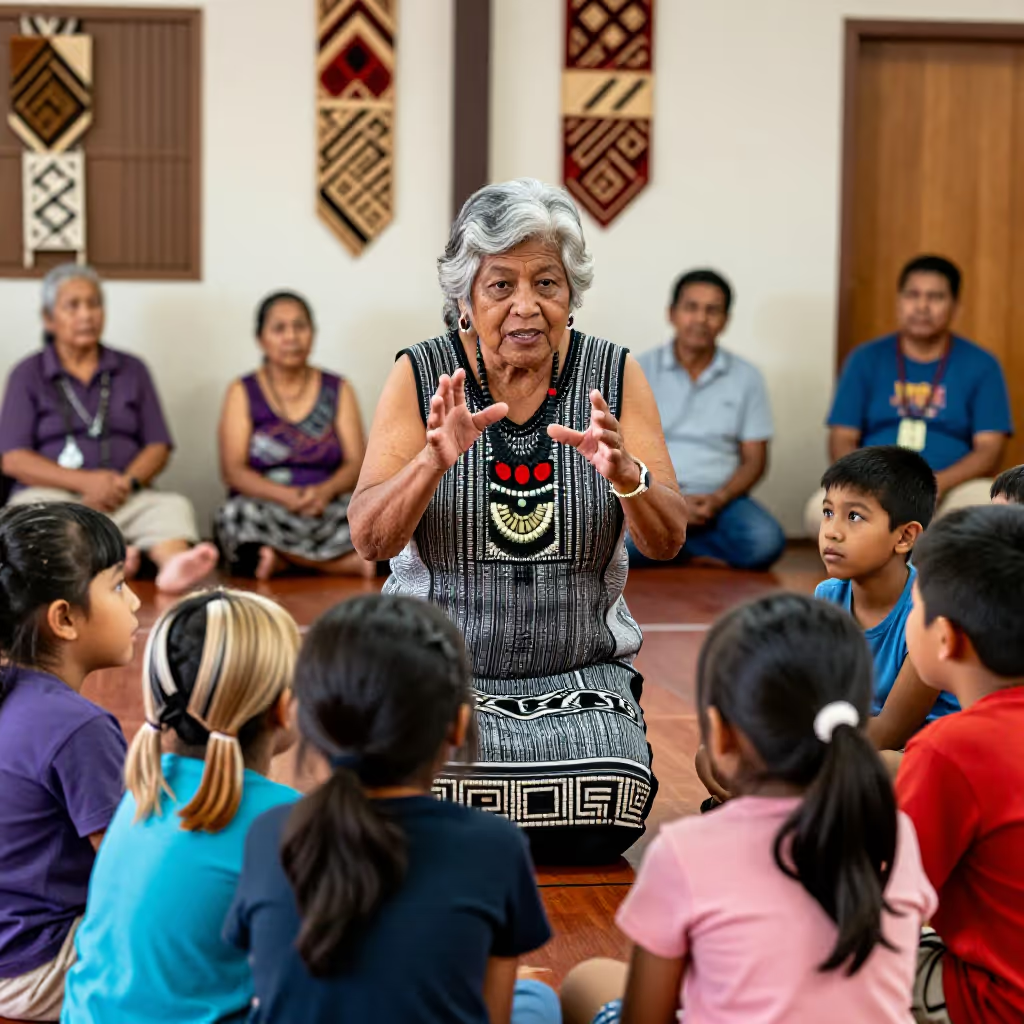
Die Sprache der Region wird auch in vielen Schulen unterrichtet.
The language of the region is also taught in many schools.
Die Zunge der Region wird auch in vielen Gedichten gewürdigt.
The tongue of the region is also celebrated in many poems.