


die Zunge
tongue
The movable, muscular organ in the mouth that is used for tasting, swallowing, and speaking.
EXAMPLE
Der Arzt sagte mir, ich solle die Zunge herausstrecken.
The doctor told me to stick out my tongue.
tongue
Loading your saved state.
tongue
The movable, muscular organ in the mouth that is used for tasting, swallowing, and speaking.
Der Arzt sagte mir, ich solle die Zunge herausstrecken.
The doctor told me to stick out my tongue.

to be on the tip of one's tongue
To be unable to remember a word or name at the moment, even though you feel that you actually know it.
Wie hieß der Film noch gleich? Es liegt mir auf der Zunge!
What was the film called again? It's on the tip of my tongue!

to get burned
To say something thoughtless or inappropriate and experience negative consequences as a result.
Mit dieser Bemerkung über das Essen seiner Schwiegermutter hat er sich ordentlich die Zunge verbrannt.
With that comment about his mother-in-law's food, he really got burned.

tongue / language
In a figurative or elevated sense, the language or manner of speaking of a person or people.
Die Konferenz wurde in vielen verschiedenen Zungen abgehalten.
The conference was held in many different tongues.
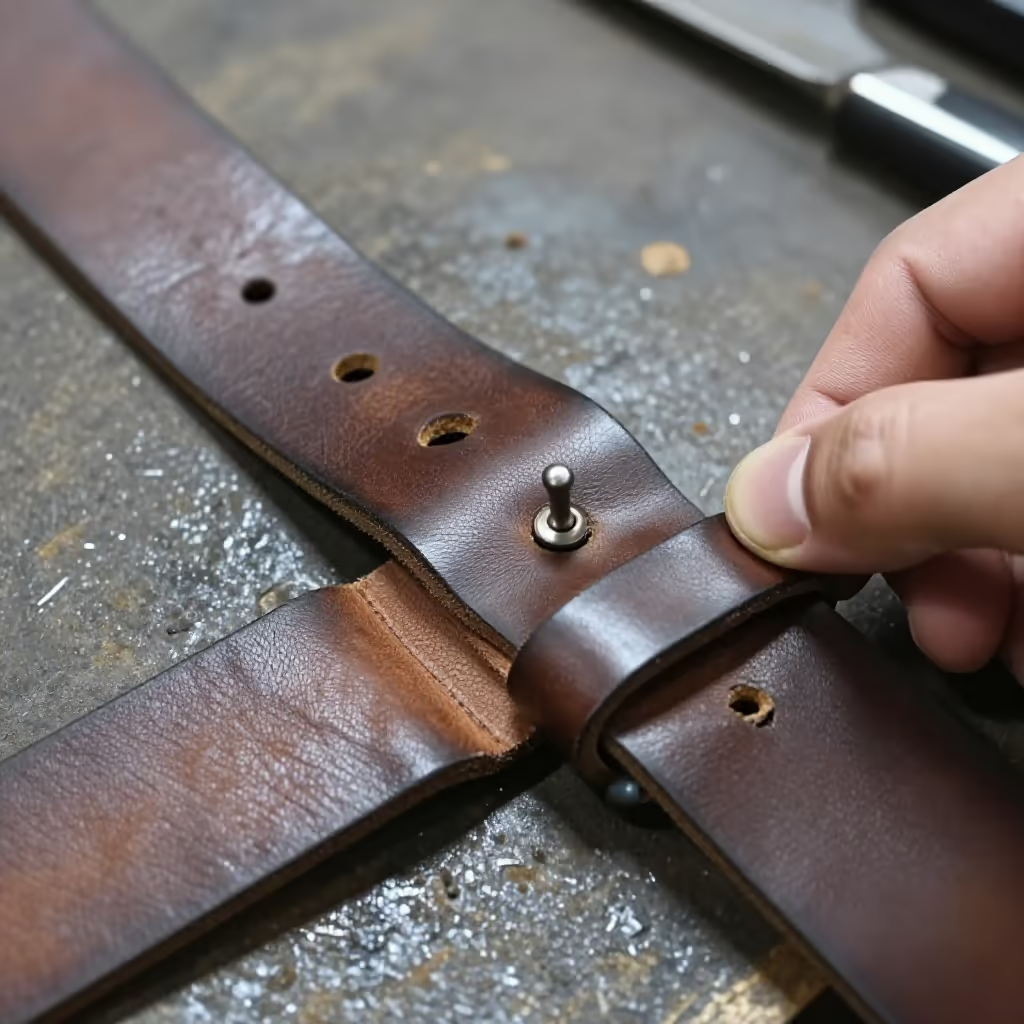
tongue
The movable metal pin on a belt buckle or clasp that is inserted into a hole.
Die Zunge an meinem Gürtel ist abgebrochen, jetzt kann ich ihn nicht mehr schließen.
The tongue on my belt has broken off, so now I can't fasten it anymore.
In connection with the body part, 'Zunge' (tongue) is often used in fixed collocations. Common ones are 'sich auf die Zunge beißen' (to bite one's tongue, also figuratively) and 'die Zunge herausstrecken' (to stick out one's tongue).
Ich wollte etwas Unhöfliches sagen, habe mir aber gerade noch auf die Zunge gebissen.
I wanted to say something rude, but I managed to bite my tongue just in time.
The expression 'etwas liegt einem auf der Zunge' (something is on the tip of one's tongue) always uses the dative for the person. So it is 'es liegt MIR auf der Zunge', not 'ich'.
Warte, sag es nicht! Der Name liegt mir auf der Zunge.
Wait, don't say it! The name is on the tip of my tongue.
The expression 'sich die Zunge verbrennen' (to get burned by saying something inappropriate) is reflexive. You must use the appropriate reflexive pronoun in the dative: ich verbrenne MIR, du verbrennst DIR, er verbrennt SICH die Zunge.
Sei vorsichtig, was du im Meeting sagst, damit du dir nicht die Zunge verbrennst.
Be careful what you say in the meeting so you don't get burned.
The use of 'Zunge' (tongue) for 'Sprache' (language) is elevated or poetic. In normal everyday language, the word 'Sprache' is almost always used.
Der Dichter beherrschte mehrere Zungen.
The poet mastered several tongues.
You will always recognize this specific, technical meaning from the context. If a 'Gürtel' (belt), 'Schnalle' (buckle), or 'Verschluss' (clasp/fastener) is mentioned, this small metal part is meant.
Die Zunge der Gürtelschnalle ist aus Messing.
The tongue of the belt buckle is made of brass.
language
Sprache is the neutral term for the communication system of a country or region. Zunge can refer to the same language in a figurative, elevated style. In factual statements, Sprache is the usual choice; Zunge fits better in literary or ceremonial texts.

Die Zunge der Region wird auch in vielen Gedichten gewürdigt.
The tongue of the region is also celebrated in many poems.
Die Sprache der Region wird auch in vielen Schulen unterrichtet.
The language of the region is also taught in many schools.