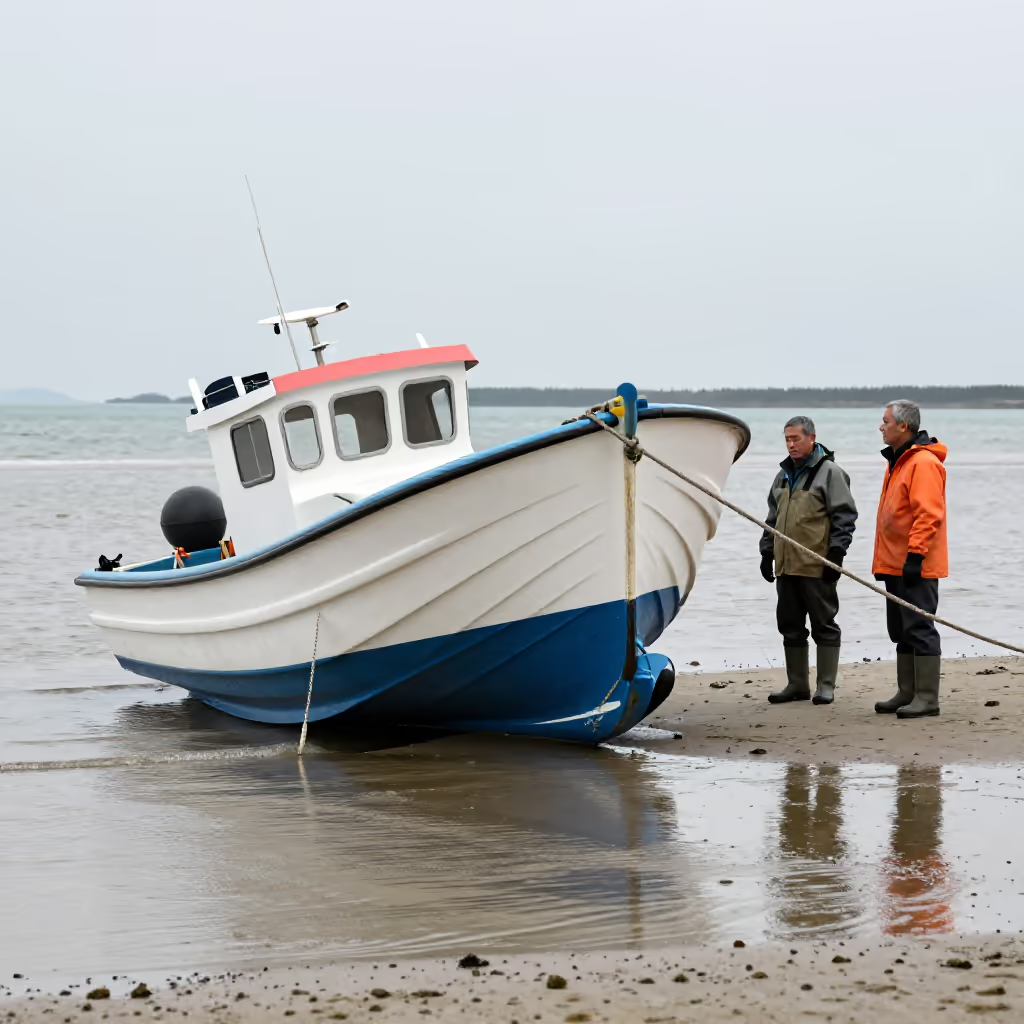
To run aground with a ship, to be stuck on the beach or on a sandbank and no longer be able to continue sailing.
example
Das Containerschiff ist bei starkem Seegang vor der Küste gestrandet.
The container ship ran aground off the coast in heavy seas.

Usage tips
Word family
The verb 'stranden' (to run aground / to be stranded) is derived directly from the noun 'der Strand' (the beach). The original meaning describes a ship that is stuck on the beach. This idea of being stuck against one's will is then transferred to people and projects.
EXAMPLE
Das Schiff ist an der Küste gestrandet.
The ship ran aground on the coast.
Perfect tense with 'sein'
'Stranden' (to run aground / to be stranded) describes a change of place or state (one is stuck). Therefore, the perfect tense is always formed with the auxiliary verb 'sein' (to be), not with 'haben' (to have).
EXAMPLE
Wir sind gestern am kleinen Bahnhof ohne Geld gestrandet.
We were stranded yesterday at the small train station without any money.
Context clues
The context reveals the meaning: If it is about ships or coasts, the literal meaning is intended. If it is about travelers, airports, or train stations, people are stuck. With abstract nouns like 'Verhandlungen' (negotiations) or 'Pläne' (plans), it means 'scheitern' (to fail).
EXAMPLE
Aufgrund des Schneesturms sind viele Autofahrer auf der Autobahn gestrandet.
Because of the snowstorm, many drivers were stranded on the highway.
Typical places
When people 'stranden' (are stranded), this often happens in typical travel locations. Common combinations are 'am Flughafen stranden' (to be stranded at the airport), 'am Bahnhof stranden' (to be stranded at the train station), or 'in einer fremden Stadt stranden' (to be stranded in a foreign city).
EXAMPLE
Als der letzte Bus ausfiel, sind wir in dem kleinen Dorf gestrandet.
When the last bus was canceled, we were stranded in the small village.
Compare with
near_synonym · confusable
stranden vs Grund
reason / ground
'auf Grund laufen' and 'stranden' can both mean that a ship or boat is stuck and cannot continue. 'auf Grund laufen' focuses more on the process: the ship touches the ground under the water. 'stranden' emphasizes the result more: the ship is stuck, often on the beach or on a sandbank. The words can be confused because both are used in similar situations on the water. If you mean contact with the shallow bottom, 'auf Grund laufen' fits well; if you mean being stuck on the shore or on sand, 'stranden' sounds more natural.
stranden
Nach dem Sturm strandete ein Fischerboot auf einer Sandbank.
After the storm, a fishing boat was stranded on a sandbank.
Grund
Das Segelboot ist in der Nacht auf Grund gelaufen.