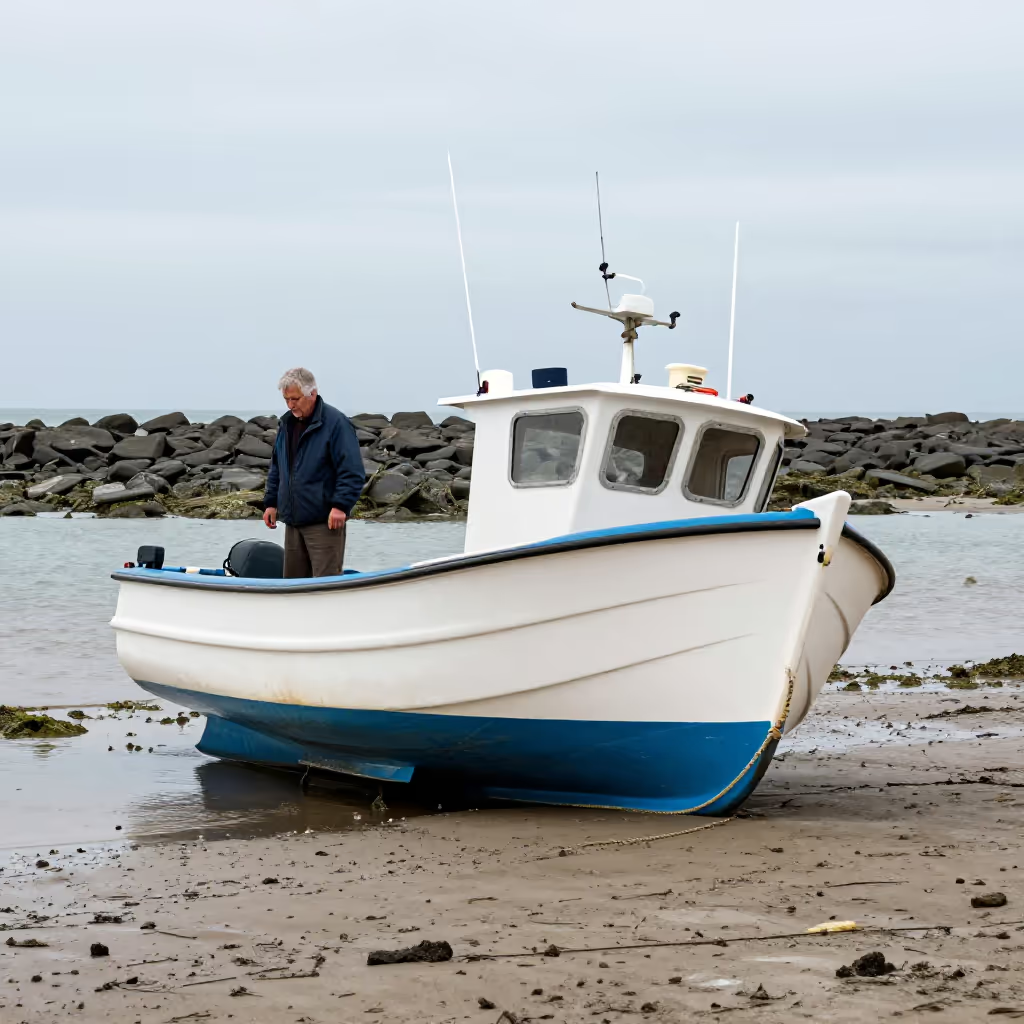
To run aground with a ship or boat, that is, to sail onto a shallow area such as a sandbank or reef and get stuck.
example
Das Containerschiff ist bei Niedrigwasser auf eine Sandbank aufgelaufen.
The container ship ran aground on a sandbank at low tide.

Usage tips
Separable verb
'Auflaufen' is a separable verb. The prefix 'auf' comes at the end in main clauses, remains attached to the verb in subordinate clauses, and with the infinitive with 'zu', 'zu' goes in the middle.
EXAMPLE
Die Mannschaft läuft gleich auf.
The team is about to take the field.
Auxiliary verb 'sein'
Since 'auflaufen' describes movement or a change of state, the perfect tense is always formed with the auxiliary verb 'sein' (to be).
EXAMPLE
Das Schiff ist auf Grund gelaufen.
The ship ran aground.
Word structure
The verb combines the prefix 'auf' with 'laufen' (to run/walk). The literal idea of 'running onto something' helps explain some meanings: a ship runs onto a sandbank, or a team runs onto the playing field.
EXAMPLE
Das Boot ist auf ein Riff aufgelaufen.
The boat ran aground on a reef.
Context clue
In this meaning, 'auflaufen' is used almost exclusively in financial or economic contexts. Typical signal words are 'Kosten' (costs), 'Schulden' (debts), 'Zinsen' (interest), or 'Verluste' (losses).
EXAMPLE
Durch die Reparaturen sind unerwartet hohe Kosten aufgelaufen.
Unexpectedly high costs accumulated because of the repairs.
Sports context clue
This meaning is limited to the context of sports. You can recognize it from words like 'Mannschaft' (team), 'Spieler' (player), 'Stadion' (stadium), 'Spielfeld' (playing field), or 'Platz' (field/pitch).
EXAMPLE
Die Nationalmannschaft ist mit den Kindern an der Hand aufgelaufen.
The national team took the field holding the children's hands.
Register: colloquial
This meaning is used mainly in colloquial language. It often has a slightly surprised or negative connotation, as if the people appear unexpectedly or at an inconvenient time.
EXAMPLE
Plötzlich ist meine ganze Familie bei mir aufgelaufen.
Suddenly my whole family showed up at my place.
Compare with
near_synonym · confusable
auflaufen vs Grund
reason / ground
'auf Grund laufen' and 'auflaufen' can both describe a ship or boat touching a shallow area and getting stuck. The difference is mainly in the form: 'auf Grund laufen' (to run aground) is a fixed expression with the noun 'Grund'. 'auflaufen' is a single verb. Learners may confuse them because the meaning is very similar and in both cases a ship can no longer continue. In practice, you can say 'Das Boot läuft auf Grund' or 'Das Boot läuft auf', but not simply 'das Boot grundet'.
auflaufen
Das Schiff lief vor der Küste auf und musste befreit werden.
The ship ran aground off the coast and had to be freed.
Grund
Bei dichtem Nebel ist das kleine Boot auf Grund gelaufen.