
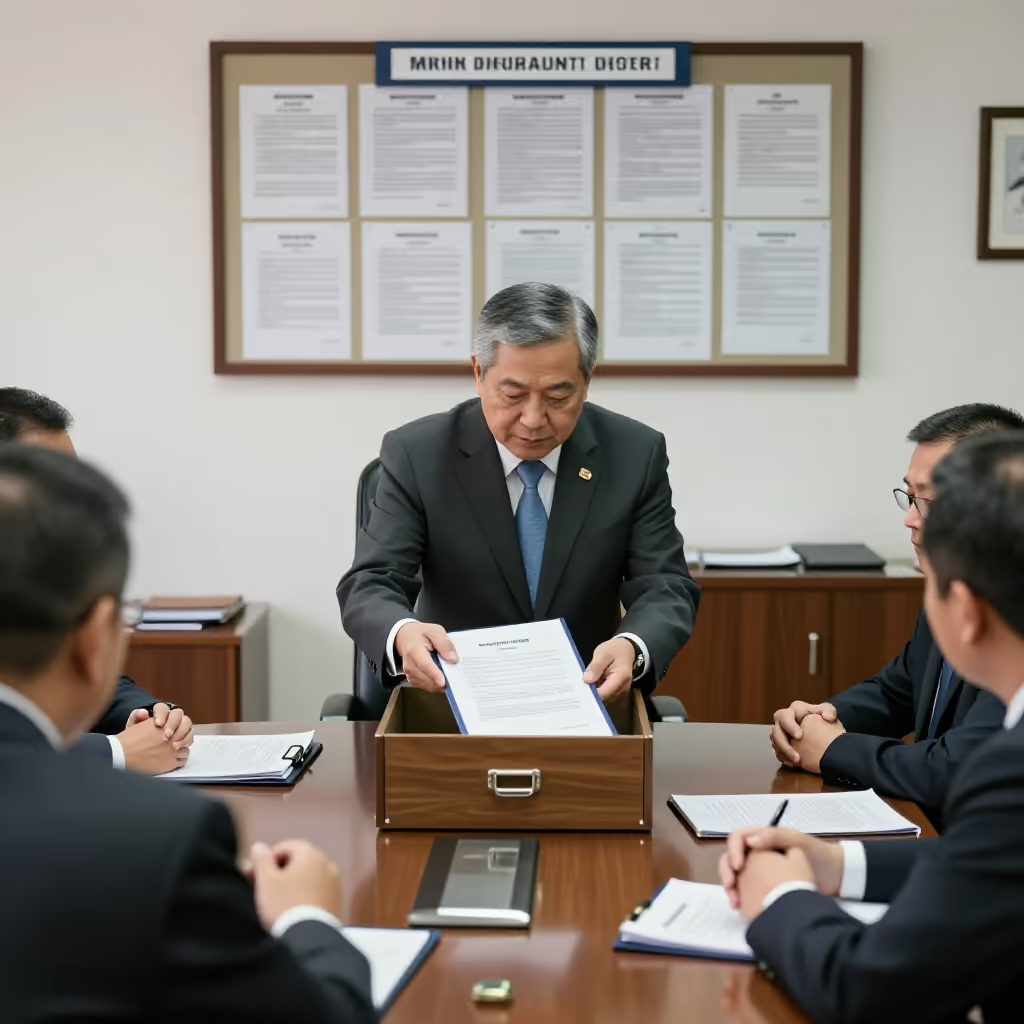
To temporarily exclude someone from their duties, office, or school, often as a disciplinary measure or during an investigation. The person usually retains their status but is not allowed to perform their activity.
example
Der Polizist wurde nach dem Vorfall vom Dienst suspendiert.
The police officer was suspended from duty after the incident.
Usage tips
Verbs ending in "-ieren"
'Suspendieren' (to suspend) is a verb of foreign origin that ends in '-ieren'. Such verbs are always regular and form the past participle with 'hat' and the ending '-t', but without the prefix 'ge-'. So it is 'hat suspendiert' (has suspended).
EXAMPLE
Die Universität hat den Professor suspendiert.
The university suspended the professor.
Sentence structure with "von"
When a person is excluded from an activity, you use the structure: 'jemanden (Akkusativ) von etwas (Dativ) suspendieren' — to suspend someone (accusative) from something (dative).
EXAMPLE
Der Spieler wurde vom Training suspendiert.
The player was suspended from training.
Technical context
The meaning 'Teilchen in einer Flüssigkeit schweben lassen' (to keep particles suspended in a liquid) is purely technical language. It is used only in scientific contexts such as chemistry or physics.
EXAMPLE
Für das Experiment müssen wir feine Sandkörner in Wasser suspendieren.
For the experiment, we have to suspend fine grains of sand in water.
Register and style
In the meaning 'jemanden von einer Aufgabe entbinden' (to relieve someone of a task), 'suspendieren' (to suspend) belongs to formal official and administrative language. It sounds more official and stricter.
EXAMPLE
Die Beamtin wurde mit sofortiger Wirkung vom Dienst suspendiert.
The civil servant was suspended from duty with immediate effect.
Compare with
near_synonym · confusable
suspendieren vs ausschließen
to exclude / rule out
'ausschließen' and 'suspendieren' can both mean that someone is not allowed to take part or perform their role for the time being. However, 'ausschließen' is more general: you can exclude someone from a group, a party, or a course. This can be temporary or final. 'suspendieren' fits especially with school, work, office, or duty. It sounds more formal and usually means: the person officially still has their status, but is not allowed to work or participate for a while, often because of a problem or an investigation. The words can be confused because both feel like exclusion. As a practical rule: for everyday situations and groups, you are more likely to use 'ausschließen'; for an official temporary measure, 'suspendieren' is more likely.
suspendieren
Die Schule suspendiert den Schüler für eine Woche, bis der Vorfall geklärt ist.
The school suspends the student for a week until the incident has been clarified.
ausschließen
Der Verein schließt das Mitglied nach mehreren Beschwerden aus.
The club excludes the member after several complaints.