aussetzen
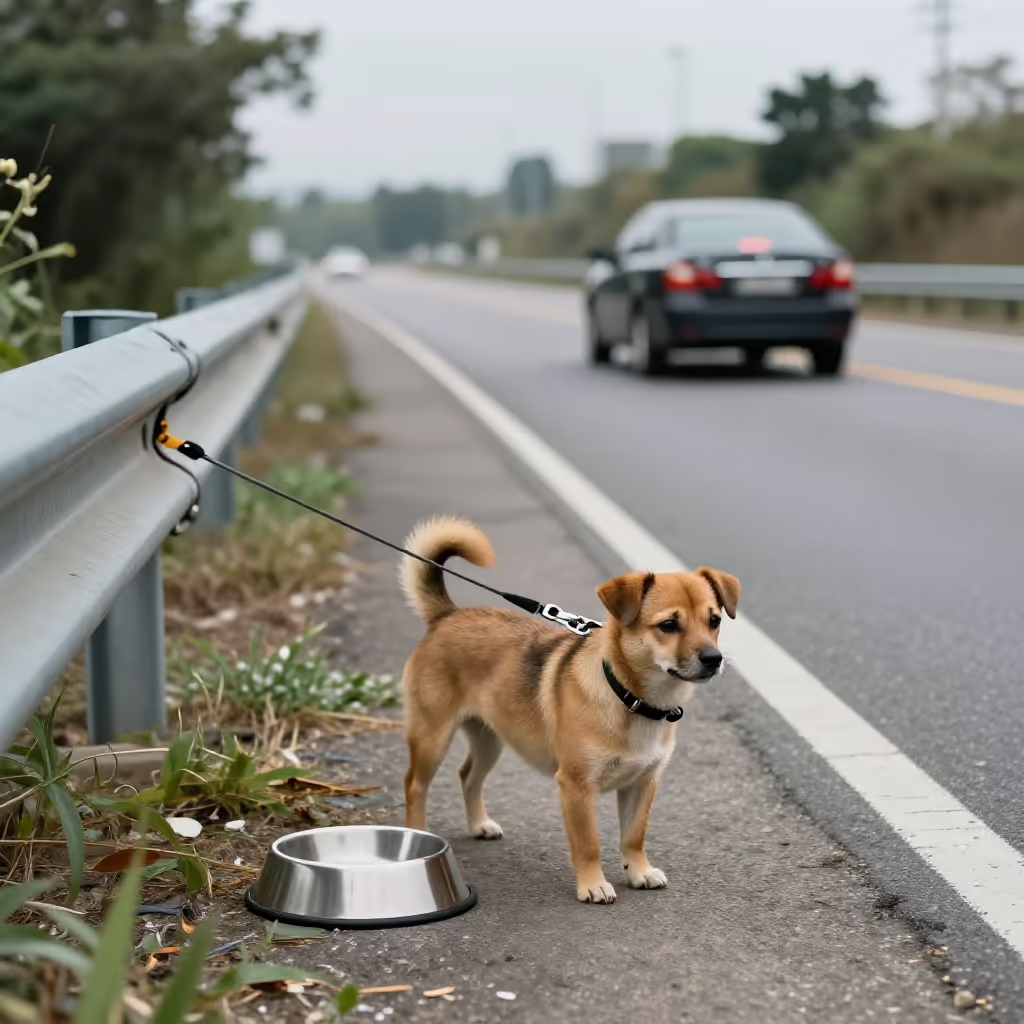
to abandon
To leave behind someone or an animal that depends on help, and no longer take care of them.
Es ist herzlos und verboten, Haustiere einfach im Wald auszusetzen.
It is heartless and illegal to simply abandon pets in the forest.


to abandon / suspend / expose
Loading your saved state.
to abandon
To leave behind someone or an animal that depends on help, and no longer take care of them.
Es ist herzlos und verboten, Haustiere einfach im Wald auszusetzen.
It is heartless and illegal to simply abandon pets in the forest.

'Aussetzen' is a separable verb. The prefix 'aus' comes at the end in a main clause. In subordinate clauses and in the infinitive with 'zu', the verb stays together.
Er setzte eine hohe Belohnung aus.
He offered a large reward.
The verb consists of the prefix 'aus-' (out) and 'setzen' (to set, to place). The basic idea of 'putting something outside' or 'leaving something outside' helps with understanding many meanings, e.g. leaving an animal outside or staying out of a round.
Wer sein Tier aussetzt, macht sich strafbar.
Anyone who abandons their animal is committing a punishable offense.
In the meaning 'to pause for a round', 'aussetzen' is often used without an object. It is clear that the person themselves is interrupting the activity.
Ich bin müde, ich setze bei diesem Spiel aus.
I'm tired; I'm sitting out this game.
The meaning 'to criticize' exists only in the fixed expression 'etwas an jemandem/etwas auszusetzen haben' (to have something to find fault with in someone/something). The preposition 'an' is always followed by the dative.
Meine Mutter hat immer etwas an meiner Kleidung auszusetzen.
My mother always has something to find fault with in my clothes.
When you 'aussetzen' (expose) someone or something to something, that thing is in the dative. The structure is: [accusative] [dative] aussetzen.
Der Bergsteiger setzte sich bewusst der Gefahr aus.
The mountaineer deliberately exposed himself to the danger.
The meaning 'to temporarily lift or suspend' is used almost exclusively in legal or official contexts. Typical objects are 'eine Strafe' (a penalty/sentence) or 'ein Urteil' (a judgment).
Die Vollstreckung des Urteils wurde vorläufig ausgesetzt.
The enforcement of the judgment was temporarily suspended.
to fit / suit / pass
'passen' and 'aussetzen' can both mean in games or activities that someone is not taking part at that moment. 'passen' is said especially when it is your turn in a game and you do not take an action. After that, however, you normally remain in the game. 'aussetzen' means that you interrupt a round or participation; this can be voluntary or happen because of a rule. Learners may confuse the words because both express a pause in the action. 'passen' is more like a move in a game, while 'aussetzen' is more like interrupted participation.

Sofia setzt beim Training eine Woche aus, weil ihr Knie weh tut.
Sofia is sitting out training for a week because her knee hurts.
Heute passe ich in dieser Runde, weil ich keine passende Karte habe.
Today I’ll pass in this round because I don’t have a suitable card.