

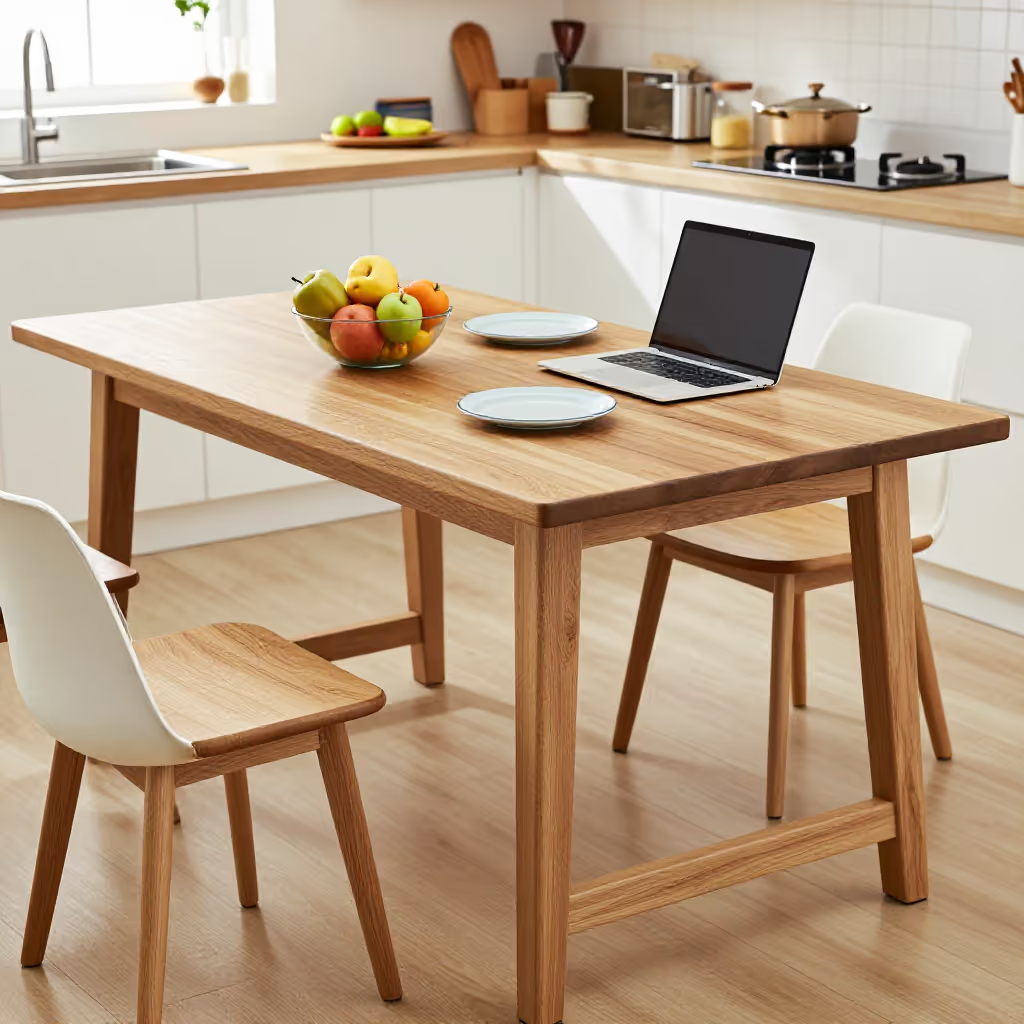
der Tisch
table
A piece of furniture with a flat top and one or more legs, used for eating, working, or putting objects on.
EXAMPLE
Stell die Gläser bitte auf den Tisch.
Please put the glasses on the table.
table
Loading your saved state.
table
A piece of furniture with a flat top and one or more legs, used for eating, working, or putting objects on.
Stell die Gläser bitte auf den Tisch.
Please put the glasses on the table.

to be off the table
An idiom meaning that a topic, plan, or problem has been dealt with, settled, or is no longer current.
Nach der gestrigen Entscheidung ist der Vorschlag nun endgültig vom Tisch.
After yesterday's decision, the proposal is now finally off the table.

to come clean
An idiom meaning to clarify an unclear situation, tell the truth, or make a confession.
Er beschloss, reinen Tisch zu machen und seinem Chef den Fehler zu gestehen.
He decided to come clean and confess the mistake to his boss.

to rip someone off
A colloquial idiom meaning to cheat someone or take advantage of them.
Ich glaube, der Verkäufer hat mich mit dem Preis für das gebrauchte Auto über den Tisch gezogen.
I think the seller ripped me off with the price for the used car.
With 'Tisch' (table), the distinction between dative (location) and accusative (direction) is important. 'Auf dem Tisch' (on the table) describes where something is, while 'auf den Tisch' (onto the table) describes movement.
Die Zeitung liegt auf dem Tisch.
The newspaper is lying on the table.
In everyday life, 'Tisch' (table) is often used with the verbs 'decken' (to set, as in preparing for a meal) and 'abräumen' (to clear, as in tidying up after a meal).
Kannst du bitte schon mal den Tisch decken?
Can you please go ahead and set the table?
The idiom 'vom Tisch sein' (to be off the table) means that a topic has been dealt with. The topic that is no longer current appears as the subject of the sentence.
Die Idee einer Reise nach Australien ist für dieses Jahr vom Tisch.
The idea of a trip to Australia is off the table for this year.
The expression 'reinen Tisch machen' (to come clean) means to tell the truth or confess something. The person who confesses is the subject of the sentence.
Nach wochenlangem Schweigen hat er endlich reinen Tisch gemacht.
After weeks of silence, he finally came clean.
The idiom 'jemanden über den Tisch ziehen' (to rip someone off) always needs an accusative object. This object is the person who is being cheated.
Pass auf, dass dich der Händler nicht über den Tisch zieht.
Be careful that the dealer doesn't rip you off.
desk
A Tisch is generally a piece of furniture for eating, working, or putting things on. A Schreibtisch is specifically designed as a workplace for writing, reading, or working at a computer. Tisch is suitable for any usable surface, while Schreibtisch refers to a permanently arranged workplace.

Lea macht ihre Hausaufgaben heute am Küchentisch.
Lea is doing her homework at the kitchen table today.
Lea macht ihre Hausaufgaben sonst an ihrem Schreibtisch.
Lea usually does her homework at her desk.