


umdrehen
to turn over
To turn or flip something onto the other side.
EXAMPLE
Du musst das Steak in der Pfanne umdrehen, damit es von beiden Seiten gar wird.
You need to turn the steak over in the pan so that it cooks on both sides.
to turn over / turn around
Loading your saved state.
to turn over
To turn or flip something onto the other side.
Du musst das Steak in der Pfanne umdrehen, damit es von beiden Seiten gar wird.
You need to turn the steak over in the pan so that it cooks on both sides.

to turn around
To turn around one's own axis in order to look or go in the opposite direction.
Als sie ihren Namen rufen hörte, drehte sie sich sofort um.
When she heard her name being called, she turned around immediately.

to turn back
To stop going along the chosen route and return in the opposite direction.
Wir waren schon fast am Gipfel, aber wegen des aufziehenden Gewitters mussten wir umdrehen.
We were already almost at the summit, but because of the approaching thunderstorm we had to turn back.

to twist someone's words
To deliberately report or distort a person's statement incorrectly in order to give it a different meaning.
Sei fair und hör auf, mir ständig das Wort im Mund umzudrehen!
Be fair and stop constantly twisting my words!
'Umdrehen' (to turn over / turn around) is a separable verb. The prefix 'um' comes at the end in main clauses. In subordinate clauses and in the infinitive with 'zu', the verb stays together.
Er dreht den Pfannkuchen geschickt um.
He skillfully turns the pancake over.
The exact meaning often depends on the object. With an accusative object, it means 'wenden' (to turn over / flip). Reflexively ('sich'), it means to turn the body. Without an object, it usually means 'zurückkehren' (to return / turn back).
Kannst du bitte die Seite im Buch umdrehen?
Can you please turn the page in the book?
In the meaning 'wenden' (to turn over / flip), 'umdrehen' is often used with flat objects or things with two sides. Typical phrases are: 'eine Münze umdrehen' (to turn over a coin), 'eine Karte umdrehen' (to turn over a card), or 'den Schlüssel im Schloss umdrehen' (to turn the key in the lock).
Er drehte die Münze um, um das Ergebnis zu sehen.
He turned the coin over to see the result.
The idiom 'jemandem das Wort im Mund umdrehen' (to twist someone's words) is a fixed unit. The person whose words are being distorted is always in the dative.
In Diskussionen neigt er dazu, anderen das Wort im Mund umzudrehen.
In discussions, he tends to twist other people's words.
to turn / contact
When referring to a vehicle, wenden and umdrehen can both express changing to the opposite direction. Wenden particularly describes the driving maneuver needed to do this. Umdrehen is more general and, in colloquial use, emphasizes abandoning the route so far and driving back.
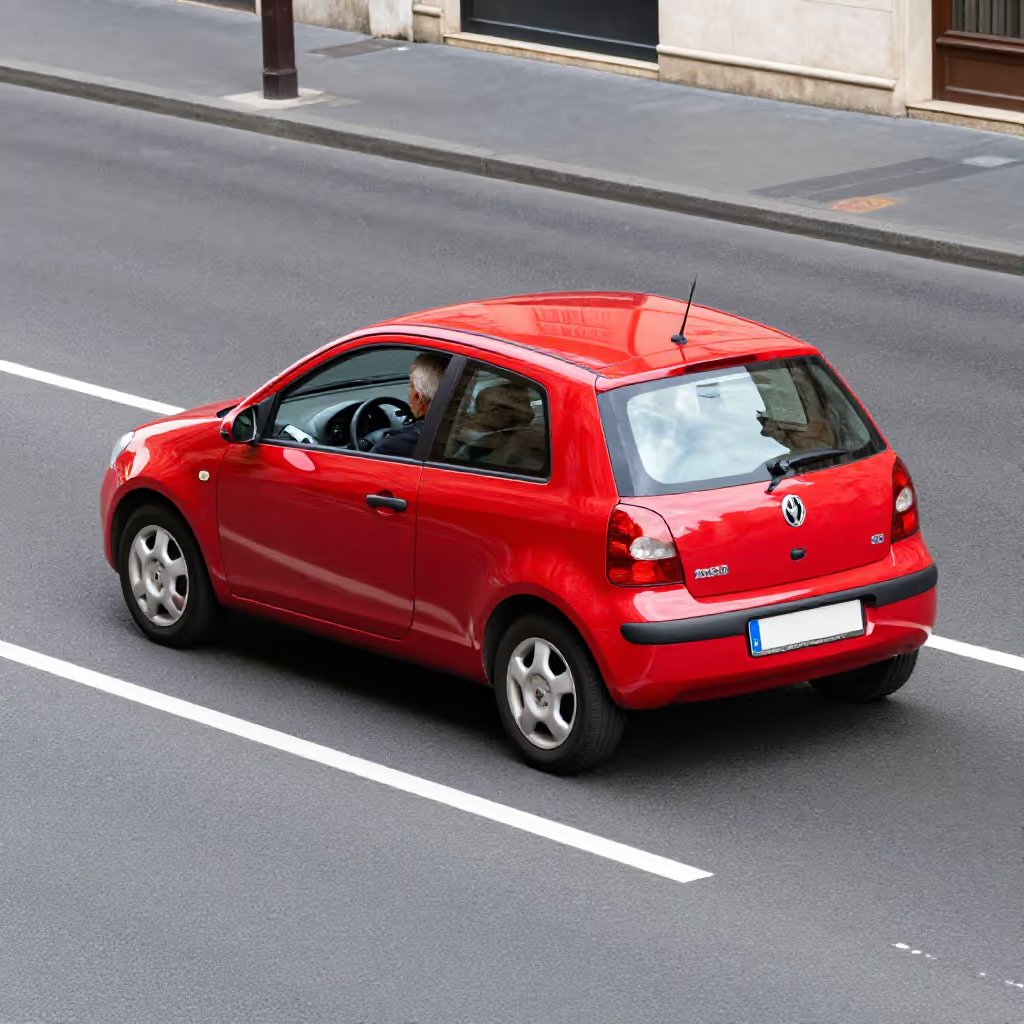
Wegen der Straßensperre dreht die Fahrerin um und fährt nach Hause.
Because of the road closure, the driver turns around and drives home.
Vor der Straßensperre wendet die Fahrerin ihr Auto in einer Einfahrt.
Before the road closure, the driver turns her car around in a driveway.