


unregelmäßig
irregular
Not occurring at equal, fixed intervals; varying in time or sequence.
EXAMPLE
Die Busse auf dieser Linie fahren sehr unregelmäßig.
The buses on this route run very irregularly.
irregular
Loading your saved state.
irregular
Not occurring at equal, fixed intervals; varying in time or sequence.
Die Busse auf dieser Linie fahren sehr unregelmäßig.
The buses on this route run very irregularly.

irregular
Having no even, smooth, or symmetrical shape or surface.
Der handgefertigte Tisch hat eine charmante, unregelmäßige Oberfläche.
The handmade table has a charming, irregular surface.

irregular
In grammar, showing a deviation from the normal rules of inflection or conjugation.
Das Verb „gehen“ ist ein unregelmäßiges Verb.
The verb 'gehen' (to go) is an irregular verb.
The word consists of the prefix 'un-' (not) and the adjective 'regelmäßig' (regular). 'Regelmäßig' comes from 'die Regel' (the rule). 'Unregelmäßig' (irregular) therefore means that something does not follow a rule, pattern, or norm.
Sein Puls war nach dem Sport schnell und unregelmäßig.
His pulse was fast and irregular after exercising.
'Unregelmäßig' (irregular/irregularly) can stand as an adjective before a noun or as an adverb that describes a verb. As an adverb, it often stands after the verb and remains unchanged.
Er hat eine sehr unregelmäßige Handschrift.
He has very irregular handwriting.
When it is about time or a sequence, 'unregelmäßig' (irregular) is often combined with nouns such as 'Abstände' (intervals), 'Arbeitszeiten' (working hours), or 'Mahlzeiten' (meals). It describes that something does not happen predictably or rhythmically.
Wegen seiner unregelmäßigen Arbeitszeiten kann er schlecht planen.
Because of his irregular working hours, he cannot plan well.
In the context of grammar, 'unregelmäßig' (irregular) is a very important term for German learners. It describes verbs, nouns, or adjectives that do not change according to the standard rules. The most common combination is 'unregelmäßiges Verb' (irregular verb).
Viele häufige Verben im Deutschen sind unregelmäßig, zum Beispiel ‚sein‘, ‚haben‘ und ‚werden‘.
Many common verbs in German are irregular, for example 'sein' (to be), 'haben' (to have), and 'werden' (to become).
strong
In grammar, a „starkes“ verb is a particular type of „unregelmäßiges“ verb: its stem vowel changes systematically in the past forms. „Unregelmäßig“ is the broader term for verbs whose forms generally deviate from the normal conjugation rules.
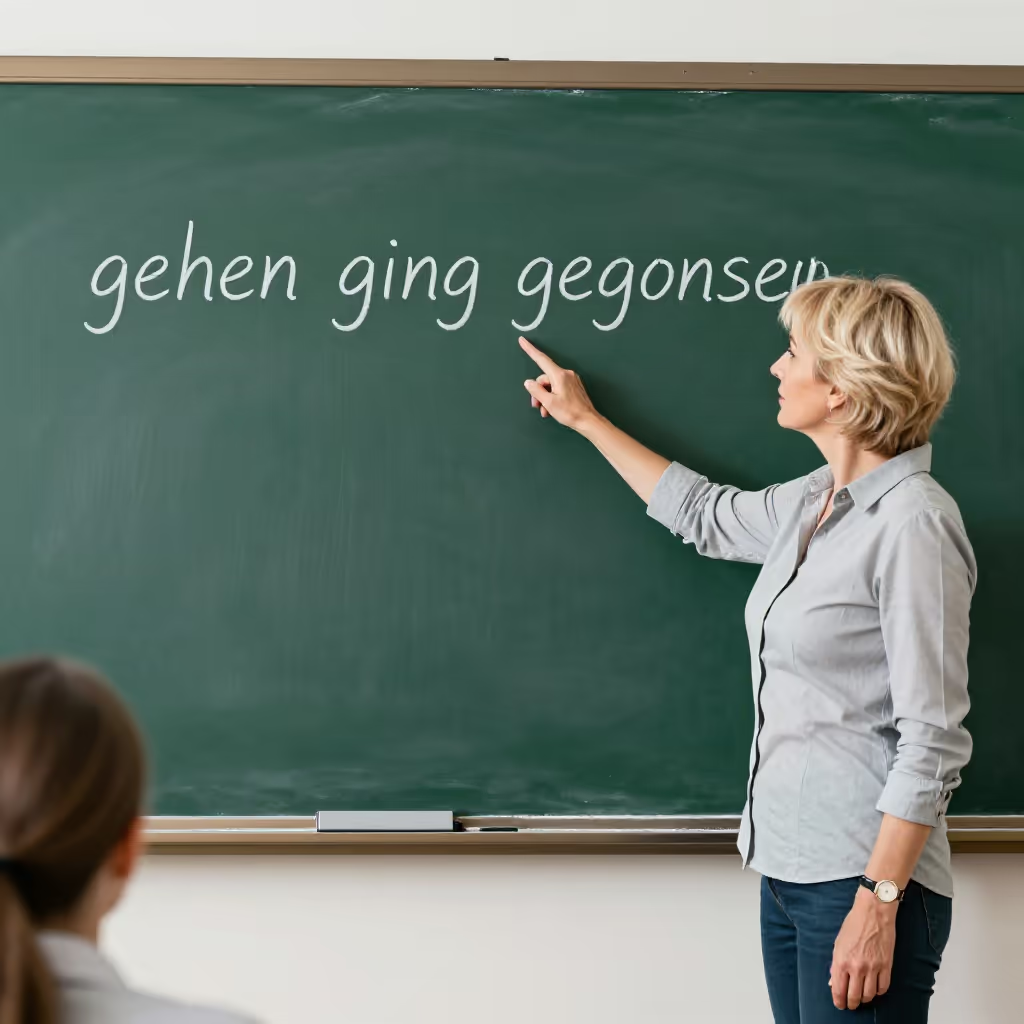
„Sein“ ist ein unregelmäßiges Verb, weil seine Formen von der normalen Konjugation abweichen.
„Sein“ is an irregular verb because its forms deviate from the normal conjugation.
„Singen“ ist ein starkes Verb, wie die Formen „sang“ und „gesungen“ zeigen.
„Singen“ is a strong verb, as shown by the forms „sang“ and „gesungen“.