

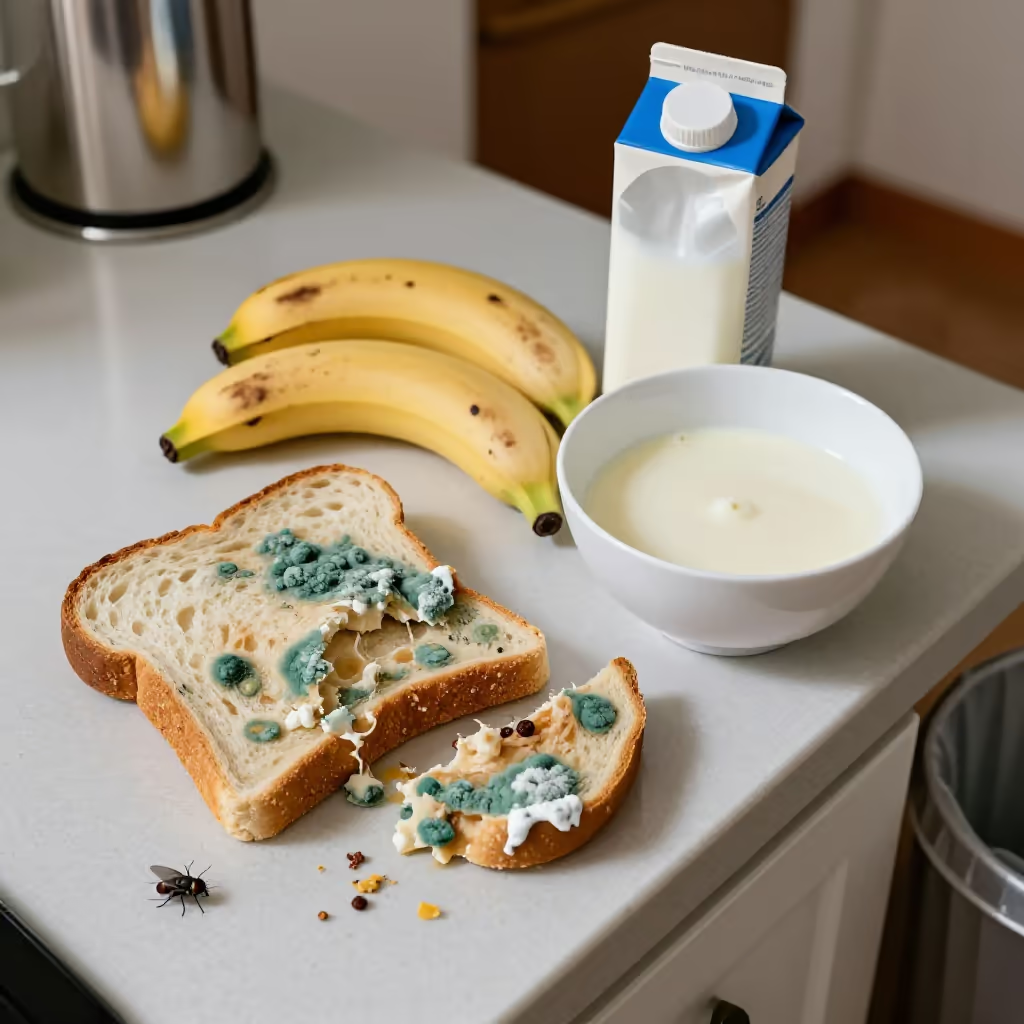
verderben
to spoil
For food: to go bad and therefore become inedible.
EXAMPLE
Die Milch ist in der Hitze schnell verdorben.
The milk spoiled quickly in the heat.
to spoil / ruin
Loading your saved state.
to spoil
For food: to go bad and therefore become inedible.
Die Milch ist in der Hitze schnell verdorben.
The milk spoiled quickly in the heat.

to ruin
To destroy or seriously damage something good, such as a mood, joy, or opportunity.
Sein schlechter Witz hat die gute Stimmung verdorben.
His bad joke ruined the good mood.

to fall out with someone
To destroy a good relationship with another person through one's own behavior.
Wegen einer Kleinigkeit will ich es mir nicht mit meinen Nachbarn verderben.
I don't want to fall out with my neighbors over a small thing.

to upset one's stomach
To get stomach problems from eating bad or unsuitable food.
Ich glaube, ich habe mir mit den alten Meeresfrüchten den Magen verdorben.
I think I upset my stomach with the old seafood.

to corrupt
To lead someone morally down a bad path; to have a negative influence on a person's character.
Manche Eltern fürchten, dass schlechter Umgang ihre Kinder verdirbt.
Some parents fear that bad company will corrupt their children.

too many cooks spoil the broth
A proverb that says that a result becomes worse when too many people work on it or interfere.
Am Ende wusste keiner mehr, was zu tun war – viele Köche verderben eben den Brei.
In the end, nobody knew what to do anymore—too many cooks spoil the broth.
'Verderben' (to spoil/ruin) is an inseparable verb. The prefix 'ver-' always stays attached to the verb stem and often indicates that something becomes bad, fails, or is destroyed.
Zu viel Salz verdirbt die Suppe.
Too much salt spoils the soup.
The meaning of 'verderben' depends strongly on the object. With food, it means 'to go bad'. With abstract nouns like 'Stimmung' (mood), 'Freude' (joy), or 'Appetit' (appetite), it means 'to ruin' or 'to destroy'.
Das Fleisch ist verdorben, wir müssen es wegwerfen.
The meat has spoiled; we have to throw it away.
The past participle 'verdorben' is very often used like an adjective to describe the condition of food. It then means 'bad' or 'inedible'.
Der Joghurt riecht komisch, ich glaube, er ist verdorben.
The yogurt smells strange; I think it has spoiled.
When you ruin something for someone, the person is in the dative. The structure is: 'jemandem (Dativ) etwas (Akkusativ) verderben' (to ruin something for someone).
Mit deiner schlechten Laune verdirbst du uns allen den Abend.
With your bad mood, you're ruining the evening for all of us.
The idiom 'es sich mit jemandem verderben' (to fall out with someone) is a fixed structure. 'Es' and 'sich' are fixed components. The person with whom the relationship worsens is connected with 'mit + Dativ'.
Ich möchte es mir mit meinen Kollegen nicht verderben, also halte ich mich aus dem Streit heraus.
I don't want to fall out with my colleagues, so I'm staying out of the argument.
The expression 'sich den Magen verderben' (to upset one's stomach) is a fixed unit. The person this happens to is in the dative, which is expressed by the reflexive pronoun, e.g. 'ich verderbe mir den Magen' (I upset my stomach).
Iss die Mayonnaise nicht, sonst verdirbst du dir noch den Magen!
Don't eat the mayonnaise, or you'll upset your stomach!
The sentence 'Viele Köche verderben den Brei' (Too many cooks spoil the broth) is a well-known German proverb. It is used to comment on a situation in which too many people are working on a task and the result becomes worse because of it.
Alle wollten bei der Projektplanung mitreden, aber das Ergebnis war chaotisch. Viele Köche verderben eben den Brei.
Everyone wanted to have a say in the project planning, but the result was chaotic. Too many cooks spoil the broth.
to mess up / soil
Both words can indicate that someone seriously harms a good mood, someone’s enjoyment, or an opportunity. „Verderben“ is the general form and is also suitable in neutral texts. „Versauen“ means the same here, but sounds clearly more colloquial and vulgar.

Der Streit verdarb uns den schönen Abend.
The argument spoiled our lovely evening.
Der Streit versaut uns den schönen Abend.
The argument messed up our lovely evening.