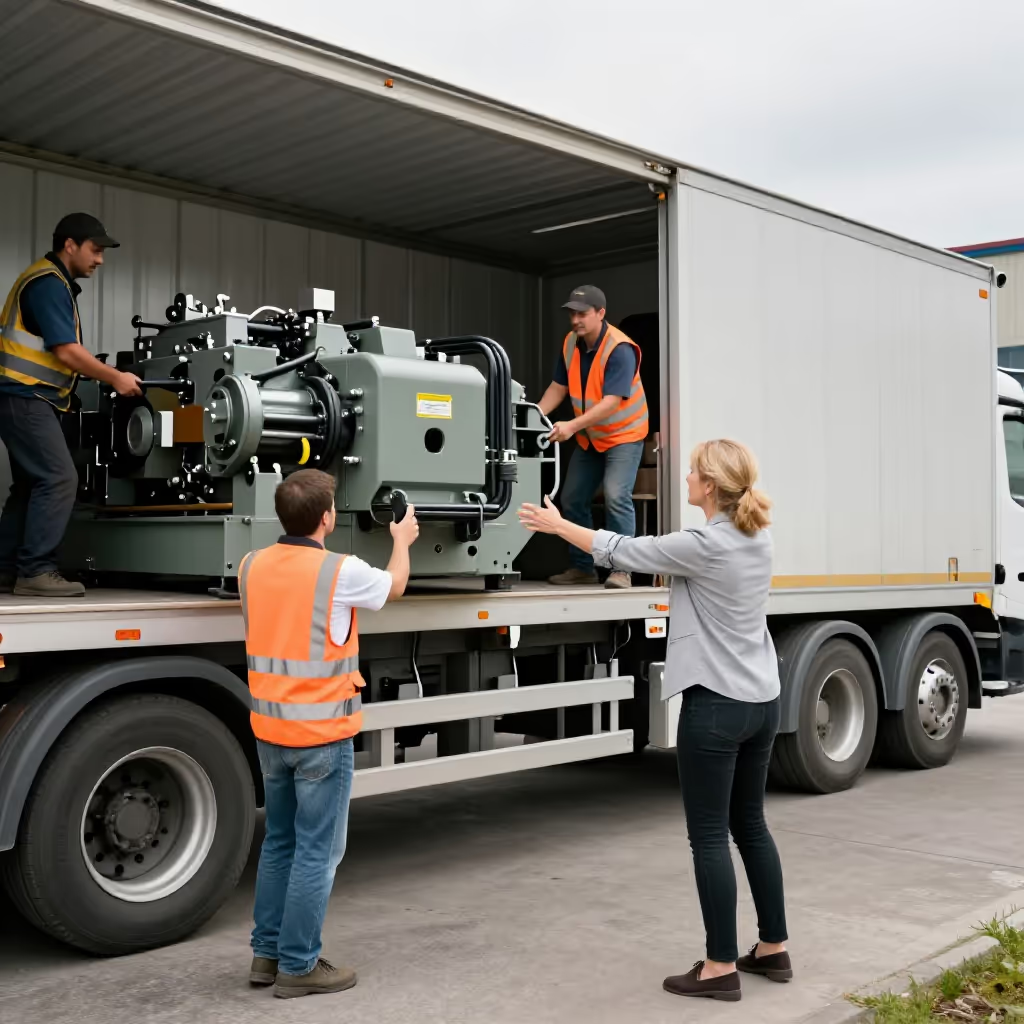
To move or relocate something, such as a factory, a place of residence, or an activity, to another place.
example
Das Unternehmen hat beschlossen, seine Produktion komplett nach Asien zu verlagern.
The company decided to relocate its production completely to Asia.

Usage tips
Word structure
The verb 'verlagern' (to relocate / shift) is derived from the noun 'das Lager' (place, site). The inseparable prefix 'ver-' expresses a change of place. So literally it means to bring something to another place.
EXAMPLE
Wegen des Lärms haben wir unseren Schlafplatz in ein anderes Zimmer verlagert.
Because of the noise, we relocated our sleeping spot to another room.
Transitive vs. reflexive
The verb can be used transitively or reflexively. 'Etwas verlagern' (to relocate/shift something) means that an actor actively moves something. 'Sich verlagern' (to shift) means that the focus shifts by itself.
EXAMPLE
Der Konzern verlagert viele Arbeitsplätze ins Ausland.
The corporation is relocating many jobs abroad.
Typical collocations
In the meaning 'verlegen' (to relocate), the verb is often used in an economic context. Typical objects are: production, company headquarters, jobs, or the focus. As the destination, 'nach' or 'in' is often used.
EXAMPLE
Viele Firmen verlagern ihre Produktion in Länder mit niedrigeren Löhnen.
Many companies relocate their production to countries with lower wages.
Sentence structure with a shift in focus
When the focus or a topic shifts, the new topic is often introduced with the preposition 'auf' + accusative. Typical subjects are: the focus, the main emphasis, the discussion, the interest.
EXAMPLE
Das Interesse der Öffentlichkeit verlagerte sich auf den neuen Skandal.
The public's interest shifted to the new scandal.
Compare with
near_synonym · confusable
verlagern vs übertragen
to transmit / transfer
'übertragen' and 'verlagern' can both express that something moves from one area to another. 'übertragen' is used when you apply an idea, a principle, or a result from one context to another. So it is more about content or meaning. 'verlagern' means that something changes its location, focus, or weight. This can be very concrete, for example a factory, or more abstract, for example the focus of a conversation. The risk of confusion comes from the fact that both describe a kind of shift. Memory aid: you can 'eine Methode übertragen' (apply a method), but you 'verlagert einen Ort oder Schwerpunkt' (shift a location or focus).
verlagern
Beim Training verlagert Tom sein Gewicht langsam auf das rechte Bein.
During training, Tom slowly shifts his weight onto his right leg.
übertragen
Die Lehrerin zeigt, wie man die Regel auf ein neues Beispiel überträgt.
The teacher shows how to apply the rule to a new example.