


verstellen
to block
To place an object in such a way that it blocks a path, a door, or the view.
EXAMPLE
Bitte verstell nicht den Notausgang mit den Kisten.
Please don't block the emergency exit with the boxes.
to block / adjust / disguise
Loading your saved state.
to block
To place an object in such a way that it blocks a path, a door, or the view.
Bitte verstell nicht den Notausgang mit den Kisten.
Please don't block the emergency exit with the boxes.
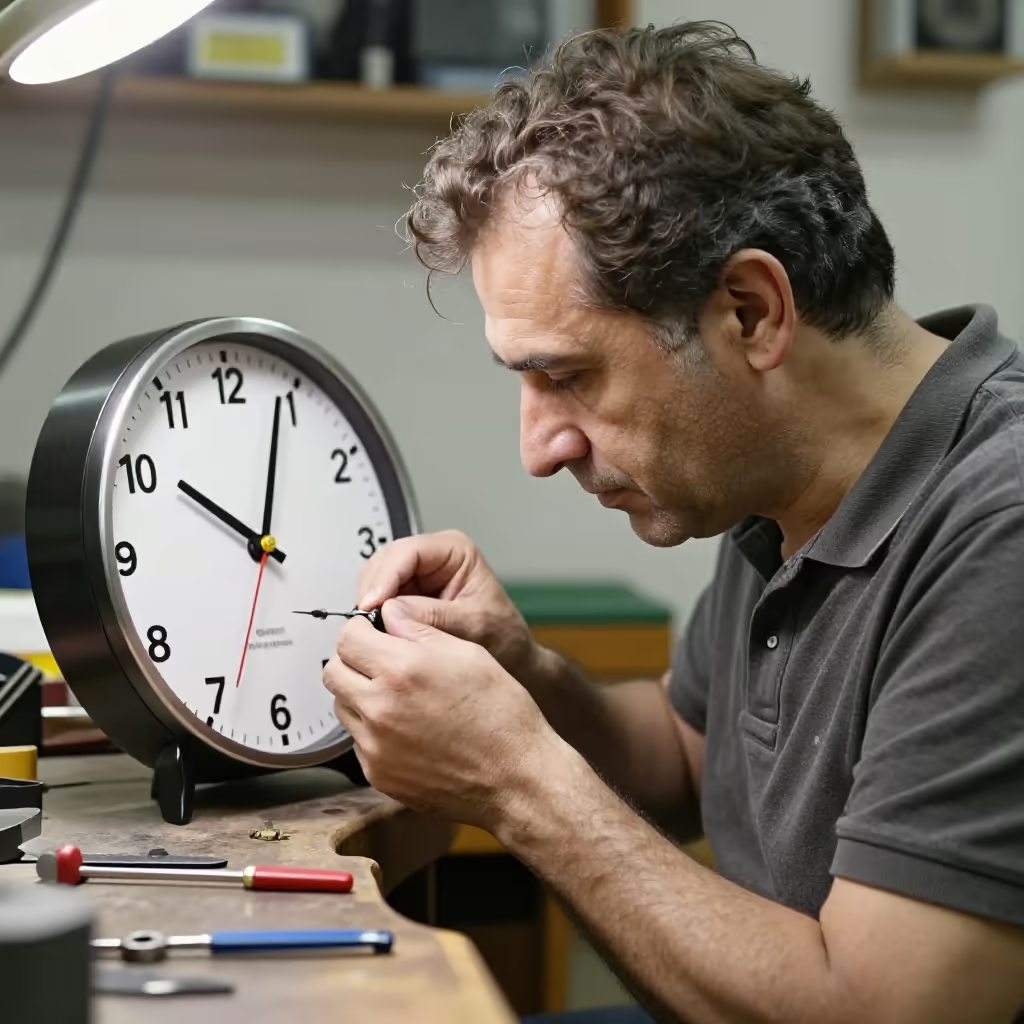
to adjust
To change the setting of a device, clock, or mechanism.
Kannst du bitte den Wecker auf 6 Uhr verstellen?
Can you please set the alarm clock to 6 o'clock?

to pretend
To act differently from who one really is; to hide one's true feelings, intentions, or identity.
Er kann sich gut verstellen, man weiß nie, was er wirklich denkt.
He is good at pretending; you never know what he really thinks.

to disguise one's voice
To deliberately speak in a different, unnatural voice so as not to be recognized.
Der Entführer hatte seine Stimme am Telefon verstellt.
The kidnapper had disguised his voice on the phone.
The verb is made up of 'ver-' and 'stellen' (to put/place). The prefix 'ver-' has several functions here: it can mean putting something in the wrong place (blocking), changing a setting, or presenting oneself falsely ('sich verstellen' — to pretend).
Wer hat den Stuhl mitten in den Weg verstellt?
Who blocked the path with the chair?
'Verstellen' (to block / adjust / disguise) is an inseparable verb. The prefix 'ver-' is not separated from the verb stem, not even in a main clause.
Er verstellt oft seine Meinung, um anderen zu gefallen.
He often misrepresents his opinion in order to please others.
The verb can be used transitively with an accusative object (to block something, to adjust something) or reflexively ('sich verstellen'), which means 'to pretend' or 'to act as if'.
Ich muss die Klimaanlage verstellen, es ist zu kalt.
I have to adjust the air conditioning; it's too cold.
In the meaning 'blockieren' (to block), 'verstellen' is often combined with objects that block access or visibility: 'den Weg verstellen' (to block the way), 'die Tür verstellen' (to block the door), 'den Eingang verstellen' (to block the entrance), or 'die Sicht verstellen' (to block the view).
Ein großer LKW verstellte die Einfahrt zur Garage.
A large truck blocked the driveway to the garage.
The combination 'seine Stimme verstellen' (to disguise one's voice) is a fixed expression. It means to deliberately speak differently so as not to be recognized.
Am Telefon verstellte er seine Stimme, damit ich ihn nicht erkenne.
On the phone, he disguised his voice so that I wouldn't recognize him.
to put / to set
When talking about a clock, stellen means setting it to a specific desired time. Verstellen, by contrast, emphasizes only that the previous setting is changed; the new setting may be right or wrong. Use stellen for deliberately setting something and verstellen for a mere or accidental change.

Beim Batteriewechsel habe ich die Uhr versehentlich um zehn Minuten verstellt.
While replacing the battery, I accidentally set the clock ten minutes off.
Nach dem Batteriewechsel stelle ich die Uhr auf acht Uhr.
After replacing the battery, I set the clock to eight o’clock.