


verziehen
to move away
To change one's place of residence; to move to another place.
EXAMPLE
Unsere ehemaligen Nachbarn sind letztes Jahr nach Hamburg verzogen.
Our former neighbors moved away to Hamburg last year.
to move away / spoil / warp
Loading your saved state.
to move away
To change one's place of residence; to move to another place.
Unsere ehemaligen Nachbarn sind letztes Jahr nach Hamburg verzogen.
Our former neighbors moved away to Hamburg last year.

to spoil someone
To negatively influence a child's development through excessive leniency and a lack of boundaries, so that the child develops undesirable behaviors.
Wenn man einem Kind alles erlaubt, verzieht man es nur.
If you allow a child everything, you only spoil them.

to make a face
To involuntarily change one's facial expression, often as a reaction to pain, disgust, effort, or an unpleasant surprise.
Als er die saure Zitrone probierte, verzog er angewidert das Gesicht.
When he tasted the sour lemon, he made a disgusted face.
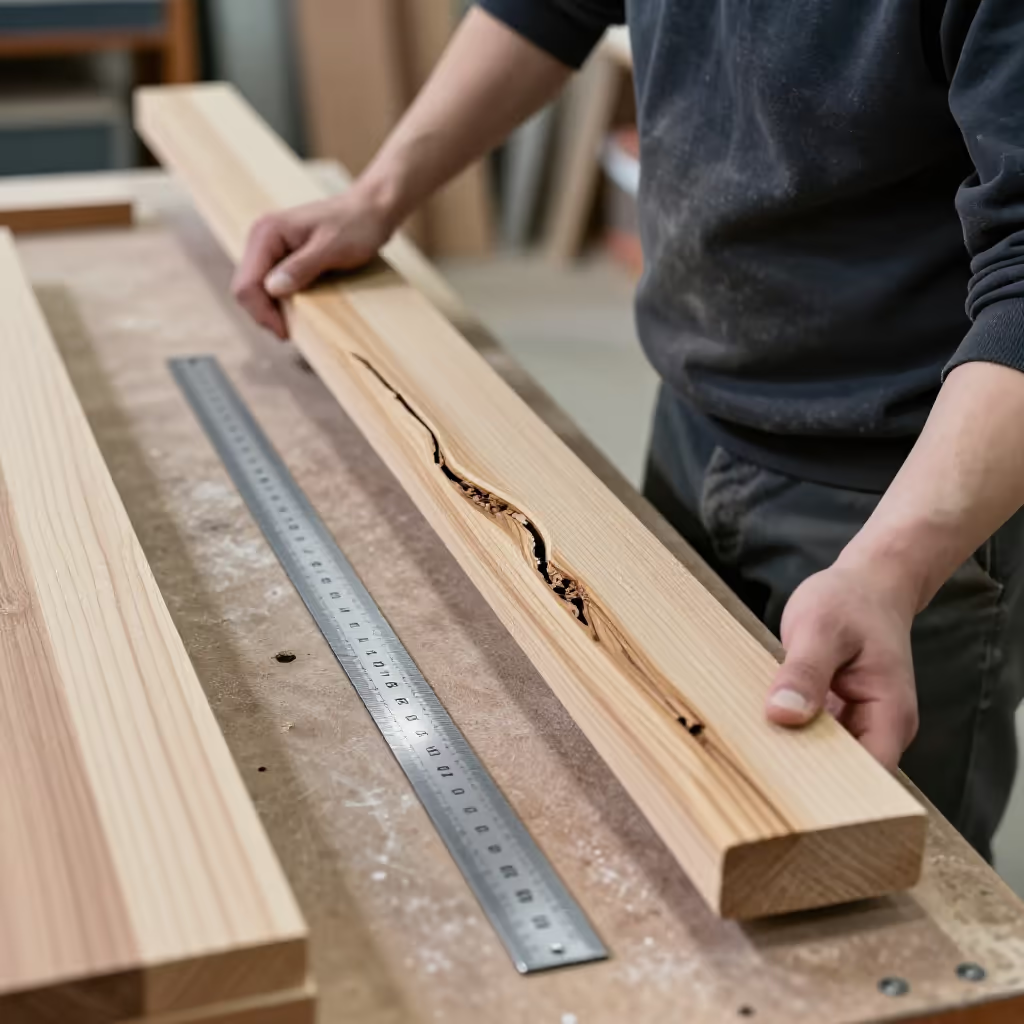
to warp
(Of materials such as wood or metal) to become deformed or bent due to influences such as moisture or heat.
Die alte Holztür hat sich im Laufe der Jahre verzogen und schließt nicht mehr richtig.
The old wooden door has warped over the years and no longer closes properly.

to clear off
(Colloquial) To leave a place; to disappear. It can also be used as a rude command.
Als der Regen anfing, haben sich alle schnell vom Park nach Hause verzogen.
When the rain started, everyone quickly cleared off from the park and went home.
'Verziehen' is an inseparable verb based on the base verb 'ziehen' (to pull). The prefix 'ver-' remains firmly attached to the stem in all conjugated forms and sentence positions.
Meine Tante ist vor langer Zeit nach Kanada verzogen.
My aunt moved away to Canada a long time ago.
You can recognize the meaning of 'verziehen' from the sentence structure. With the auxiliary verb 'sein' (to be), it means 'to move away'. As a transitive verb with a person as the object, it means 'to spoil'. Reflexively ('sich verziehen') it can mean 'to deform/warp' (material) or, colloquially, 'to disappear/clear off' (person).
Sie sind letztes Jahr verzogen.
They moved away last year.
In the meaning 'to change one's place of residence', the perfect tense is always formed with the auxiliary verb 'sein' (to be). The reason is that it describes movement from one place to another.
Wann seid ihr in diese Wohnung verzogen?
When did you move into this apartment?
The expression 'das Gesicht verziehen' (to make a face) is a fixed collocation. It describes an involuntary reaction to pain, disgust, or something unpleasant. The object is almost always 'das Gesicht' (the face) or 'die Miene' (the expression).
Beim Anblick der Wunde verzog er das Gesicht.
At the sight of the wound, he made a face.
The reflexive form 'sich verziehen' in the sense of 'to go away' or 'to disappear' is colloquial. As a command in the imperative ('Verzieh dich!' — 'Get lost!'), it is a very rude way of forcing someone to leave.
Es wird spät, ich glaube, ich verziehe mich mal.
It's getting late; I think I'll clear off now.
to move / change clothes
Both verbs can express a change of residence. Umziehen presents the move as a process or a new living situation, while verziehen tends to refer to moving away to another place. Use umziehen in general announcements and verziehen when leaving the previous place is emphasized.

Die Familie verzieht im Sommer von München nach Bremen.
The family is moving away from Munich to Bremen in the summer.
Die Familie zieht im Sommer um, weil sie eine größere Wohnung gefunden hat.
The family is moving in the summer because they found a bigger apartment.