

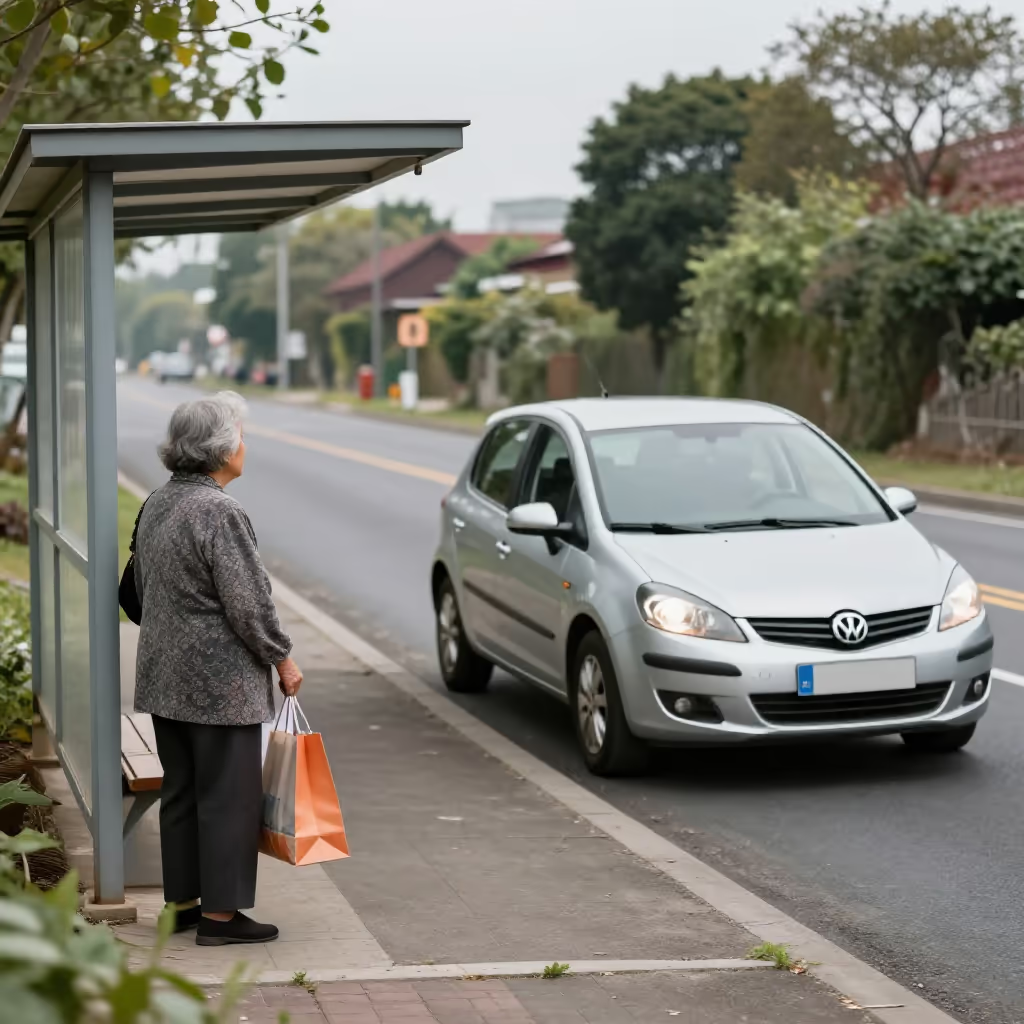
vorbeifahren an
to drive past
To pass by a place, person, or object in a vehicle or in another way without stopping.
Wir sind gestern an deinem Haus vorbeigefahren, aber du warst nicht da.
We drove past your house yesterday, but you weren't there.


to drive past / to stop by
Loading your saved state.
to drive past
To pass by a place, person, or object in a vehicle or in another way without stopping.
Wir sind gestern an deinem Haus vorbeigefahren, aber du warst nicht da.
We drove past your house yesterday, but you weren't there.

'Vorbeifahren' is a separable verb. The prefix 'vorbei-' goes at the end in a main clause. In subordinate clauses and in the infinitive with 'zu', the verb stays together.
Der Bus fährt direkt an unserem Büro vorbei.
The bus drives right past our office.
Since 'fahren' (to drive/go) is a verb of motion, the perfect tense of 'vorbeifahren' is always formed with 'sein' (to be), not with 'haben' (to have).
Ich bin vorhin an der Post vorbeigefahren, aber sie hatte schon zu.
I drove past the post office earlier, but it was already closed.
The preposition reveals the meaning: 'vorbeifahren an' (+ dative) means to drive past something. 'Vorbeifahren bei' (+ dative) colloquially means to visit someone briefly.
Wir sind an einem schönen alten Schloss vorbeigefahren.
We drove past a beautiful old castle.
The meaning 'to visit someone' is colloquial. It describes a short, often spontaneous visit because you are nearby anyway.
Wenn ich Zeit habe, fahre ich am Wochenende bei dir vorbei.
If I have time, I'll stop by your place on the weekend.
to happen / pass
'passieren' and 'vorbeifahren' can both describe moving past a place or object. 'passieren' is more general and can also be used without a vehicle, for example with a border, an entrance, or a checkpoint. 'vorbeifahren' is used when someone drives past something in a vehicle and does not stop. Learners may confuse the words because both can express 'going past something'. When it is about a specific point that you cross or leave behind, 'passieren' fits. When a car, bus, bicycle, or train goes past a place, 'vorbeifahren' is more natural.

Morgen fahre ich auf dem Weg zur Arbeit an deiner Wohnung vorbei.
Tomorrow, I'll drive past your apartment on my way to work.
Wir passierten den Eingang, ohne das Schild zu sehen.
We passed the entrance without seeing the sign.