

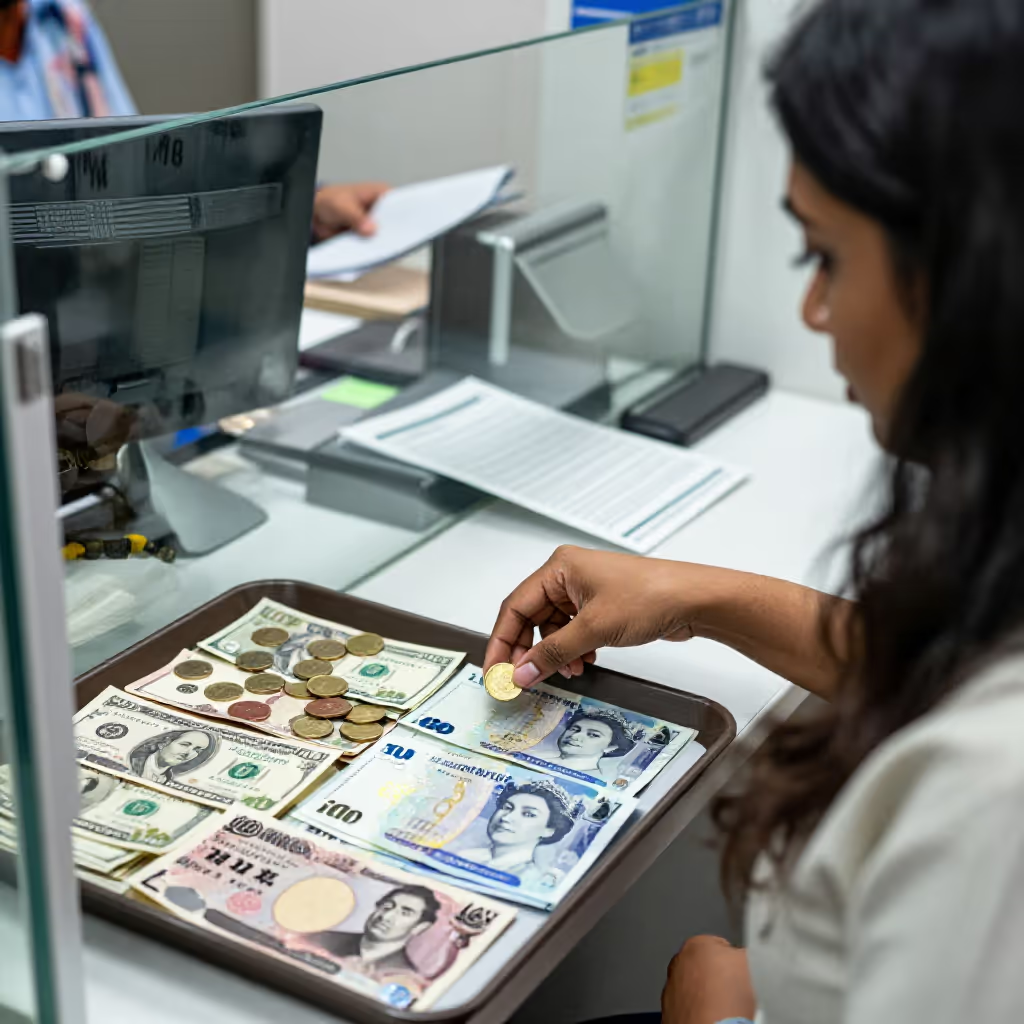
die Währung
currency
The official legal means of payment of a country or a community of states.
EXAMPLE
Der Euro ist die gemeinsame Währung vieler europäischer Länder.
The euro is the common currency of many European countries.
currency
Loading your saved state.
currency
The official legal means of payment of a country or a community of states.
Der Euro ist die gemeinsame Währung vieler europäischer Länder.
The euro is the common currency of many European countries.

currency
In a figurative sense, something that is considered valuable or serves as a medium of exchange in a particular social or professional context.
In der Wissenschaft ist eine hohe Anzahl an Zitationen eine harte Währung.
In academia, a high number of citations is a hard currency.
The word 'Währung' (currency) is related to 'währen' (to last) and 'Wert' (value). So it originally describes something that has a stable, guaranteed value.
Eine stabile Währung ist wichtig für die Wirtschaft eines Landes.
A stable currency is important for a country's economy.
In connection with money, 'Währung' (currency) is often combined with adjectives such as 'lokal' (local), 'fremd' (foreign), 'stabil' (stable), or 'schwach' (weak). Common verbs are 'umrechnen' (to convert) or 'wechseln' (to exchange).
Vor der Reise müssen wir noch Geld in die lokale Währung wechseln.
Before the trip, we still need to exchange money into the local currency.
You can recognize the figurative meaning by the fact that it is not about money. Instead, abstract things like 'Daten' (data), 'Wissen' (knowledge), or 'Vertrauen' (trust) are described as valuable.
In der digitalen Welt sind persönliche Daten eine wichtige Währung.
In the digital world, personal data is an important currency.
In the figurative meaning, the phrases 'als harte Währung gelten' (to count as hard currency) or 'die neue Währung sein' (to be the new currency) are often used. This expresses that something is especially valuable.
In diesem Unternehmen gilt Zuverlässigkeit als harte Währung.
In this company, reliability counts as hard currency.
money
Geld refers to the means of payment used to pay for goods and services. Währung, by contrast, refers to the official means of payment of a country or group of countries, such as the euro or franc. Use Geld for a specific payment and Währung when you mean the official system or unit.

Vor der Reise prüfte sie, welche Währung im Zielland offiziell gilt.
Before the trip, she checked which currency was officially used in the destination country.
Für den Einkauf brauche ich noch Geld, weil ich mein Portemonnaie vergessen habe.
I still need money for the shopping because I forgot my wallet.