

wegholen
to take away
To remove something from one place and bring it somewhere else or take it with you.
EXAMPLE
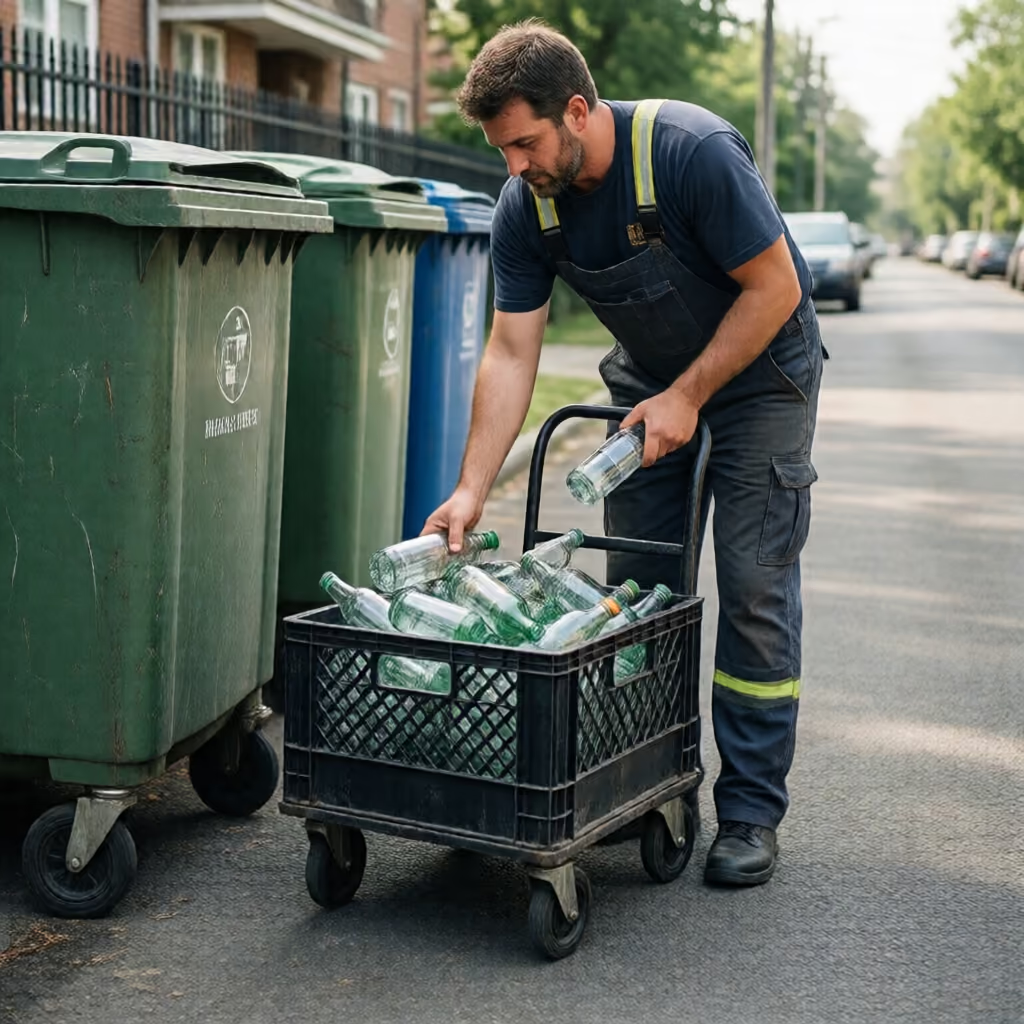
Kannst du bitte die leeren Flaschen wegholen?
Could you please take the empty bottles away?
to take away / catch
wegholen – holte weg – hat weggeholt
Loading your saved state.
to take away
To remove something from one place and bring it somewhere else or take it with you.
Kannst du bitte die leeren Flaschen wegholen?
Could you please take the empty bottles away?

to take away
To remove a person from a place or situation, often by taking them along or picking them up.
Die Sanitäter holten den verletzten Mann vorsichtig weg.
The paramedics carefully took the injured man away.

to catch
Colloquial: To catch an illness, especially a cold or an infection.
Bei dem nasskalten Wetter habe ich mir eine Erkältung weggeholt.
I caught a cold in that cold, wet weather.
| ich | hole weg |
|---|---|
| du | holst weg |
| er/sie/es | holt weg |
| wir | holen weg |
| ihr | holt weg |
| sie | holen weg |
| ich | holte weg |
|---|---|
| du | holtest weg |
| er/sie/es | holte weg |
| wir | holten weg |
| ihr | holtet weg |
| sie | holten weg |
| ich | habe weggeholt |
|---|---|
| du | hast weggeholt |
| er/sie/es | hat weggeholt |
| wir | haben weggeholt |
| ihr | habt weggeholt |
| sie | haben weggeholt |
| du | hol weg! hole weg! |
|---|---|
| ihr | holt weg! |
| Sie | holen Sie weg! |
| ich | hatte weggeholt |
|---|---|
| du | hattest weggeholt |
| er/sie/es | hatte weggeholt |
| wir | hatten weggeholt |
| ihr | hattet weggeholt |
| sie | hatten weggeholt |
| ich | werde wegholen |
|---|---|
| du | wirst wegholen |
| er/sie/es | wird wegholen |
| wir | werden wegholen |
| ihr | werdet wegholen |
| sie | werden wegholen |
| ich | hole weg |
|---|---|
| du | holest weg |
| er/sie/es | hole weg |
| wir | holen weg |
| ihr | holet weg |
| sie | holen weg |
Used for reported speech.
| ich | holte weg |
|---|---|
| du | holtest weg |
| er/sie/es | holte weg |
| wir | holten weg |
| ihr | holtet weg |
| sie | holten weg |
Used for wishes and “would”.
| infinitive | wegholen |
|---|---|
| with zu | wegzuholen |
| present participle | wegholend |
| past participle | weggeholt |
'Wegholen' (to take away) consists of 'weg' (away) and 'holen' (to fetch); 'weg' emphasizes removal from the original location. In a main clause, 'weg' is separated and placed at the end; in a subordinate clause, 'wegholen' stays together. In the infinitive with 'zu', 'zu' goes between the two parts.
Ich hole die Kisten morgen weg.
I'll take the boxes away tomorrow.
Sie ist froh, weil ich die Kisten morgen weghole.
She is glad because I'll take the boxes away tomorrow.
Ich habe versprochen, die Kisten morgen wegzuholen.
I promised to take the boxes away tomorrow.
You can specify the original location using 'von' (from) or 'aus' (out of), both followed by the dative. 'Von' is suitable for a surface, for example, while 'aus' is used for an enclosed space.
Hol bitte die schmutzigen Gläser vom Tisch weg.
Please take the dirty glasses away from the table.
Wir müssen die alten Möbel aus dem Keller wegholen.
We need to take the old furniture out of the basement.
When you arrange for someone else to remove something, 'etwas wegholen lassen' (to have something taken away) is a useful pattern. After 'lassen' (to have something done), 'wegholen' is used without 'zu'.
Wir lassen das kaputte Sofa morgen von einer Firma wegholen.
We're having a company take the broken sofa away tomorrow.