


willkommen
welcome
Expresses that a guest or person is wanted and that people are happy about their arrival.
EXAMPLE
Fühl dich wie zu Hause, du bist hier immer willkommen.
Make yourself at home; you are always welcome here.
welcome
Loading your saved state.
welcome
Expresses that a guest or person is wanted and that people are happy about their arrival.
Fühl dich wie zu Hause, du bist hier immer willkommen.
Make yourself at home; you are always welcome here.
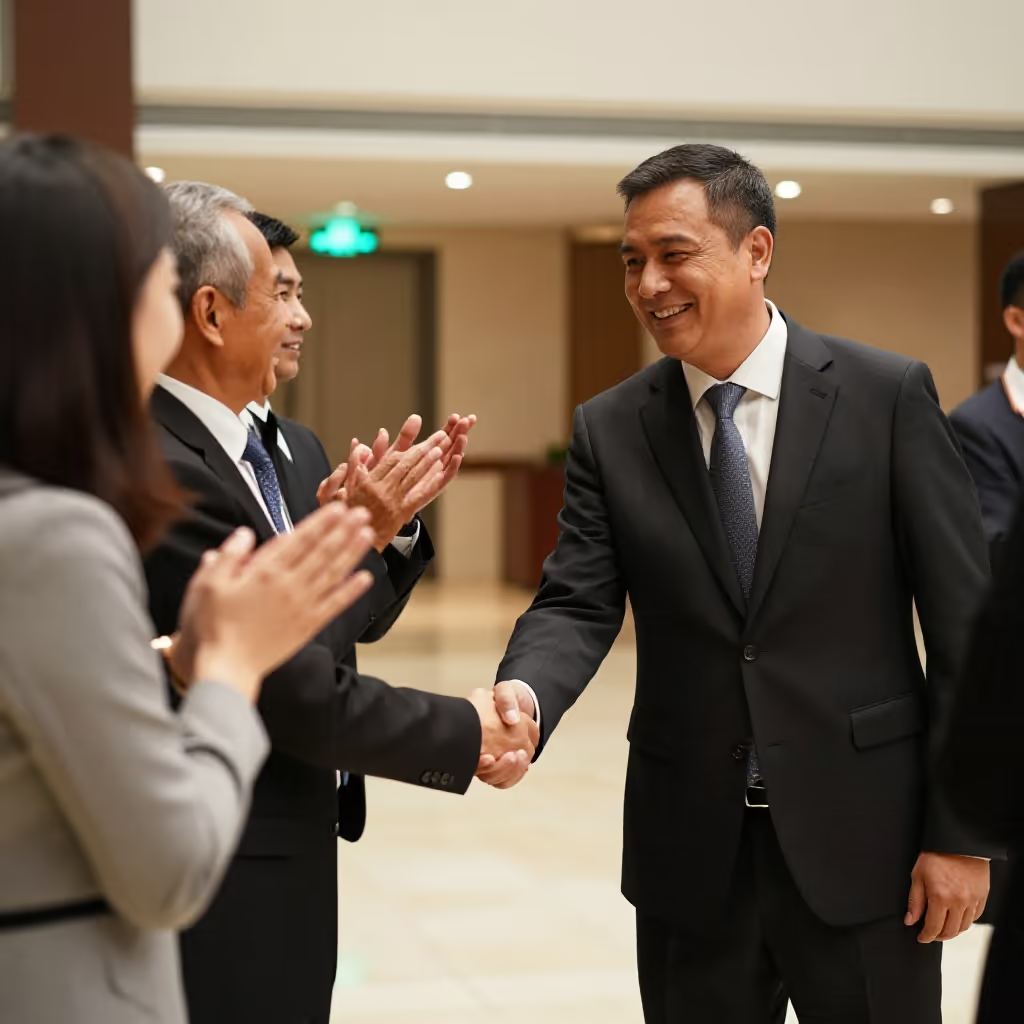
to welcome
To greet someone formally or warmly and acknowledge their arrival.
Der Firmenchef hieß die neuen Auszubildenden persönlich willkommen.
The company director personally welcomed the new trainees.

welcome
Describes a thing, event, or development as desired, appropriate, or coming at the right time.
Nach der anstrengenden Wanderung war die Pause eine willkommene Abwechslung.
After the strenuous hike, the break was a welcome change.
The word 'willkommen' (welcome) is derived from 'Wille' (will) and 'kommen' (to come). So it literally describes someone whose coming corresponds to one's own will and is therefore desired.
Jeder Gast, der in guter Absicht kommt, ist uns willkommen.
Every guest who comes with good intentions is welcome to us.
As a standalone greeting, 'Willkommen' (welcome) is capitalized. When it is used as an adjective with the verb 'sein' (to be), it is written in lowercase.
Willkommen in unserem Team!
Welcome to our team!
As a greeting, 'Willkommen' (welcome) often stands at the beginning of a sentence, followed by the preposition 'in' or 'zu' with the dative to name the place or occasion.
Willkommen in Berlin!
Welcome to Berlin!
The expression 'jemanden willkommen heißen' (to welcome someone) is a fixed structure. The person being greeted is always in the accusative.
Der Rektor hieß die neuen Studierenden herzlich willkommen.
The rector warmly welcomed the new students.
When something is 'willkommen' (welcome), the word often appears before nouns like 'Abwechslung' (change), 'Gelegenheit' (opportunity), 'Pause' (break), or 'Überraschung' (surprise).
Nach der langen Arbeitswoche war das freie Wochenende eine willkommene Pause.
After the long workweek, the free weekend was a welcome break.
to greet / welcome
Willkommen, as an adjective, describes the state of a person being wanted and their arrival being a source of joy. Begrüßen, by contrast, refers to the specific action taken when meeting someone, such as using words or a gesture. Thus, someone is willkommen, while another person begrüßt them.

Unsere neue Kollegin ist im Team herzlich willkommen.
Our new colleague is warmly welcome on the team.
Das Team begrüßt die neue Kollegin an ihrem ersten Arbeitstag herzlich.
The team warmly greets the new colleague on her first day at work.