

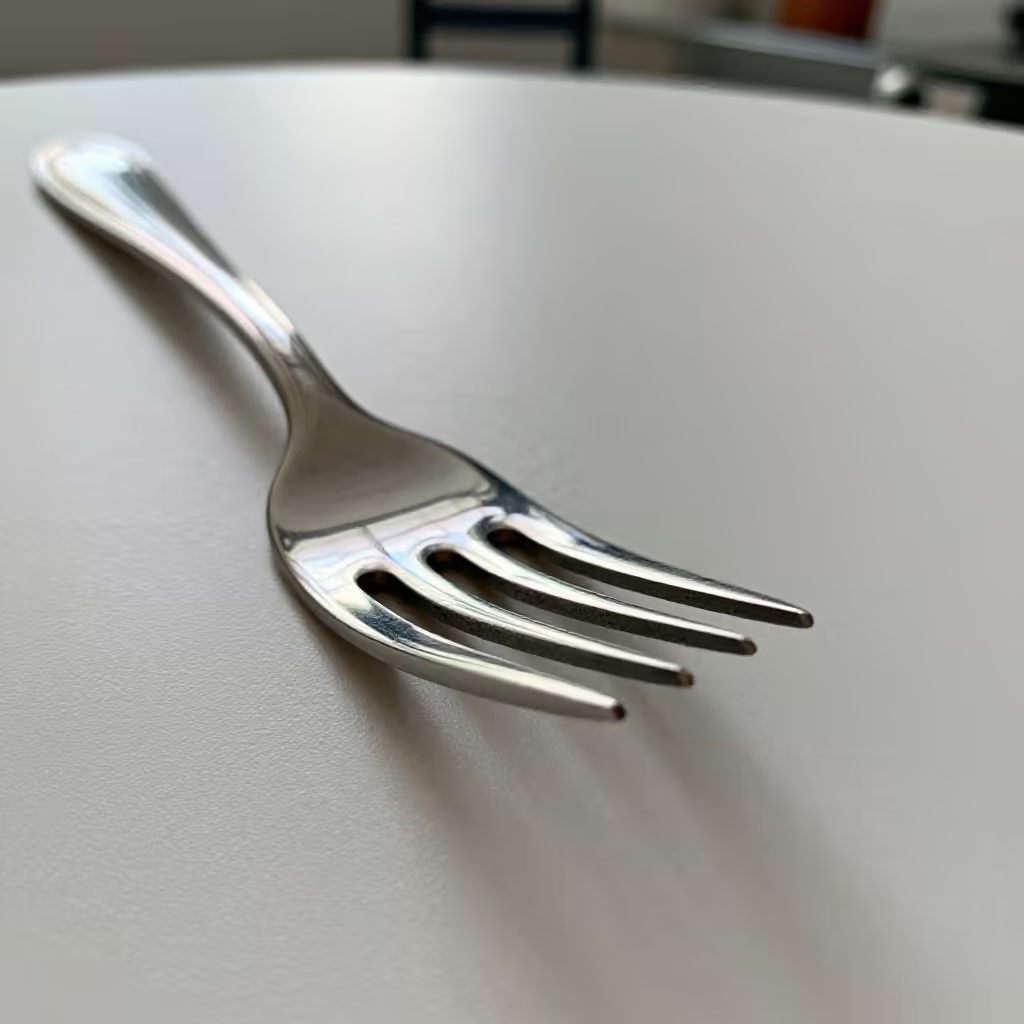
die Zacke
prong / point
A pointed, protruding edge or tip on an object, such as on a fork, a saw, or a crown.
EXAMPLE
Eine Zacke ist aus der Gabel herausgebrochen.
A prong has broken off the fork.
prong / point
Loading your saved state.
prong / point
A pointed, protruding edge or tip on an object, such as on a fork, a saw, or a crown.
Eine Zacke ist aus der Gabel herausgebrochen.
A prong has broken off the fork.

to pick up the pace
A colloquial way of telling someone to hurry up or increase the pace.
Wir müssen einen Zacken zulegen, sonst verpassen wir den Zug.
We need to pick up the pace, otherwise we'll miss the train.
The adjective 'zackig' is derived from 'Zacke' (prong / point). 'Zackig' can mean 'having points or prongs', but also colloquially 'quick' or 'brisk'. This second meaning is closely connected to the idiom 'einen Zacken zulegen' (to pick up the pace).
Die Bergkette hat ein sehr zackiges Profil am Horizont.
The mountain range has a very jagged profile on the horizon.
A 'Zacke' (prong / point) is usually part of a larger object. Typical formulations are therefore 'die Zacken einer Gabel' (the prongs of a fork), 'die Zacken einer Säge' (the teeth of a saw), or 'die Zacken einer Krone' (the points of a crown).
Vorsicht, die Säge hat sehr scharfe Zacken.
Careful, the saw has very sharp teeth.
The colloquial idiom 'einen Zacken zulegen' means 'to speed up' or 'to hurry up'. The verb 'zulegen' is separable here; the prefix 'zu' goes at the end of the sentence.
Leg mal einen Zacken zu, wir kommen sonst zu spät!
Pick up the pace, or we'll be late!
The request 'einen Zacken zulegen' is clearly colloquial. You use it among friends or in informal situations, but not in formal writing.
Leute, wir müssen einen Zacken zulegen, die Deadline ist morgen!
People, we need to pick up the pace—the deadline is tomorrow!
tip / top / lace
With a crown, Zacke can refer to the entire pointed, protruding part. Spitze, by contrast, refers only to its narrow outermost end. If the entire projection is damaged, Zacke is appropriate; if only the end is affected, Spitze is appropriate.

An der Papierkrone ist eine ganze Zacke abgerissen.
One entire prong has broken off the paper crown.
An der Papierkrone ist nur die Spitze einer Zacke geknickt.
Only the tip of one prong on the paper crown is bent.