


zeichnen
to draw
To create a picture or graphic representation with a pencil, chalk, or similar tool.
EXAMPLE
Sie kann sehr gut Porträts von Menschen zeichnen.
She can draw portraits of people very well.
to draw / sign
Loading your saved state.
to draw
To create a picture or graphic representation with a pencil, chalk, or similar tool.
Sie kann sehr gut Porträts von Menschen zeichnen.
She can draw portraits of people very well.

to become apparent
To become visible as an outline or contour, or to develop gradually and become recognizable.
Es zeichnet sich ab, dass das Projekt teurer wird als geplant.
It is becoming apparent that the project will be more expensive than planned.

to sign
To officially sign a document, contract, or deed.
Beide Parteien haben den Vertrag gestern gezeichnet.
Both parties signed the contract yesterday.

to subscribe
In finance, to make a binding declaration to buy shares or bonds at a certain price.
Investoren können die neuen Aktien des Unternehmens ab Montag zeichnen.
Investors can subscribe to the company's new shares starting Monday.

to be marked by
To show clear traces of something negative, such as illness, suffering, or exertion.
Sein Gesicht war von den Strapazen der langen Reise gezeichnet.
His face was marked by the hardships of the long journey.
The verb 'zeichnen' (to draw/sign) is closely related to the noun 'das Zeichen' (sign/symbol). So 'zeichnen' literally means to create signs or lines. The result of this action is 'die Zeichnung' (the drawing).
Er machte ein Zeichen auf die Karte, um den Ort zu markieren.
He made a mark on the map to mark the place.
In the meaning 'erkennbar werden' (to become recognizable/apparent), the verb is reflexive: 'sich abzeichnen' (to become apparent). It is very often used in the impersonal phrase 'Es zeichnet sich ab, dass ...' (It is becoming apparent that ...) to describe a development or trend.
Es zeichnet sich ab, dass wir das Projekt rechtzeitig beenden werden.
It is becoming apparent that we will finish the project on time.
This meaning is used in the fixed passive construction 'gezeichnet sein von etwas' (to be marked by something). The 'von' (by) always introduces the cause of the negative traces, for example an illness, worries, or great effort.
Ihr Gesicht war von der langen Krankheit gezeichnet.
Her face was marked by the long illness.
In the basic meaning 'ein Bild erstellen' (to create a picture), 'zeichnen' (to draw) can be used with or without an object. The preposition 'mit' (with) is often used to name the tool.
Meine Tochter zeichnet gerne mit bunten Stiften.
My daughter likes drawing with colored pencils.
When 'zeichnen' is used in the sense of 'unterschreiben' (to sign), this is very formal and official language. It is found mainly in contracts, deeds, or historical documents.
Der Minister zeichnete das Abkommen im Namen der Regierung.
The minister signed the agreement on behalf of the government.
This meaning is limited to the field of finance. You can recognize it from signal words such as 'Aktien' (shares/stocks), 'Anleihen' (bonds), 'Investoren' (investors), or 'Börse' (stock exchange).
Die Anleger konnten die neuen Aktien für 50 Euro pro Stück zeichnen.
Investors were able to subscribe to the new shares for 50 euros each.
to pull / move
Ziehen and zeichnen can both create a line with a pen. Ziehen emphasizes the straight movement, while zeichnen treats the line as part of a graphic representation. Use ziehen for a single mark and zeichnen for a picture or representation.
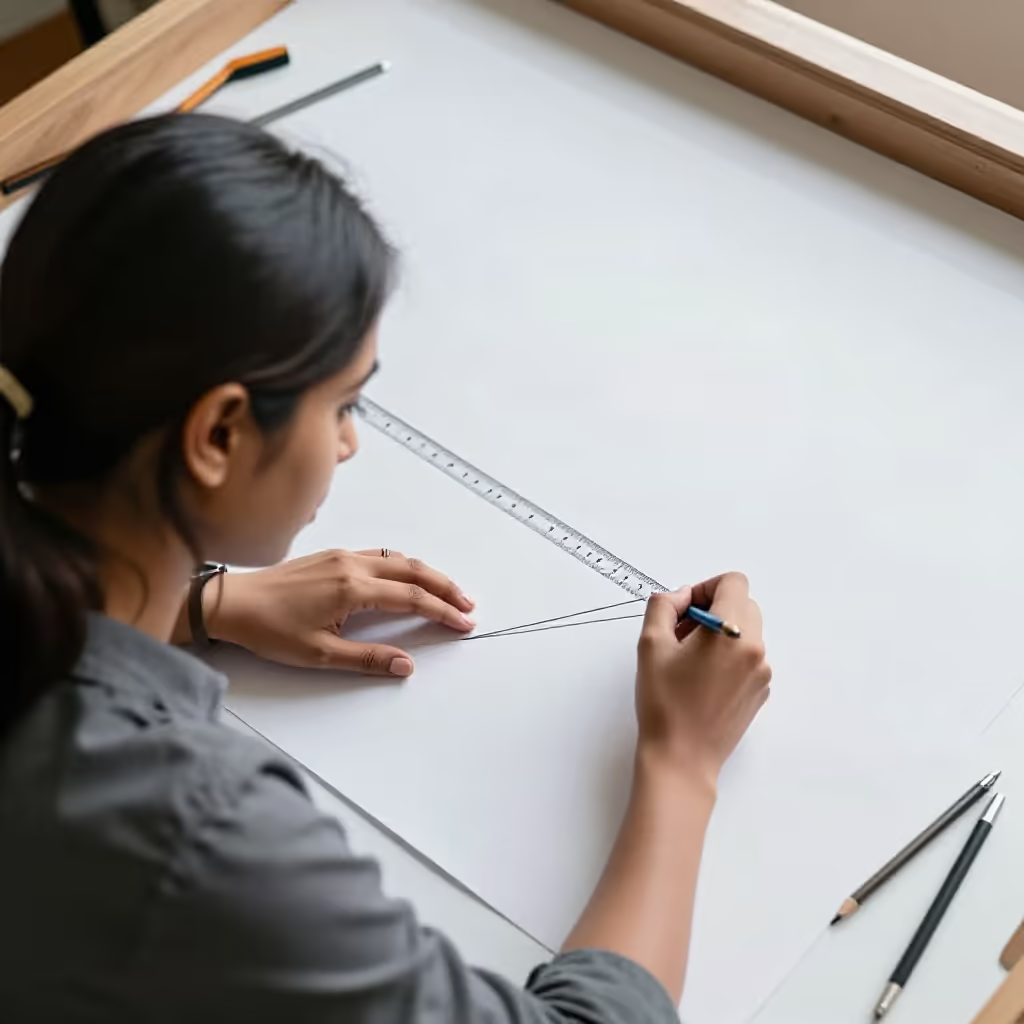
Bitte zeichnen Sie auf dem Blatt eine Karte mit einer Linie zum Bahnhof.
Please draw a map on the sheet with a line leading to the train station.
Bitte ziehen Sie mit dem Lineal eine gerade Linie unter das Wort.
Please draw a straight line under the word with the ruler.