


ziehen
to pull
To move something toward oneself or along behind oneself by applying force.
EXAMPLE
Das Kind zieht sein Spielzeugauto an einer Schnur hinter sich her.
The child pulls his toy car behind him on a string.
to pull / move
Loading your saved state.
to pull
To move something toward oneself or along behind oneself by applying force.
Das Kind zieht sein Spielzeugauto an einer Schnur hinter sich her.
The child pulls his toy car behind him on a string.

to move
To change one's place of residence; to move to another apartment, city, or country.
Nächstes Jahr ziehen wir von der Stadt aufs Land.
Next year we're moving from the city to the countryside.

to migrate
To move as a group in a particular direction, especially in the case of birds or nomads.
Im Herbst ziehen die Störche in den warmen Süden.
In autumn, the storks migrate to the warm south.
to draw
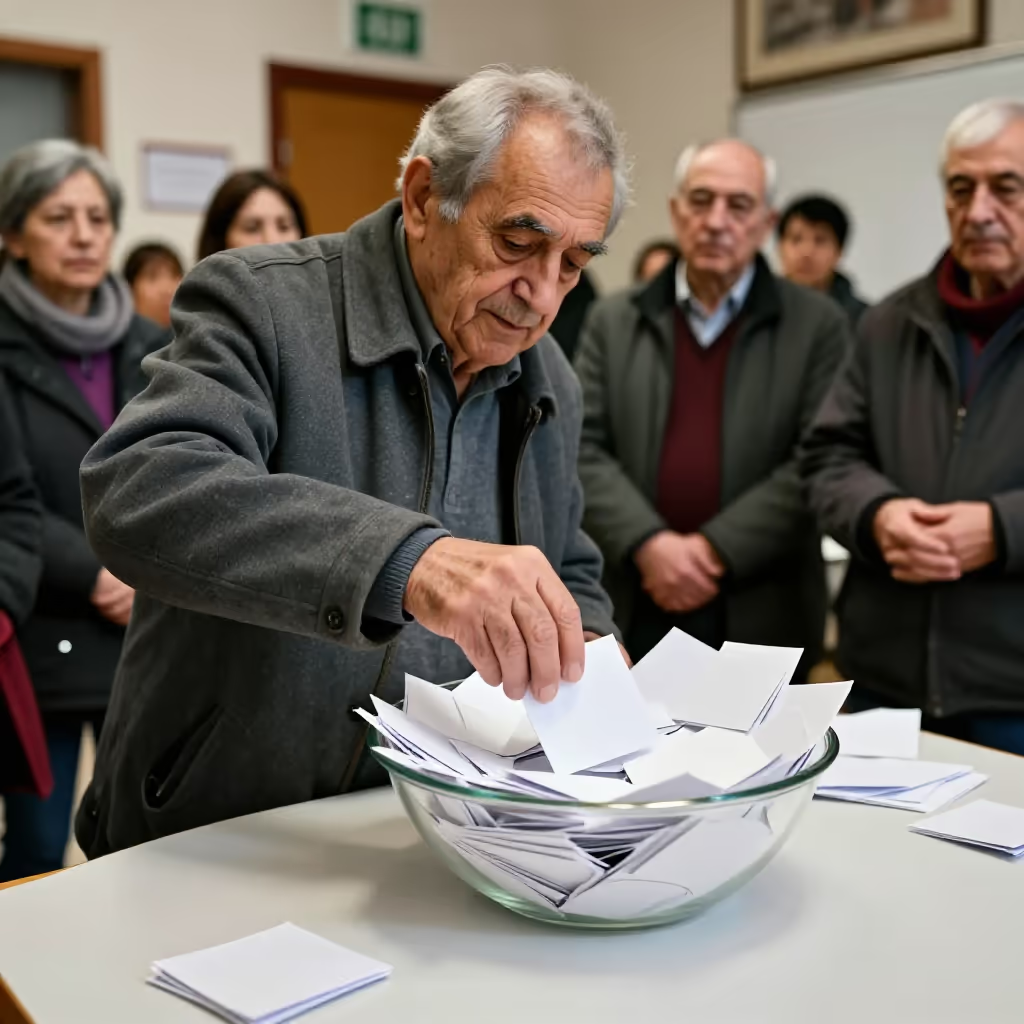
To take something from a set or container, often randomly. It frequently refers to cards, lots, or numbers.
Bei der Tombola zog sie das große Los.
At the raffle, she drew the winning ticket.

to steep
To leave a drink, usually tea or coffee, in hot water for a certain amount of time so that it releases flavor and active substances.
Lass den grünen Tee nicht länger als drei Minuten ziehen, sonst wird er bitter.
Don't let the green tea steep for more than three minutes, otherwise it will become bitter.

to draw
To create a line or boundary on a surface.
Mit dem Lineal zog er einen geraden Strich auf dem Papier.
With the ruler, he drew a straight line on the paper.

to drag on
To extend over a long time or a long distance; to continue for a long time.
Die Reparaturarbeiten an der Brücke zogen sich über mehrere Monate hin.
The repair work on the bridge dragged on for several months.

to draw a conclusion
To derive a logical conclusion from existing information or observations.
Aus den vorliegenden Daten können wir den Schluss ziehen, dass die Kampagne erfolgreich war.
From the available data, we can draw the conclusion that the campaign was successful.

to consider
To think about or consider a possibility or option.
Wir sollten auch die Möglichkeit in Betracht ziehen, das Projekt zu verschieben.
We should also consider the possibility of postponing the project.
When 'ziehen' describes movement from one place to another (e.g. moving house, birds migrating), the perfect tense is formed with 'sein'. In most other meanings (e.g. pulling something, drawing a card), 'haben' is used.
Meine Nachbarn sind letzten Monat nach Berlin gezogen.
My neighbors moved to Berlin last month.
When you pull on a part of something, you use the preposition 'an' with the dative. Typical examples are pulling on a rope, a handle, or a door.
Du musst kräftig an dem Seil ziehen, um das Tor zu öffnen.
You have to pull hard on the rope to open the gate.
When talking about moving house, the destination is given with prepositions such as 'in' (+ accusative), 'nach' (for cities/countries without an article), or 'aufs' (for 'auf das Land'—to the countryside).
Sie möchte nächstes Jahr in eine größere Wohnung ziehen.
She wants to move into a larger apartment next year.
In the meaning 'etwas zufällig auswählen' (to select something randomly), 'ziehen' is often combined with objects such as 'eine Karte' (a card), 'ein Los' (a raffle ticket/lot), or 'eine Nummer' (a number).
Jeder Teilnehmer darf eine Nummer aus dem Hut ziehen.
Each participant may draw a number from the hat.
When a drink such as tea develops its aroma, 'ziehen' is used without an object. The drink itself is the subject of the sentence.
Der Tee muss fünf Minuten ziehen, bevor du ihn trinkst.
The tea needs to steep for five minutes before you drink it.
When drawing something on a surface, 'ziehen' is often used with objects such as 'eine Linie' (a line), 'einen Strich' (a stroke/line), 'einen Kreis' (a circle), or 'eine Grenze' (a boundary).
Er zog mit einem Bleistift eine gerade Linie.
He drew a straight line with a pencil.
The reflexive form 'sich ziehen' or 'sich hinziehen' means that something takes a very long time. It is often used for processes, negotiations, or construction work.
Die Besprechung zog sich bis in den späten Abend.
The meeting dragged on until late in the evening.
The expression 'einen Schluss ziehen' means to draw a logical conclusion. You can also use other abstract nouns, e.g. 'eine Konsequenz ziehen' (to draw a consequence) or 'eine Lehre ziehen' (to learn a lesson).
Aus diesem Fehler müssen wir eine Lehre für die Zukunft ziehen.
We have to learn a lesson from this mistake for the future.
The expression 'in Betracht ziehen' is a fixed combination and means 'überlegen' (to think about) or 'erwägen' (to consider). The noun 'Betracht' is used almost only in this expression.
Ich werde Ihr Angebot ernsthaft in Betracht ziehen.
I will seriously consider your offer.
to take
Nehmen generally means taking a card from the deck. For cards, ziehen is the usual word for a random selection or a move according to the rules of a game. In a game, ziehen is therefore usually the better choice; for simply taking a card, nehmen also works.

Ich ziehe die oberste Karte vom Stapel, weil ich an der Reihe bin.
I draw the top card from the deck because it is my turn.
Ich nehme die oberste Karte vom Stapel, um das Bild zu prüfen.
I take the top card from the deck to check the picture.