


prägen
to shape
To strongly and lastingly influence someone or something in their development, character, or appearance.
EXAMPLE
Die Zeit im Ausland hat ihn für sein ganzes Leben geprägt.
The time abroad shaped him for his whole life.
to shape / mint
Loading your saved state.
to shape
To strongly and lastingly influence someone or something in their development, character, or appearance.
Die Zeit im Ausland hat ihn für sein ganzes Leben geprägt.
The time abroad shaped him for his whole life.
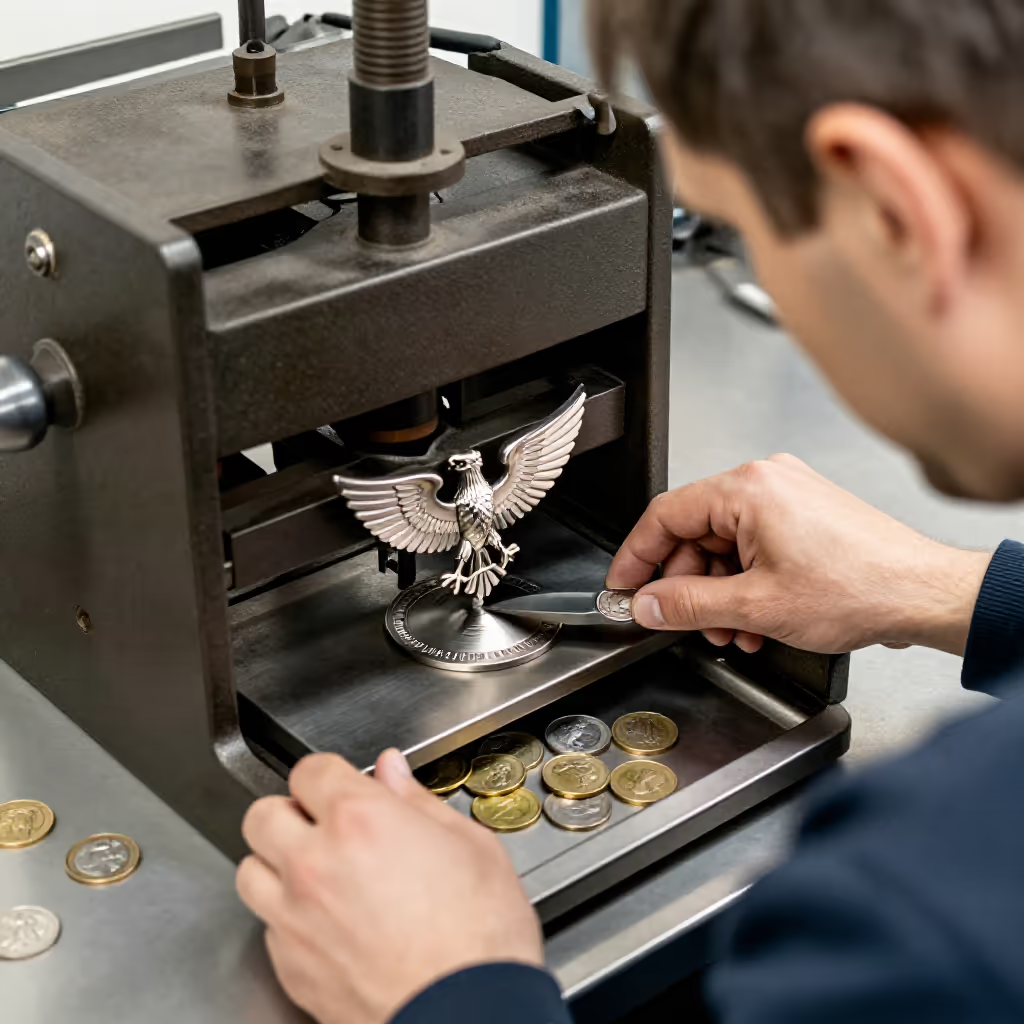
to mint
To press or stamp an image, pattern, or writing into a surface, usually made of metal, especially with coins and medals.
Die neue Euromünze wird in Berlin geprägt.
The new euro coin is minted in Berlin.

to memorize
To memorize something so that you do not forget it again.
Präge dir sein Gesicht gut ein, damit du ihn wiedererkennst.
Memorize his face well so that you recognize him again.

to coin
To create or use a term, word, or expression for the first time so that it becomes known.
Sigmund Freud hat den Begriff des Unbewussten entscheidend geprägt.
Sigmund Freud decisively shaped the concept of the unconscious.
The basic meaning of 'prägen' (to mint) is the physical pressing of a pattern into metal, as with a coin. All other meanings are metaphorical: An experience 'prägt' (shapes) a character, you 'prägst' (imprint) a word into your memory, or you 'prägst' (coin) a new term for the language.
Diese Reise hat meine Sicht auf die Welt nachhaltig geprägt.
This trip had a lasting influence on my view of the world.
The object of the verb makes the meaning clear: You prägt Münzen (mint coins, metal), eine Persönlichkeit (shape a personality, person), einen Begriff (coin a term, language), or das Gedächtnis (memory, reflexive: sich etwas einprägen).
Seine Kindheit auf dem Land hat ihn sehr geprägt.
His childhood in the countryside shaped him greatly.
In the meaning of 'beeinflussen' (to influence), 'prägen' (to shape) is often used with abstract nouns such as 'den Charakter' (character), 'das Bild' (the image) of a city, or 'eine Epoche' (an era).
Die Architektur des 19. Jahrhunderts prägt das Stadtzentrum.
The architecture of the 19th century shapes the city center.
'Sich einprägen' (to memorize) is a separable, reflexive verb. The person is in the dative (ich präge MIR ein), and the information is in the accusative. In a main clause, the prefix 'ein' separates.
Ich muss mir deine Telefonnummer gut einprägen.
I have to memorize your phone number well.
In the meaning of 'schaffen' (to create), 'prägen' (to coin) is almost always combined with linguistic elements: 'einen Begriff prägen' (to coin a term), 'ein Wort prägen' (to coin a word), or 'eine Redewendung prägen' (to coin an expression).
Dieser Philosoph hat viele neue Begriffe geprägt.
This philosopher coined many new terms.
to hit / beat
When producing a coin, prägen describes pressing an image or writing into the metal. Schlagen, by contrast, generally refers to a forceful physical blow and does not name this manufacturing process. Therefore, use „prägen“ for creating the image on a coin, while „schlagen“ expresses only the blow itself.

Die Münzanstalt prägt das neue Bild auf den Metallrohling.
The mint stamps the new image onto the metal blank.
Der Hammer schlägt kräftig auf den Metallrohling.
The hammer strikes the metal blank forcefully.