


zerbrechen
to break
To fall apart into pieces or become damaged, usually because of a fall or impact (intransitive).
EXAMPLE
Das Glas ist vom Tisch gefallen und zerbrochen.
The glass fell off the table and broke.
to break
Loading your saved state.
to break
To fall apart into pieces or become damaged, usually because of a fall or impact (intransitive).
Das Glas ist vom Tisch gefallen und zerbrochen.
The glass fell off the table and broke.

to break
To actively smash or break something into pieces (transitive).
Aus Wut hat er den alten Stuhl zerbrochen.
Out of anger, he broke the old chair.

to break down
Refers to something abstract, such as a relationship, a hope, or a plan, that fails or comes to an end.
Ihre Freundschaft ist nach dem großen Streit zerbrochen.
Their friendship broke down after the big argument.

to rack one's brain
To think very intensely and with great effort about a problem.
Ich zerbreche mir schon seit Tagen den Kopf darüber, wie wir das Problem lösen können.
I've been racking my brain for days about how we can solve the problem.
'Zerbrechen' (to break) is an inseparable verb. The prefix 'zer-' often expresses destruction or falling apart into many pieces. This idea is reflected in all meanings of the word.
Durch den Sturm zerbrach der alte Baum in der Mitte.
Because of the storm, the old tree broke in the middle.
This verb can be used transitively (with an accusative object) or intransitively (without an object). The auxiliary verb in the perfect tense changes accordingly: intransitive with 'sein', transitive with 'haben'.
Die Vase ist vom Regal gefallen und zerbrochen.
The vase fell from the shelf and broke.
In a figurative sense, 'zerbrechen' (to break down/fail) is used for abstract things that end or fail. Typical nouns are 'eine Freundschaft' (a friendship), 'eine Beziehung' (a relationship), 'Vertrauen' (trust), or 'eine Hoffnung' (a hope).
Nach diesem Verrat ist ihr Vertrauen zerbrochen.
After this betrayal, her trust was broken.
The idiom 'sich den Kopf zerbrechen' (to rack one's brain) is reflexive and uses the dative ('sich'). The topic one is thinking about is introduced with the preposition 'über' (+ accusative).
Er zerbricht sich den Kopf darüber, wie er das Geld zurückzahlen soll.
He is racking his brain about how he should pay the money back.
to break
Brechen and zerbrechen can both mean that a hard object is split by force. Brechen also works for a deliberate break at a specific point. Zerbrechen emphasizes more strongly the result: the entire object is broken and in pieces.
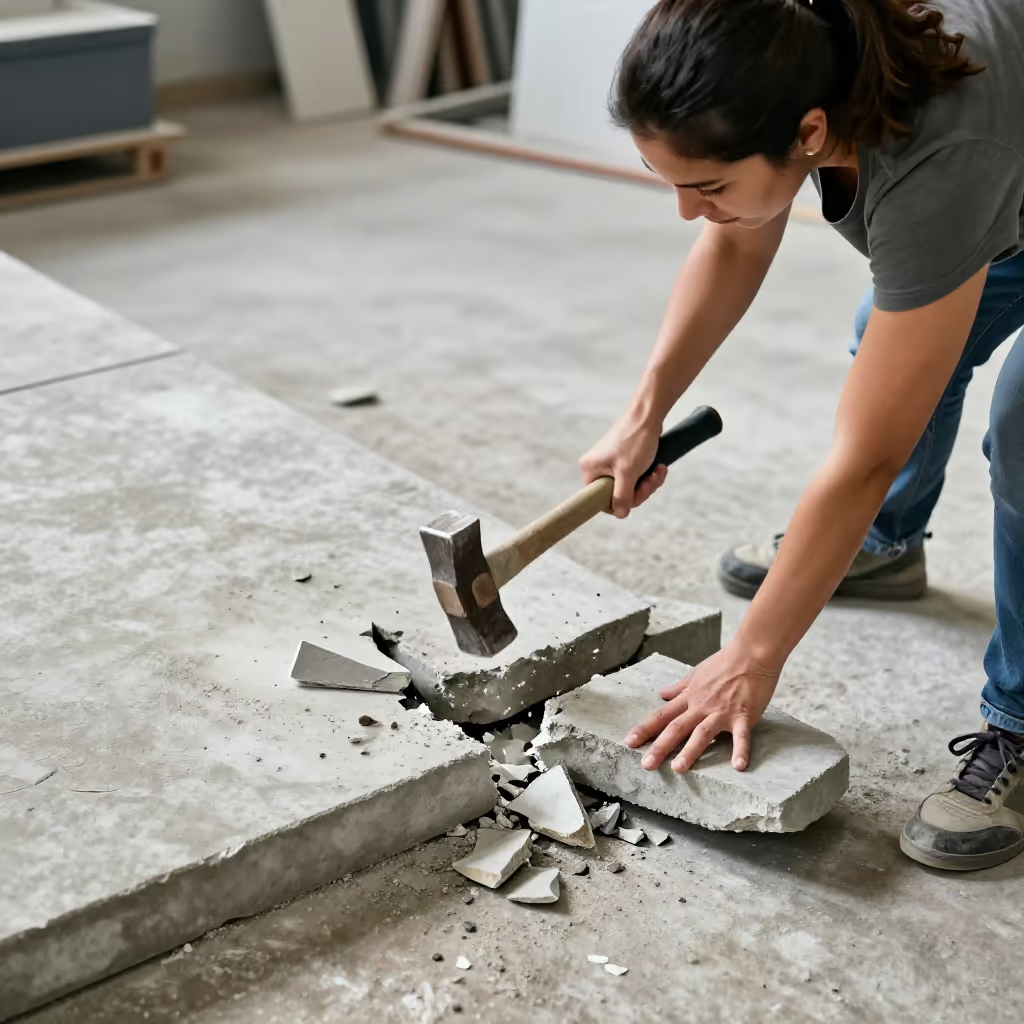
Lina zerbricht die beschädigte Schokoladentafel vollständig in kleine Stücke.
Lina completely breaks the damaged chocolate bar into small pieces.
Lina bricht die Schokoladentafel an der Linie in zwei Hälften.
Lina breaks the chocolate bar in half along the line.