


anfassen
to touch
To touch something with the hand or fingers.
EXAMPLE
Vorsicht, die Herdplatte ist noch heiß, nicht anfassen!
Careful, the stovetop is still hot—don't touch it!
to touch / tackle
Loading your saved state.
to touch
To touch something with the hand or fingers.
Vorsicht, die Herdplatte ist noch heiß, nicht anfassen!
Careful, the stovetop is still hot—don't touch it!

to tackle
To tackle a task or problem; to begin dealing with it.
Wir müssen dieses Problem jetzt endlich richtig anfassen, um es zu lösen.
We finally have to properly tackle this problem now in order to solve it.

to touch someone
To handle someone physically, often in a particular way, e.g. gently or roughly.
Der Sanitäter fasste den verletzten Arm des Jungen ganz vorsichtig an.
The paramedic touched the boy's injured arm very carefully.
'Anfassen' (to touch / tackle) is a separable verb. The prefix 'an-' comes at the end in a main clause. In subordinate clauses and in the infinitive with 'zu', the verb stays together.
Fass den Hund bitte nicht an, er ist sehr scheu.
Please don't touch the dog; it's very shy.
You can recognize the meaning from the object: With a concrete object or a person, it means 'to touch'. With an abstract noun like 'Problem' (problem) or 'Thema' (topic), it means 'to begin dealing with it'.
Darf ich den Stoff mal anfassen?
May I touch the fabric?
In the meaning of 'to begin a task', the verb is used metaphorically. You do not physically 'touch' the problem, but begin working on it. Typical objects are 'ein Problem' (a problem), 'eine Aufgabe' (a task), or 'ein Projekt' (a project).
Sie weiß nicht, an welcher Stelle sie das Projekt anfassen soll.
She doesn't know where she should start tackling the project.
When 'anfassen' (to touch) describes how someone handles a person, an adverb is almost always added. This adverb describes the manner of the touch, for example 'sanft anfassen' (to touch gently), 'vorsichtig anfassen' (to touch carefully), or 'grob anfassen' (to touch roughly).
Er fasste sie grob am Arm an.
He grabbed her roughly by the arm.
to concern / turn on / tackle
An Problem angehen and ein Problem anfassen both mean beginning to deal with a problem. Angehen is the neutral choice for engaging with it in terms of its content. Anfassen figuratively emphasizes the practical start and is especially suitable when action should finally be taken.
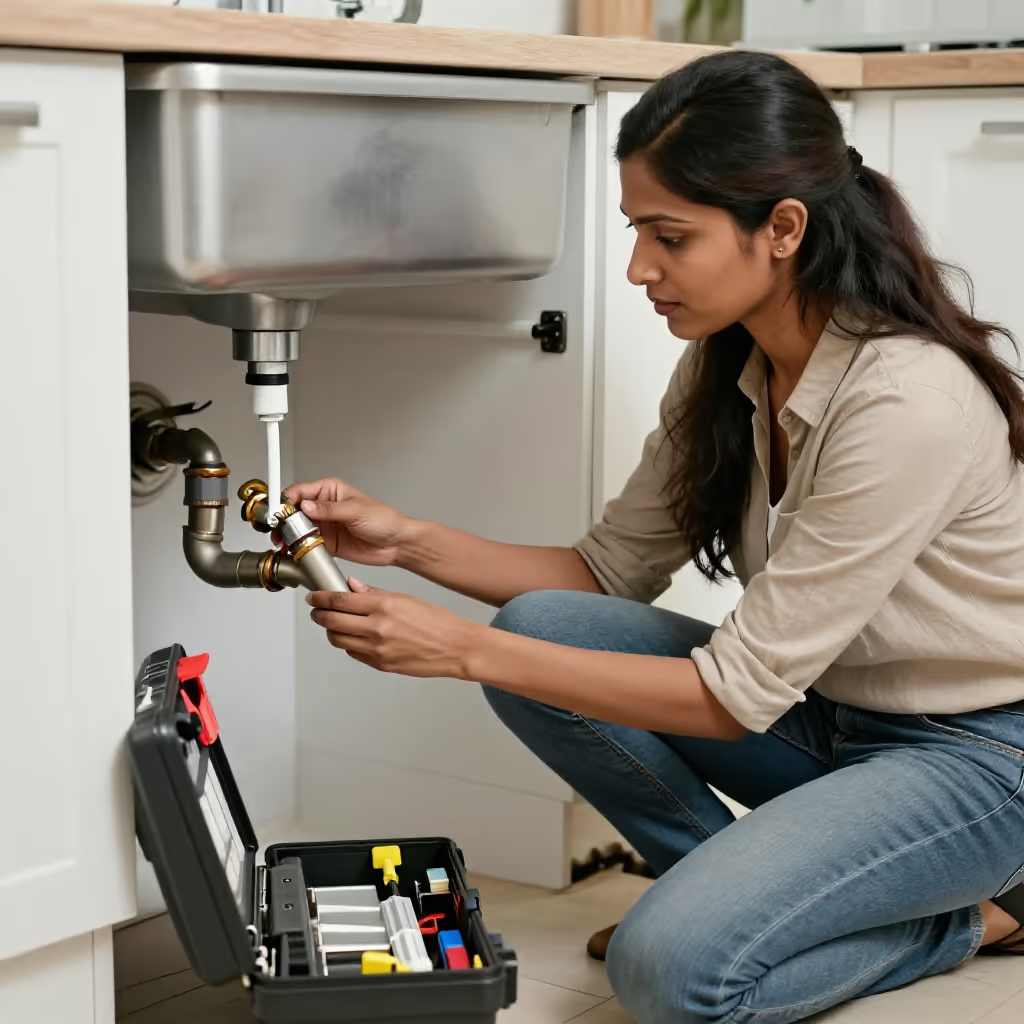
Morgen fassen wir das Problem endlich an.
Tomorrow we'll finally tackle the problem.
Morgen gehen wir das Problem Schritt für Schritt an.
Tomorrow we'll tackle the problem step by step.