

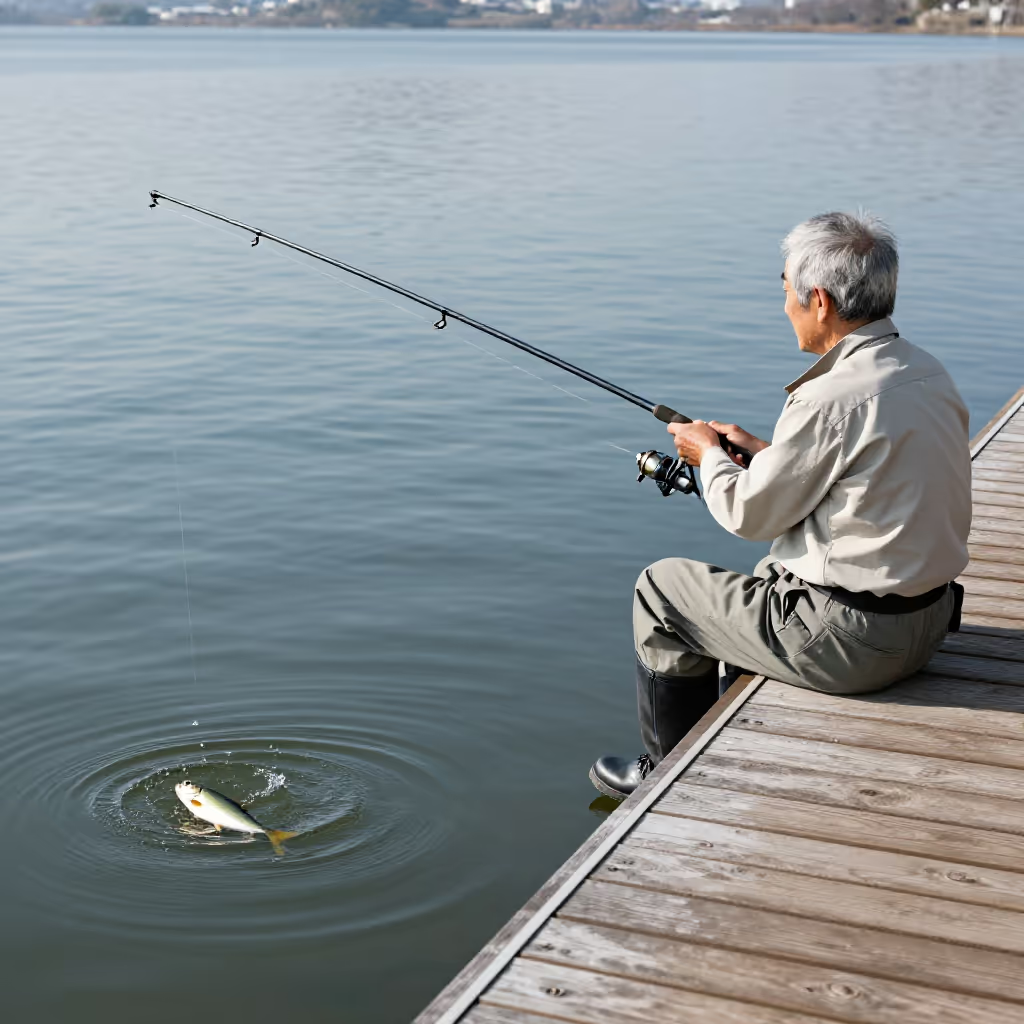
angeln
to fish
To catch fish from the water with a fishing rod (a rod with line and hook).
EXAMPLE
Am Wochenende gehen wir oft am See angeln.
On weekends, we often go fishing at the lake.
to fish
Loading your saved state.
to fish
To catch fish from the water with a fishing rod (a rod with line and hook).
Am Wochenende gehen wir oft am See angeln.
On weekends, we often go fishing at the lake.

to fish out
(colloquial) To reach for something or manage to grab it skillfully, often because it is hard to reach.
Er angelte sich die letzte Praline aus der Schachtel.
He fished the last praline out of the box.

to fish for
(figurative) To try to get something in a skillful or indirect way, for example information or a compliment.
Mit ihrer Frage angelte sie ganz offensichtlich nach einem Kompliment.
With her question, she was quite obviously fishing for a compliment.
The verb 'angeln' (to fish) is derived directly from the noun 'die Angel' (the fishing rod), which is a rod used to catch fish. All meanings, including the figurative ones, contain the idea of deliberately 'catching' something.
Für das Angeln braucht man eine gute Angel und viel Geduld.
For fishing, you need a good fishing rod and a lot of patience.
In the figurative meaning of 'to fish for something', the preposition 'nach' (+ dative) is always used. Typical phrases are 'nach Komplimenten angeln' (to fish for compliments) or 'nach Informationen angeln' (to fish for information).
Er fragte beiläufig nach ihrer Meinung und angelte damit nach einem Lob.
He casually asked for her opinion and was fishing for praise by doing so.
When someone 'angelt' something for themselves (skillfully grabs something), a reflexive dative pronoun is often used. The structure is: subject + angelt + sich (dative) + object (accusative).
Sie angelte sich das letzte Stück Kuchen vom Teller.
She fished the last piece of cake off the plate for herself.
When naming the place where someone is fishing, the prepositions 'an' or 'in' with the dative are usually used. You fish 'am See' (at the lake), 'am Fluss' (by the river), or 'im Meer' (in the sea).
Mein Vater hat mir das Angeln am nahegelegenen Teich beigebracht.
My father taught me fishing at the nearby pond.
to grab / take effect
Greifen generally means taking hold of an object with your hand. Angeln can colloquially describe the same action, but it emphasizes that the object is difficult to reach and is skillfully brought closer. Use greifen for an object that is within normal reach and angeln when access is difficult.

Mara angelte den Schlüssel geschickt unter dem Schrank hervor.
Mara skillfully fished the key out from under the cabinet.
Mara griff nach dem Schlüssel neben dem Schrank.
Mara reached for the key next to the cabinet.