


die Arbeit
job / work
The professional activity for which you are paid; employment or a job.
EXAMPLE
Nach dem Studium hat sie eine gute Arbeit gefunden.
After finishing her studies, she found a good job.
work
Loading your saved state.
job / work
The professional activity for which you are paid; employment or a job.
Nach dem Studium hat sie eine gute Arbeit gefunden.
After finishing her studies, she found a good job.
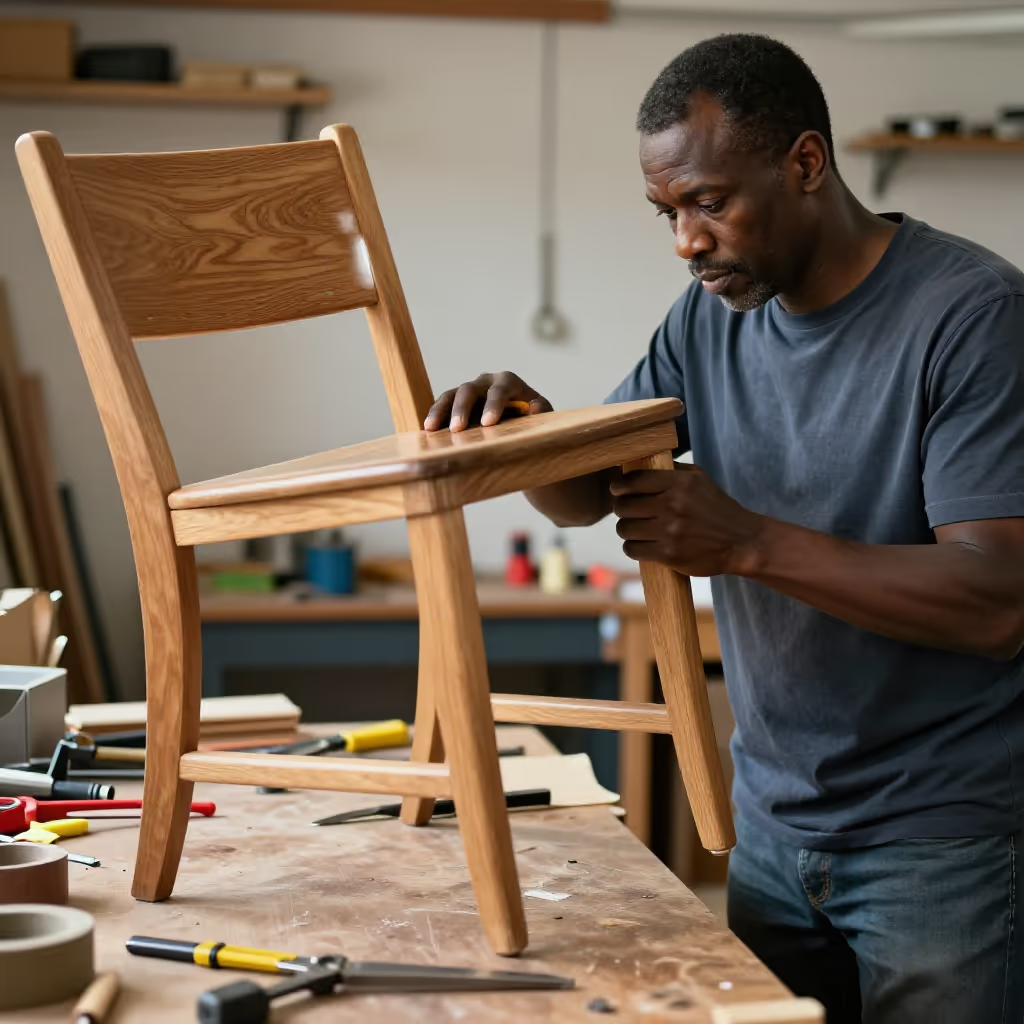
work / task
A specific task, piece of work, or project that needs to be completed.
Diese Arbeit muss bis Freitag fertig sein.
This work has to be finished by Friday.

work / effort
The effort, exertion, or labor required for an activity.
Es hat viel Arbeit gekostet, den Garten so schön zu machen.
It took a lot of work to make the garden so beautiful.

paper / thesis
An academic text written as part of university or school studies, such as a term paper or thesis.
Sie schreibt gerade an ihrer Bachelor-Arbeit.
She is currently writing her bachelor's thesis.

work
A physics term that describes the energy transferred to a body by a force along a path.
Die physikalische Einheit für Arbeit ist Joule.
The physical unit for work is the joule.
To express location or direction in relation to the workplace, certain prepositions are used. You go 'zur Arbeit' (to work; direction), but you are 'bei der Arbeit' or 'auf der Arbeit' (at work; location).
Ich fahre jeden Morgen mit dem Fahrrad zur Arbeit.
I ride my bike to work every morning.
'Arbeit' (work) is a very productive base word in German. It forms many compound nouns that refer to the world of work.
Mein neuer Arbeitsplatz ist nur zehn Minuten von zu Hause entfernt.
My new workplace is only ten minutes from home.
'Arbeit' (work) can be countable when it refers to a specific task or an academic text. When it refers to professional activity in general or to effort, the word is uncountable and has no plural.
Ich muss noch zwei Arbeiten für die Universität fertigstellen.
I still have to finish two papers for university.
In the context of employment, 'Arbeit' (job/work) is often combined with certain verbs. Typical phrases are 'eine Arbeit suchen' (to look for a job), 'eine Arbeit finden' (to find a job), or 'seine Arbeit verlieren' (to lose one's job).
Er sucht seit drei Monaten eine neue Arbeit.
He has been looking for a new job for three months.
When 'Arbeit' (work/effort) means effort or exertion, it is often used with verbs like 'machen' (to make/do) or 'kosten' (to cost/take). It is then usually accompanied by 'viel' (a lot of), 'wenig' (little), or 'keine' (no).
Das Renovieren des Hauses hat uns viel Arbeit gemacht.
Renovating the house was a lot of work for us.
In an academic context, people talk about 'eine Arbeit schreiben' (to write a paper/thesis), 'abgeben' (to submit), or 'präsentieren' (to present). The type of paper is often named directly.
Sie muss ihre Hausarbeit bis nächste Woche abgeben.
She has to submit her term paper by next week.
place / position
Arbeit and Stelle can both refer to paid employment. Arbeit refers to employment in general, while a Stelle means a specific workplace or position. If you are simply looking for employment, Arbeit is appropriate; if you are referring to a specific position, use Stelle.

Nach dem Umzug sucht sie schnell Arbeit in der neuen Stadt.
After moving, she quickly looked for work in the new city.
Nach dem Umzug bewirbt sie sich auf eine bestimmte Stelle in der neuen Stadt.
After moving, she applied for a specific position in the new city.