


aufheben
to pick up
To pick something up from the floor or from a lower position with your hands.
EXAMPLE
Er bückte sich, um den heruntergefallenen Schlüssel aufzuheben.
He bent down to pick up the key that had fallen.
to pick up / keep / cancel
Loading your saved state.
to pick up
To pick something up from the floor or from a lower position with your hands.
Er bückte sich, um den heruntergefallenen Schlüssel aufzuheben.
He bent down to pick up the key that had fallen.

to keep
To keep or save something for later use.
Ich habe alle alten Fotos aus meiner Kindheit aufgehoben.
I kept all the old photos from my childhood.
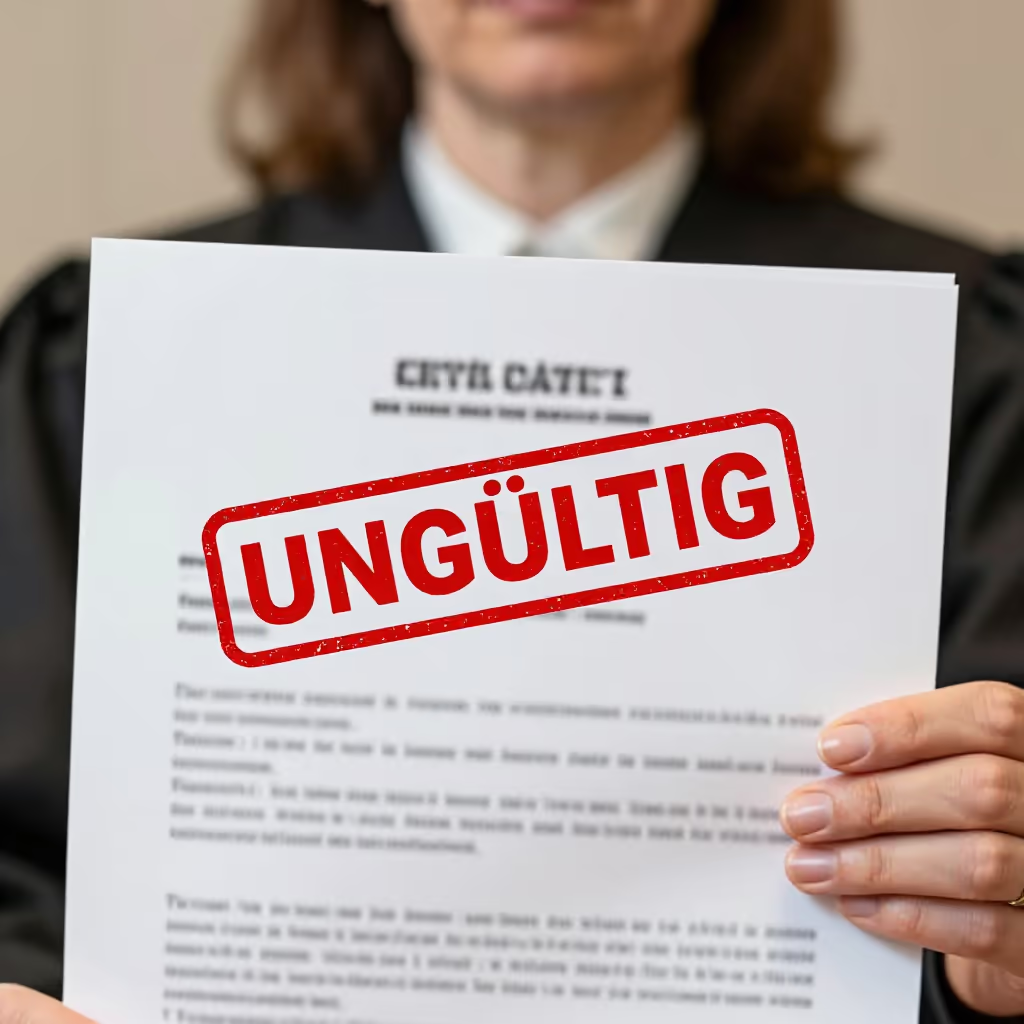
to cancel
To declare a rule, law, decision, or provision invalid and put it out of force.
Das Gericht hat das umstrittene Urteil in der zweiten Instanz aufgehoben.
The court canceled the controversial ruling in the second instance.

to cancel each other out
To balance out or neutralize each other so that no effect remains.
Die Vorteile und Nachteile dieser Methode heben sich gegenseitig auf.
The advantages and disadvantages of this method cancel each other out.

to feel well looked after
To feel safe, comfortable, and well cared for in a place or with certain people.
Bei seinen Großeltern fühlt sich das Kind immer gut aufgehoben.
The child always feels well looked after at his grandparents' house.
'Aufheben' is a separable verb. In a main clause, the prefix 'auf' goes at the end of the sentence. In subordinate clauses or in the infinitive with 'zu', the verb is not separated.
Sie hebt den Stift vom Boden auf.
She picks the pen up from the floor.
The verb consists of 'auf' and 'heben' (to lift). The literal meaning 'hochheben' (to lift up) (meaning 1) is the basis for the other, more abstract meanings: you 'hebst' something 'auf' in order to keep it, or you 'hebst' a rule 'auf' in order to make it invalid.
Kannst du bitte das Buch aufheben?
Can you please pick up the book?
You can recognize this meaning by the fact that it is always about a concrete, physical object that is in a lower place (e.g. on the floor, on the table).
Er hat die Münze aufgehoben, die ihm aus der Tasche gefallen war.
He picked up the coin that had fallen out of his pocket.
In the meaning 'aufbewahren' (to keep/store), the verb is often combined with things that have personal or practical value. Typical examples are: 'den Kassenbon aufheben' (to keep the receipt), 'alte Briefe aufheben' (to keep old letters), 'eine Erinnerung aufheben' (to keep a memory/memento).
Heb den Kassenbon gut auf, falls du das Gerät umtauschen musst.
Keep the receipt safe in case you need to exchange the device.
This meaning is almost always used in an official, legal, or administrative context. The object is typically something abstract, such as a law, a judgment, a ban, or a contract.
Wegen des Sturms wurden alle Flüge für heute aufgehoben.
Because of the storm, all flights for today were canceled.
The reflexive form 'sich aufheben' means that two opposing things balance each other out. The subject is always plural or refers to a set of things.
Die beiden Kräfte sind gleich stark und heben sich daher gegenseitig auf.
The two forces are equally strong and therefore cancel each other out.
The expression 'sich gut/sicher/wohl aufgehoben fühlen' (to feel well/safely/comfortably looked after) is a fixed unit. It describes the feeling of being well cared for and safe in a place or with people.
In diesem Team fühle ich mich von Anfang an gut aufgehoben.
I have felt well looked after in this team from the very beginning.
to record / take in
When taking an object from the floor, aufheben is the usual concrete choice. Aufnehmen can also be used in this sense, but it usually sounds more formal or requires a special context. In everyday situations, aufheben is therefore usually more suitable.

Der Helfer hob den heruntergefallenen Brief vom Boden auf.
The helper picked up the fallen letter from the floor.
Der Helfer nahm die heruntergefallenen Briefe sorgfältig vom Boden auf.
The helper carefully picked up the fallen letters from the floor.