


ausgebrannt
burned out
Completely exhausted and without energy, often as a result of prolonged stress or overwork (burnout).
Nach monatelangen Überstunden fühlte sie sich völlig ausgebrannt.
After months of overtime, she felt completely burned out.
burned out
Loading your saved state.

burned out
Completely exhausted and without energy, often as a result of prolonged stress or overwork (burnout).
Nach monatelangen Überstunden fühlte sie sich völlig ausgebrannt.
After months of overtime, she felt completely burned out.


burned out
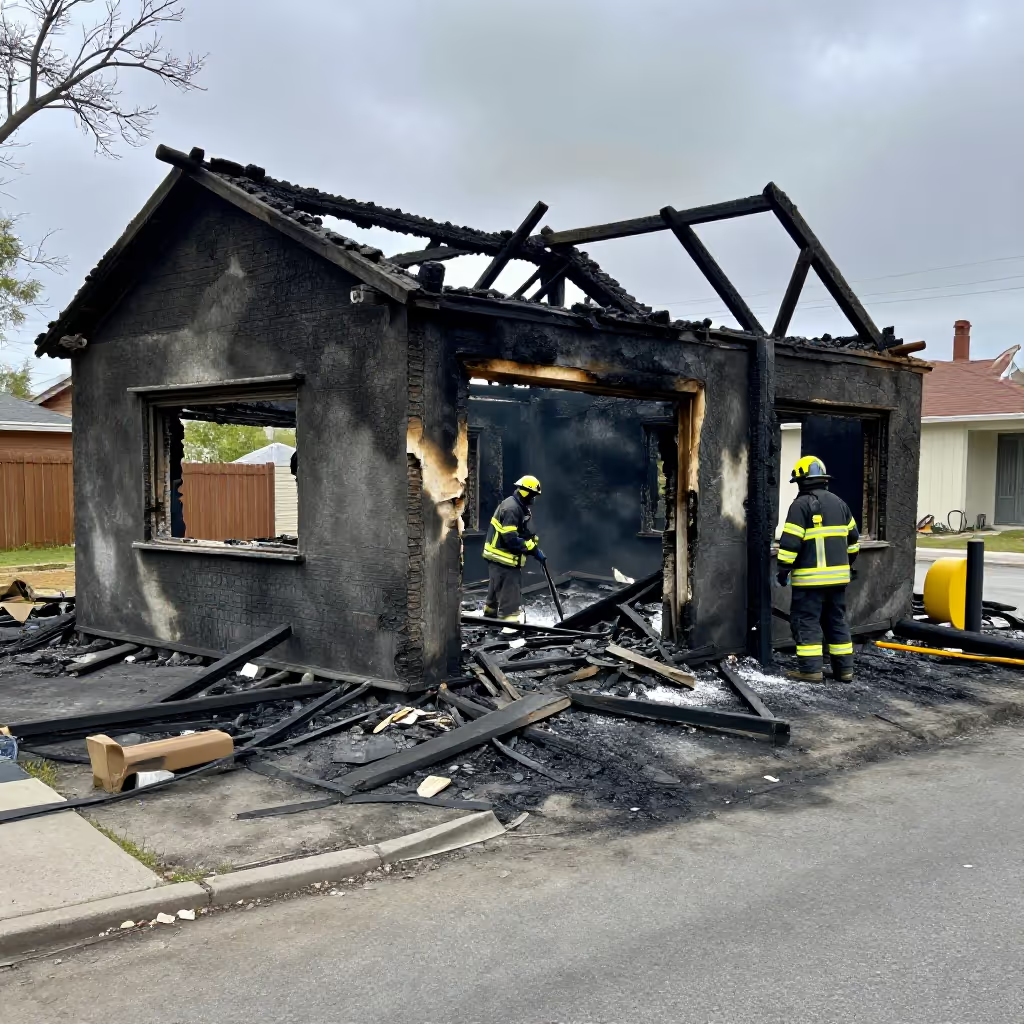
Completely destroyed by fire or burned out inside.
Das alte Lagerhaus ist letzte Nacht komplett ausgebrannt.
The old warehouse burned out completely last night.
'Ausgebrannt' (burned out) is the past participle form of the separable verb 'ausbrennen' (to burn out). Like many participles, it can be used as an adjective to describe a state.
Der Manager ist nach dem Projekt völlig ausgebrannt.
The manager is completely burned out after the project.
The meaning depends on the subject. If 'ausgebrannt' (burned out) refers to a person, it means emotionally exhausted. If it refers to a building or object, it means destroyed by fire.
Der Arzt erklärte, der Patient sei ausgebrannt.
The doctor explained that the patient was burned out.
In the context of exhaustion, 'ausgebrannt' (burned out) is often combined with verbs like 'sein' (to be) or 'sich fühlen' (to feel) and adverbs like 'völlig' (completely) or 'total' (totally).
Viele Mitarbeiter in diesem Sektor fühlen sich nach wenigen Jahren beruflich ausgebrannt.
Many employees in this sector feel professionally burned out after just a few years.
In its literal meaning, the adjective often describes the noun directly. Typical combinations are 'ein ausgebranntes Haus' (a burned-out house), 'ein ausgebranntes Auto' (a burned-out car), or 'eine ausgebrannte Ruine' (a burned-out ruin).
In den Nachrichten zeigten sie Bilder der ausgebrannten Fabrikhalle.
On the news, they showed pictures of the burned-out factory building.
empty
Both words can describe someone who has no energy left. Leer tends to describe the subjective feeling of inner emptiness, while ausgebrannt usually points to complete exhaustion after prolonged stress or overwork. Use leer for the feeling itself and ausgebrannt when the ongoing strain is the focus.

Nach Monaten mit Überstunden war sie völlig ausgebrannt und hatte keine Energie mehr.
After months of working overtime, she was completely burned out and had no energy left.
Nach dem Abschied fühlte sie sich innerlich leer und konnte an nichts anderes denken.
After the farewell, she felt empty inside and could not think about anything else.