


ausschließen
to exclude
To keep or remove someone or something from a group, place, or activity.
EXAMPLE
Wegen seines Verhaltens wurde er vom Verein ausgeschlossen.
Because of his behavior, he was excluded from the club.
to exclude / rule out
Loading your saved state.
to exclude
To keep or remove someone or something from a group, place, or activity.
Wegen seines Verhaltens wurde er vom Verein ausgeschlossen.
Because of his behavior, he was excluded from the club.

to rule out
To consider a possibility, cause, or scenario impossible or very unlikely.
Die Polizei kann ein Verbrechen nicht ausschließen und ermittelt in alle Richtungen.
The police cannot rule out a crime and are investigating in all directions.
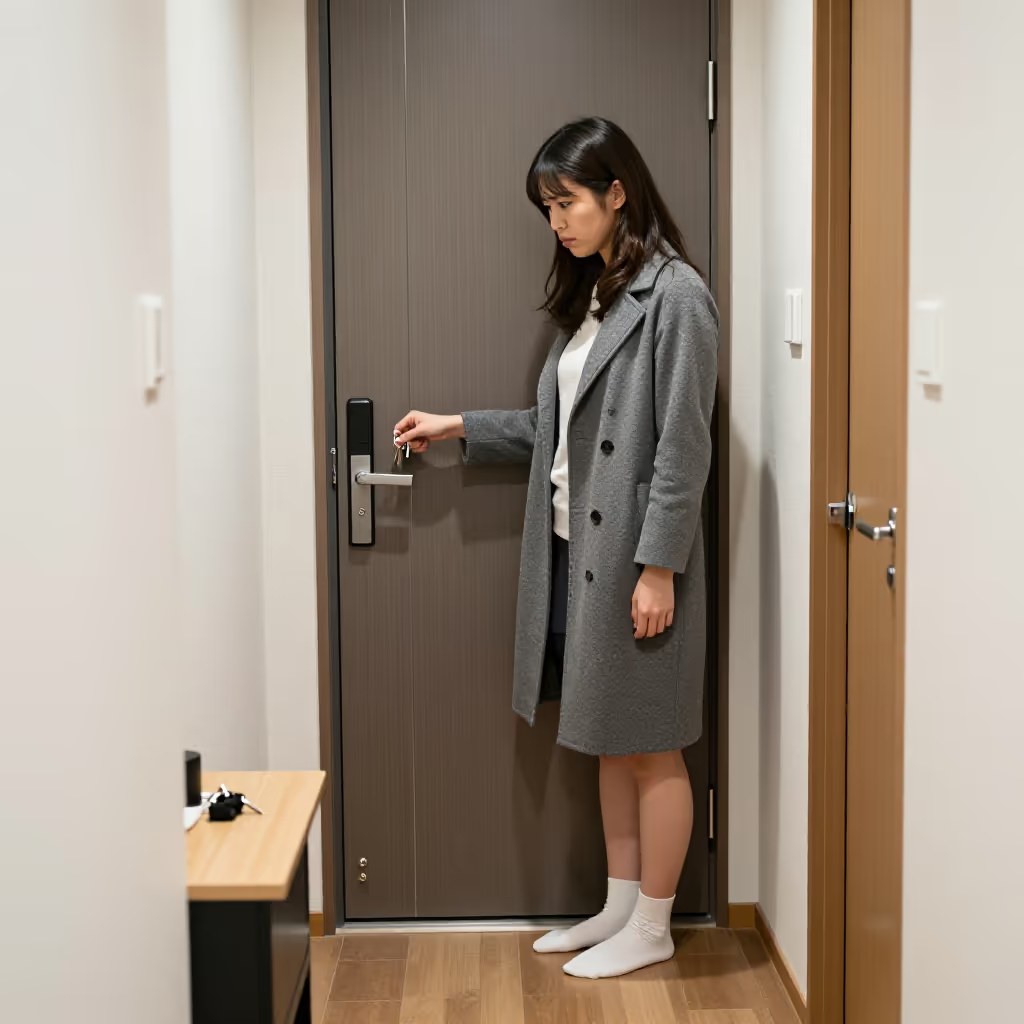
to lock oneself out
To unintentionally make it impossible to get back into one's own apartment or room because the door has shut and one does not have the key.
Ich habe mich gestern Abend aus meiner Wohnung ausgeschlossen und musste den Schlüsseldienst rufen.
I locked myself out of my apartment yesterday evening and had to call the locksmith.
'Ausschließen' is a separable verb. The prefix 'aus' goes at the end in a main clause. In a subordinate clause, the verb stays together.
Der Schiedsrichter schloss den Spieler nach dem Foul aus.
The referee excluded the player after the foul.
The verb is made up of 'aus' (out) and 'schließen' (to close, to lock). The literal meaning is therefore to leave someone or something outside by closing the door.
Er hat den Hund aus dem Schlafzimmer ausgeschlossen.
He kept the dog out of the bedroom.
When you exclude someone from an activity or group, the preposition 'von' is used with the dative. The structure is: 'jemanden von etwas ausschließen' (to exclude someone from something).
Sie wurde von der weiteren Teilnahme am Wettbewerb ausgeschlossen.
She was excluded from further participation in the competition.
To describe a possibility as unlikely, the construction 'nicht ausschließen können, dass ...' (not be able to rule out that ...) is often used. It is followed by a subordinate clause.
Ich kann nicht ausschließen, dass ich einen Fehler gemacht habe.
I can't rule out that I made a mistake.
The reflexive form 'sich ausschließen' has a very specific, everyday meaning: you have closed the door behind you and forgotten the key.
Sei vorsichtig mit der Tür, damit du dich nicht ausschließt.
Be careful with the door so you don't lock yourself out.
to block / to ban
Ausschließen and sperren can both prevent someone from taking part in an activity. „Ausschließen“ emphasizes that the person no longer belongs or is not allowed to participate; „sperren“ sounds more like an imposed, often temporary sanction. Use „ausschließen“ for removal from participation and „sperren“ for a ban on participation as a punishment.

Der Verein schloss den Spieler wegen seines Verhaltens vom Wettbewerb aus.
The club excluded the player from the competition because of his behavior.
Der Verband sperrte den Spieler wegen seines Verhaltens für drei Spiele.
The association suspended the player for three games because of his behavior.