

ausrüsten
to equip
To provide someone or something with the necessary equipment, devices, or tools for a specific purpose.
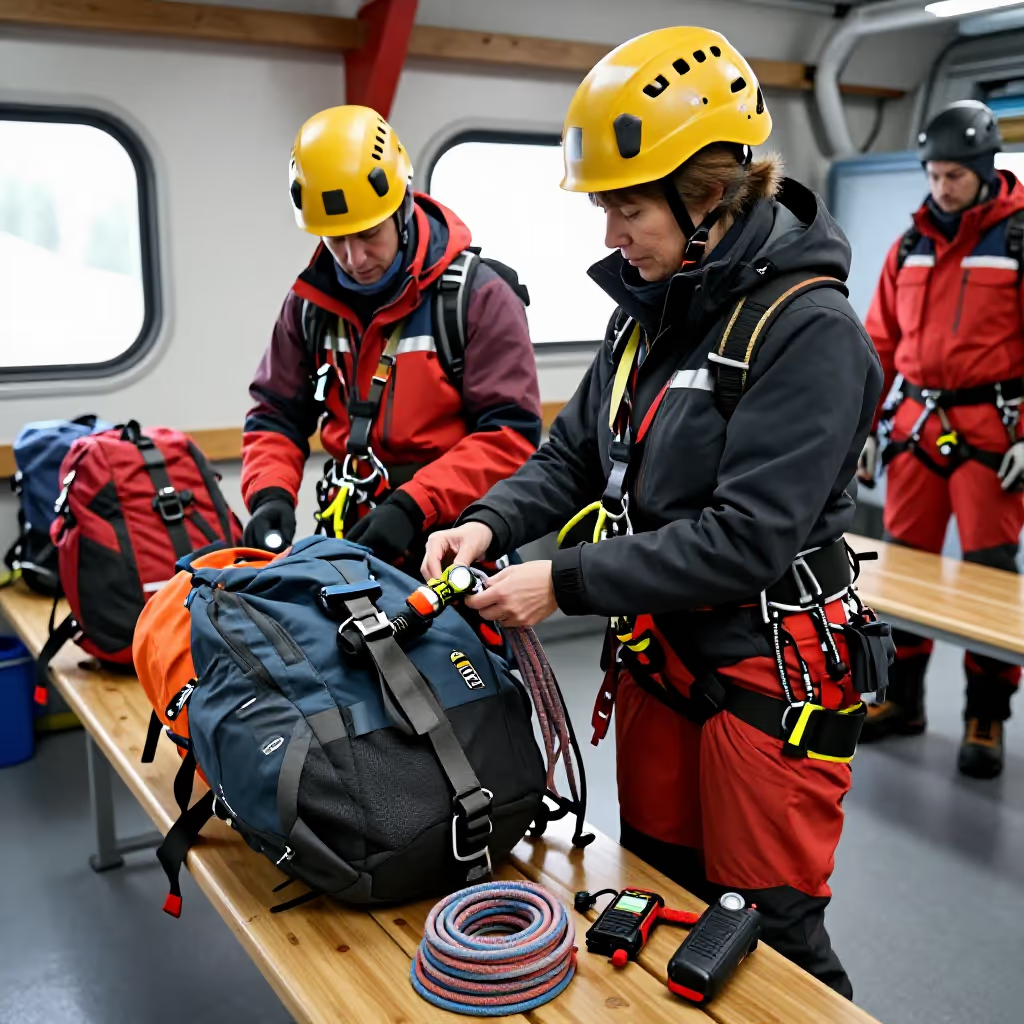
Die Bergsteiger waren für die Expedition bestens ausgerüstet.
The mountaineers were excellently equipped for the expedition.
to equip
Loading your saved state.
to equip
To provide someone or something with the necessary equipment, devices, or tools for a specific purpose.
Die Bergsteiger waren für die Expedition bestens ausgerüstet.
The mountaineers were excellently equipped for the expedition.

'Ausrüsten' is a separable verb. The prefix 'aus' comes at the end in a main clause. In subordinate clauses and in the infinitive, the verb stays together.
Die Firma rüstet alle Mitarbeiter mit neuen Laptops aus.
The company equips all employees with new laptops.
The verb follows a fixed pattern: Man rüstet jemanden (Akkusativ) mit etwas (Dativ) aus (you equip someone [accusative] with something [dative]). The preposition 'mit' (with) is very important here for naming the equipment.
Wir haben das Labor mit den modernsten Geräten ausgerüstet.
We equipped the laboratory with the most modern devices.
The past participle 'ausgerüstet' (equipped) is very often used like an adjective, often in the combination 'gut', 'schlecht', or 'voll ausgerüstet sein' (to be well, poorly, or fully equipped).
Das Rettungsteam ist für alle Notfälle bestens ausgerüstet.
The rescue team is excellently equipped for all emergencies.
The noun belonging to this verb is 'die Ausrüstung' (equipment). It refers to the complete set of items with which someone or something is provided for a purpose.
Für die Bergtour benötigen wir eine spezielle Ausrüstung.
For the mountain tour, we need special equipment.
to provide / to be mistaken
'versehen' and 'ausrüsten' can both mean that someone or something gets something that is needed. 'ausrüsten' is used especially when talking about equipment, tools, or other gear for a specific purpose, for example for a trip, work, or an operation. 'versehen mit' is more general and can also refer to labels, notices, or individual additions. Learners may confuse the words because 'versehen' can appear in the explanation of 'ausrüsten'. When preparation for a purpose is the main point, 'ausrüsten' is more precise. When something is simply being added, 'versehen' often fits.

Für die lange Wanderung rüstet Max seinen Rucksack mit Lampe, Wasser und Karte aus.
For the long hike, Max equips his backpack with a flashlight, water, and a map.
Meine Kollegin versieht die Akten vor dem Termin mit farbigen Markierungen.
Before the appointment, my colleague marks the files with colored labels.