

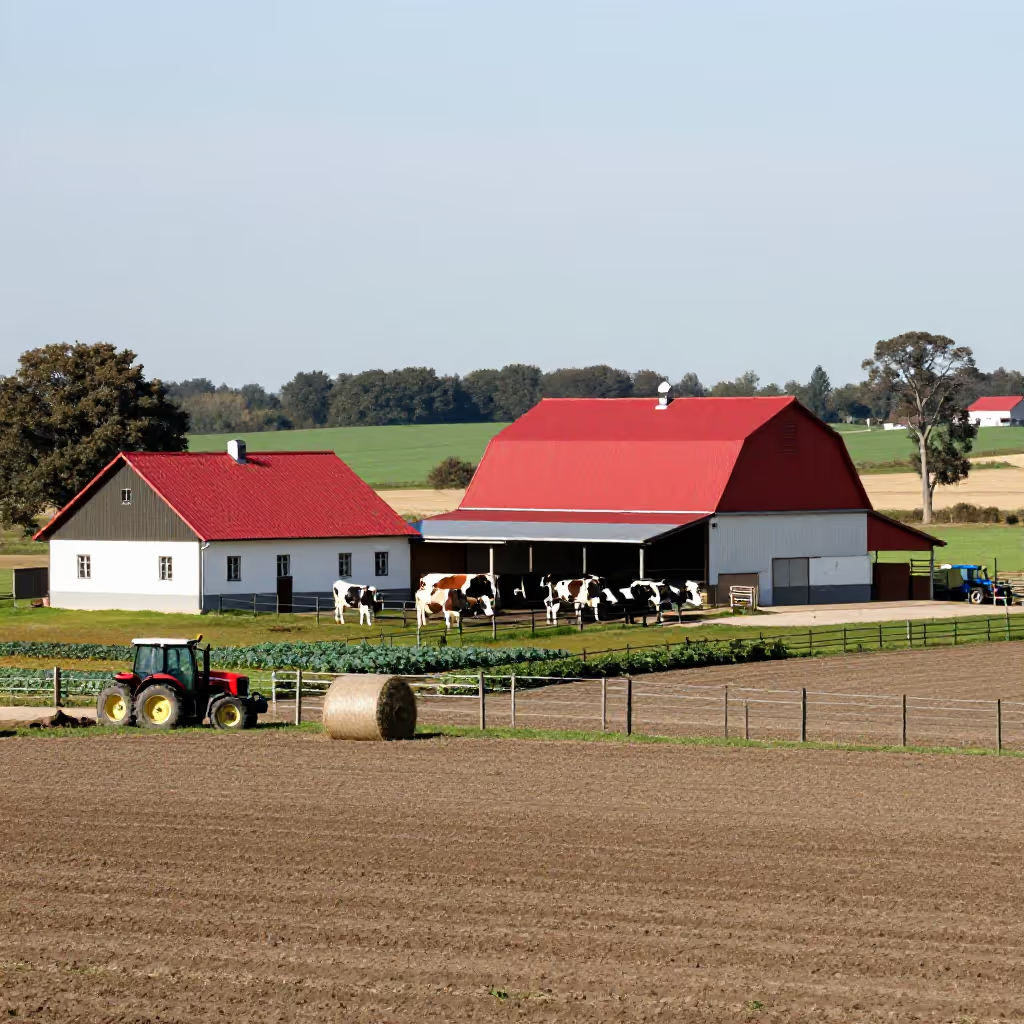
An agricultural business with a residential house, stables, barns, and fields where crops are grown and/or livestock is raised.
example
Die Kinder lieben es, in den Ferien auf dem Bauernhof die Tiere zu füttern.
The children love feeding the animals on the farm during the holidays.

Usage tips
Compound word
'Bauernhof' (farm) is a compound noun made up of 'der Bauer' (farmer) and 'der Hof' (courtyard, farmstead). The '-n-' in between is a linking element that connects the two words.
EXAMPLE
Ein moderner Bauernhof hat oft spezialisierte Maschinen.
A modern farm often has specialized machines.
Correct preposition
The most important preposition is 'auf'. A distinction is made between location (Wo? → dative) and direction (Wohin? → accusative).
EXAMPLE
Wir verbringen das Wochenende auf dem Bauernhof.
We are spending the weekend on the farm.
Typical collocations
Common verbs used in connection with 'Bauernhof' (farm) are 'leben' (to live), 'arbeiten' (to work), or 'aufwachsen' (to grow up). A very popular collocation is 'Urlaub auf dem Bauernhof machen' (to take a farm vacation).
EXAMPLE
Viele Stadtkinder machen gerne Urlaub auf dem Bauernhof.
Many city children enjoy taking farm vacations.
Compare with
near_synonym · confusable
Bauernhof vs Hof
yard / farm / court
'Hof' and 'Bauernhof' can both mean a farm. 'Bauernhof' is unambiguous: it is about agriculture, animals, stables, barns, or fields. 'Hof' can mean the same thing in this sense, but it is shorter and depends more strongly on context. In addition, 'Hof' has other meanings, such as courtyard or schoolyard. That is why learners can easily confuse the words. If it is not clear that you are talking about agriculture, 'Bauernhof' is more precise. 'Hof' sounds natural when the context is already clear.
Bauernhof
In den Ferien besuchen die Kinder einen Bauernhof mit vielen Tieren.
During the holidays, the children visit a farm with many animals.
Hof
Nach dem Frühstück hilft Karim seinem Onkel auf dem Hof.
After breakfast, Karim helps his uncle on the farm.