


benennen
to name
To give someone or something a name.
EXAMPLE
Die Straße wurde nach einer berühmten Wissenschaftlerin benannt.
The street was named after a famous scientist.
to name / specify
Loading your saved state.
to name
To give someone or something a name.
Die Straße wurde nach einer berühmten Wissenschaftlerin benannt.
The street was named after a famous scientist.

to specify / name
To call something clearly and explicitly by name, to specify it, or to list it.
Können Sie bitte die drei Hauptgründe für Ihre Entscheidung benennen?
Could you please name the three main reasons for your decision?
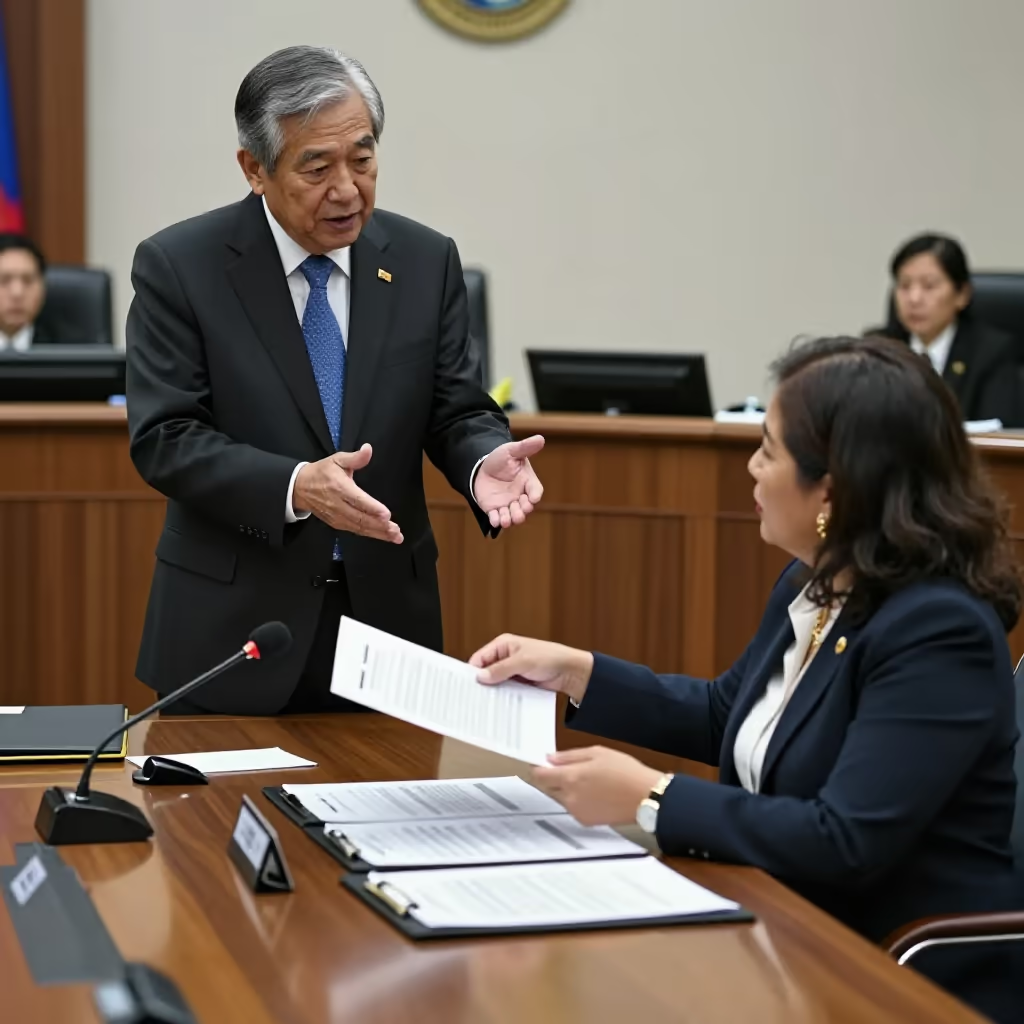
to appoint / nominate
To designate or propose someone for an office, position, or task.
Der Verein wird bald einen neuen Vorsitzenden benennen.
The association will soon appoint a new chairperson.
'Benennen' (to name/specify/appoint) is an inseparable verb. The prefix 'be-' remains firmly attached to the stem 'nennen' (to call/name) in all tenses and sentence constructions.
Er benannte die Datei falsch.
He named the file incorrectly.
You can recognize the meaning from context: the preposition 'nach' (after) points to giving a name. Abstract nouns like 'Gründe' (reasons) or 'Probleme' (problems) point to specifying. An office or position as the object points to appointing a person.
Das Institut wurde nach Marie Curie benannt.
The institute was named after Marie Curie.
When you give someone or something a name based on another person or thing, use the structure 'etwas nach jemandem/etwas benennen' (to name something after someone/something). The person or thing serving as the model is in the dative.
Sie haben ihr Kind nach dem Großvater benannt.
They named their child after the grandfather.
In the meaning 'spezifizieren' (to specify), 'benennen' (to specify/name) is often used with abstract nouns. Typical combinations are 'die Gründe benennen' (to name the reasons), 'die Ziele benennen' (to state the goals), 'die Ursachen benennen' (to identify the causes), or 'die Unterschiede benennen' (to name the differences).
Im Meeting müssen wir die nächsten Schritte klar benennen.
In the meeting, we need to clearly specify the next steps.
When someone is appointed to an office, the structure 'jemanden als [Position] benennen' (to name someone as [position]) or 'jemanden zum/zur [Position] benennen' (to appoint someone to the position of [position]) is often used.
Die Partei benannte sie als Kandidatin für die Wahl.
The party nominated her as a candidate for the election.
to call / name
Nennen and benennen can both mean giving someone or something a name. However, benennen places more emphasis on deliberately assigning or establishing a name, while nennen can also simply mean stating or using a name. benennen is therefore often the better choice when a conscious naming decision is involved.

Auf der Sitzung benannte die Leiterin das neue Projekt „Morgenstern“.
At the meeting, the director named the new project “Morgenstern.”
Auf der Sitzung nannte die Leiterin das neue Projekt „Morgenstern“.
At the meeting, the director called the new project “Morgenstern.”