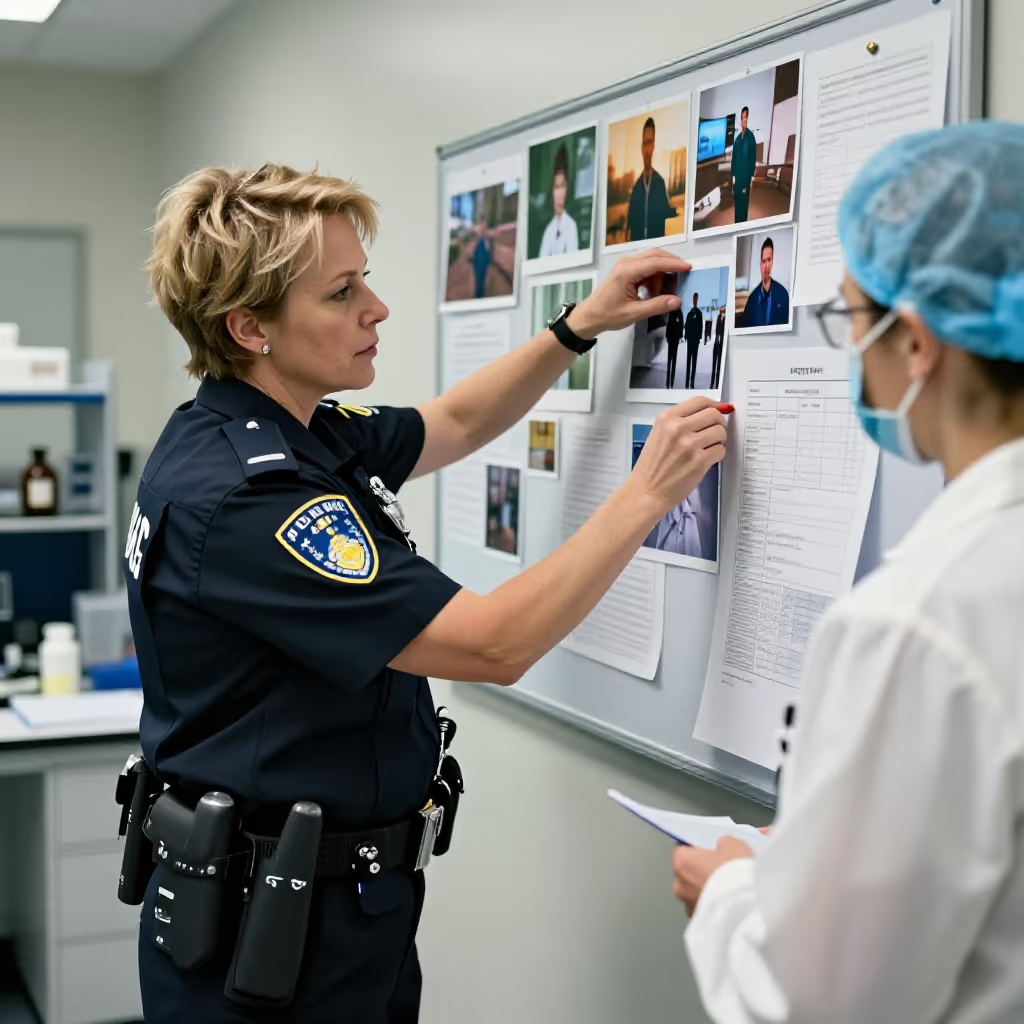
To find out facts or information through an investigation or research. Often used in the context of the police, the justice system, or science.
example
Die Polizei ermittelt noch die genaue Ursache des Unfalls.
The police are still investigating the exact cause of the accident.

Usage tips
Word structure
The verb is made up of the prefix 'er-' (result) and the stem of 'Mittel' (method, means). 'Ermitteln' (to determine / investigate) therefore means to find something out by using methods or means.
EXAMPLE
Die Wissenschaftler ermitteln die Daten durch eine lange Versuchsreihe.
The scientists determine the data through a long series of experiments.
Context clue
The context reveals the meaning: If it is about crimes, causes, or perpetrators, it refers to a police investigation. If it is about numbers, values, or results, it refers to calculation.
EXAMPLE
Die Polizei ermittelt den Täter.
The police are investigating the perpetrator.
Preposition 'gegen'
When an investigation is being conducted against a specific person or group, the preposition 'gegen' (against) is used with the accusative. This is a very common construction in news and reports.
EXAMPLE
Die Staatsanwaltschaft ermittelt gegen den Geschäftsführer der Firma.
The public prosecutor's office is investigating the managing director of the company.
Typical collocations
In a police or legal context, 'ermitteln' (to investigate) is often used with certain nouns, e.g. 'die Ursache ermitteln' (to determine the cause), 'den Täter ermitteln' (to identify the perpetrator), or 'in einem Mordfall ermitteln' (to investigate a murder case).
EXAMPLE
Die Detektive ermitteln in einem komplizierten Fall von Betrug.
The detectives are investigating a complicated case of fraud.
Compare with
near_synonym
ermitteln vs Erfahrung
experience
'in Erfahrung bringen' (to find out) and 'ermitteln' both mean that you find something out. 'in Erfahrung bringen' is a fixed expression and sounds rather general: you ask around, look for information, or try to learn something. 'ermitteln' sounds more precise and often more official or technical. It fits especially in contexts involving the police, research, measurement, or calculation. In everyday life, you are more likely to say 'Ich will in Erfahrung bringen, wann der Termin ist' (I want to find out when the appointment is). In an investigation or when establishing a result, 'ermitteln' is more natural.
ermitteln
Die Polizei ermittelt, wer den Unfall verursacht hat.
The police are investigating who caused the accident.
Erfahrung
Ich möchte in Erfahrung bringen, ob der Kurs nächste Woche beginnt.
I would like to find out whether the course starts next week.