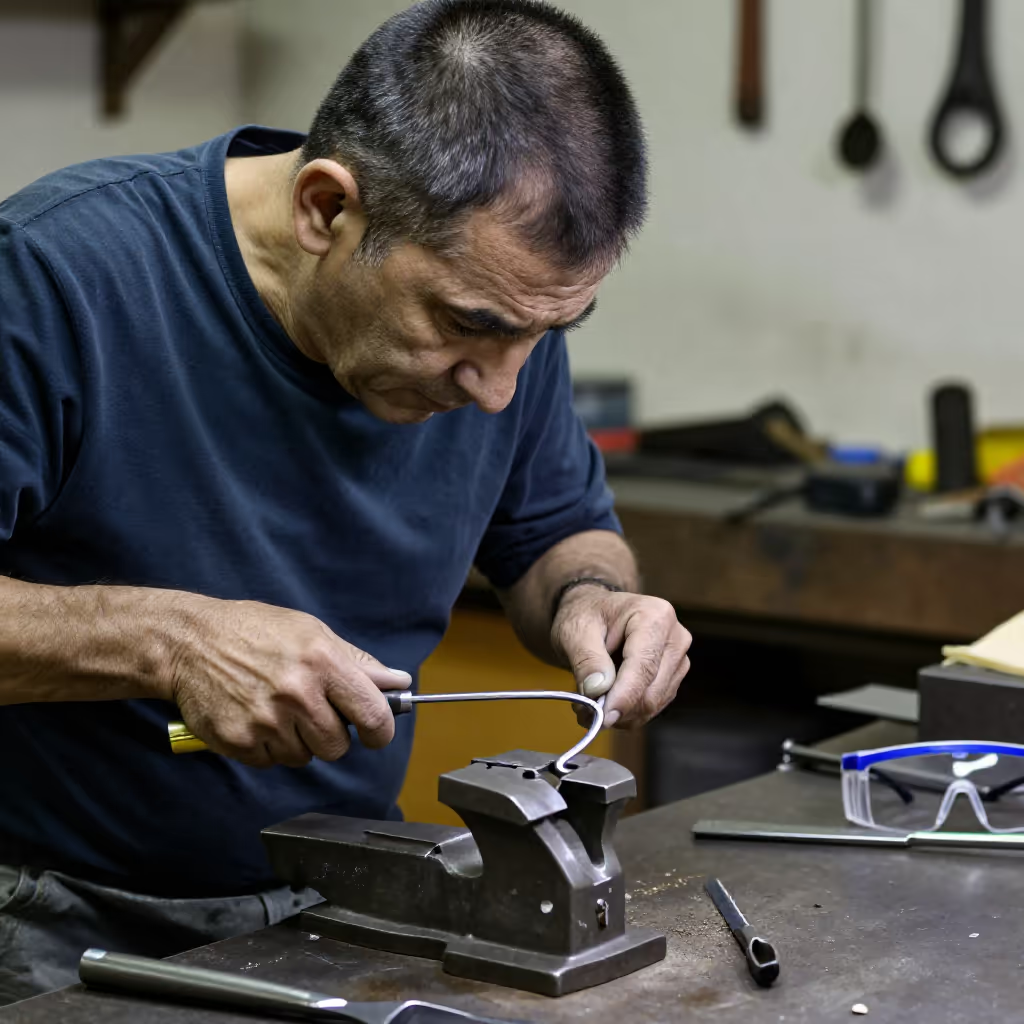
To change the shape of an object by applying force so that it gets a curve or a kink.
example
Der Schlosser musste das Eisenrohr biegen, damit es um die Ecke passt.
The locksmith had to bend the iron pipe so that it would fit around the corner.

Usage tips
Auxiliary verb: haben vs. sein
The perfect tense of 'biegen' (to bend) is formed differently depending on the meaning. When you bend an object, you use 'haben'. When you change direction ('um die Ecke biegen' — to turn the corner), you use 'sein' because it indicates movement.
EXAMPLE
Er hat den Löffel mit reiner Gedankenkraft gebogen.
He bent the spoon using pure mind power.
Fixed expression
The meaning 'die Richtung ändern' (to change direction) is used almost exclusively in the fixed expression 'um die Ecke biegen' (to turn the corner). The preposition 'um' is a fixed part of the phrase here.
EXAMPLE
Warte hier, ich biege nur kurz um die Ecke zum Bäcker.
Wait here, I'm just turning the corner quickly to go to the bakery.
Reflexive expression
To express that someone is laughing very hard, you use the reflexive expression 'sich biegen vor Lachen' (to double over laughing). The preposition 'vor' indicates the reason here.
EXAMPLE
Wir haben uns bei dem Witz alle vor Lachen gebogen.
We were all doubled over laughing at the joke.
Separable verb 'hinbiegen'
In the colloquial meaning 'etwas korrigieren' (to correct something), the separable verb 'hinbiegen' is used. The prefix 'hin-' separates from the verb in a main clause and stands at the end.
EXAMPLE
Das war ein großer Fehler, aber keine Sorge, das biegen wir schon wieder hin.
That was a big mistake, but don't worry, we'll fix it somehow.
Compare with
near_synonym · confusable
biegen vs richten
to direct / to fix
'richten' and 'biegen' can both have to do with the shape or condition of something. 'biegen' means that you make something crooked or curve it, for example wire or metal. 'richten' here means more that you bring something back into the right condition, often straight, tidy, or repaired. They can be especially confusing with bent objects: you 'biegen' an object in order to change its shape; you 'richten' it when it is supposed to be right again afterward. Colloquially, 'etwas hinbiegen' can also mean to somehow solve a difficult matter.
biegen
Für das Bastelprojekt bog Anna den Draht zu einem kleinen Kreis.
For the craft project, Anna bent the wire into a small circle.
richten
Nach dem Sturm hat Paul den schiefen Zaun wieder gerichtet.