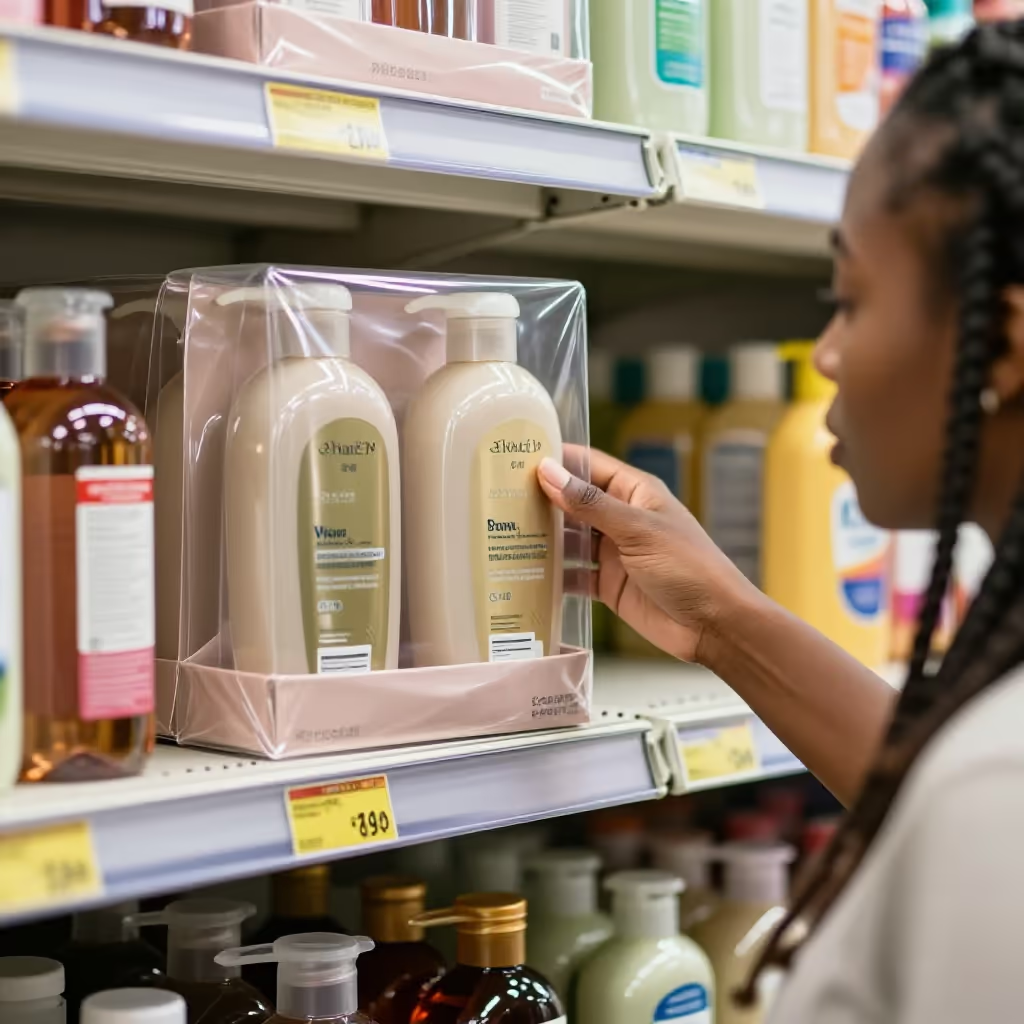
A sales package that contains two identical or related products. It is often offered at a lower price than two individual products.
example
Die Zahnpasta gibt es diese Woche im günstigen Doppelpack.
The toothpaste is available this week in a discounted double pack.

Usage tips
Word formation
This word is simply made up of 'doppel' (double) and 'der Pack' (an old form for package). So the literal meaning is 'double package'.
EXAMPLE
Ich kaufe die Batterien immer im Doppelpack, das ist billiger.
I always buy batteries in a double pack; it's cheaper.
Context clue
The context reveals the meaning: in a supermarket, it refers to products. In a sports report, it refers to two goals. When talking about people, it means two people who are always together.
EXAMPLE
Im Supermarkt: „Die Kekse gibt es heute im Doppelpack.“
In the supermarket: “The cookies are available today in a double pack.”
Use with 'im'
When it is about products, the preposition 'im' is almost always used. You buy something 'im Doppelpack' (in a double pack), or something is offered 'im Doppelpack' (in a double pack).
EXAMPLE
Die Socken werden nur im Doppelpack verkauft.
The socks are sold only in double packs.
Fixed expressions in sports
In a sports context, there are fixed verbs used with 'Doppelpack'. The most common are 'einen Doppelpack erzielen' (to score a brace) or, somewhat more colloquially, 'einen Doppelpack schnüren' (to bag a brace).
EXAMPLE
Mit seinem Doppelpack sicherte er den Sieg für seine Mannschaft.
With his brace, he secured the victory for his team.
Colloquial use
The term for two people is colloquial and often meant humorously. You say they 'treten im Doppelpack auf' (appear as a duo) or are 'ein unzertrennlicher Doppelpack' (an inseparable duo).
EXAMPLE
Meine beiden besten Freunde sind seit der Schulzeit ein echter Doppelpack.
My two best friends have been a real duo since school.
Compare with
near_synonym · confusable
Doppelpack vs Paar
pair / couple
'das Paar' and 'der Doppelpack' both have to do with two things or people that belong together. 'das Paar' is neutral and very general: it can mean two socks, two people in a relationship, or two partners in an activity. 'der Doppelpack' is often used for products that are sold together, or colloquially and jokingly for two people who almost always appear together. Learners may confuse the words because both express 'two'. For normal relationships or two matching things, 'Paar' is more natural. 'Doppelpack' sounds more specific, often connected to shopping or humor.
Doppelpack
Im Supermarkt habe ich Zahnpasta im Doppelpack gekauft.
I bought toothpaste in a double pack at the supermarket.
Paar
Im Schrank liegt noch ein sauberes Paar Socken.
There is still a clean pair of socks in the wardrobe.