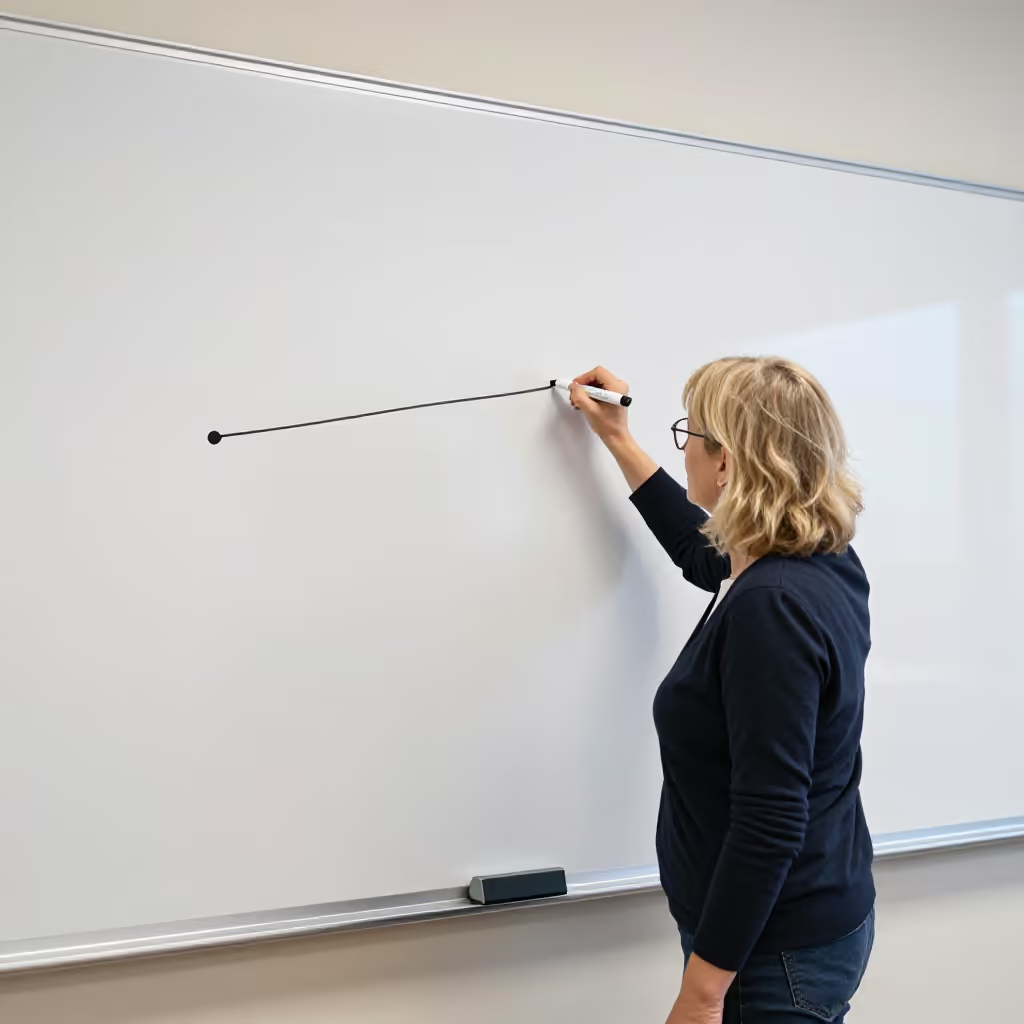
To carry out a plan or activity consistently to the end despite difficulties or interruptions. This is often used in a colloquial context.
example
Egal was passiert, wir ziehen das Projekt jetzt bis zum Ende durch.
No matter what happens, we're going to follow this project through to the end now.

Usage tips
Separable verb
'Durchziehen' is a separable verb. The prefix 'durch' comes at the end in a main clause. In subordinate clauses and in the infinitive with 'zu', the verb stays together.
EXAMPLE
Wir ziehen den Plan konsequent durch.
We are following the plan through consistently.
Word structure
The verb consists of the prefix 'durch' and the verb 'ziehen' (to pull, to move). The prefix emphasizes that an action or movement is carried out completely through something or to the end.
EXAMPLE
Ein Geruch von frisch gebackenem Brot zog durch das ganze Haus.
A smell of freshly baked bread passed through the whole house.
Typical collocations
In the meaning 'to finish something consistently', 'durchziehen' is often used with abstract nouns such as 'ein Projekt' (a project), 'einen Plan' (a plan), or colloquially 'ein Ding' (a thing).
EXAMPLE
Sie hat sich entschieden, ihr Studium trotz der Schwierigkeiten durchzuziehen.
She decided to follow through with her degree despite the difficulties.
Context clue
When the meaning involves movement, the subject is often impersonal, for example 'Wind' (wind), 'ein Geruch' (a smell), or 'eine Menschenmenge' (a crowd). It describes passing through a space.
EXAMPLE
Eine kalte Luftströmung zog durch den Flur.
A cold current of air passed through the hallway.
Use in cooking
In the context of cooking and food, 'durchziehen' is often combined with the verb 'lassen' (to let). You let a dish or drink stand so that the flavor can develop.
EXAMPLE
Man sollte den Salat eine halbe Stunde durchziehen lassen.
You should let the salad infuse for half an hour.
Sentence structure
When guiding something through an opening, the structure is: 'etwas (Akkusativ) durch etwas (Akkusativ) durchziehen' — to pull/thread something (accusative) through something (accusative).
EXAMPLE
Er zog das Seil durch die kleine Öffnung.
He pulled the rope through the small opening.
Register: colloquial
The meaning 'to stay awake all night' is strongly colloquial. The phrase 'die Nacht durchziehen' (to pull an all-nighter) or simply 'durchziehen' is often used when the context is clear.
EXAMPLE
Für die Prüfungsvorbereitung mussten wir die ganze Nacht durchziehen.
We had to pull an all-nighter to prepare for the exam.
Compare with
near_synonym · confusable
durchziehen vs ziehen
to pull / move
'ziehen' and 'durchziehen' can both have to do with movement, with aroma, or with a line. 'ziehen' often describes a simple movement in one direction, or that tea releases its flavor in water. 'durchziehen' puts more emphasis on something going through a room, through an area, or from one point to another. With food, 'durchziehen' means that the flavor should work through the whole dish. Learners may confuse the words because both occur in similar situations. A helpful guide is: 'ziehen' is more general, while 'durchziehen' often emphasizes something continuous, going all the way through, or taking effect consistently until the end.
durchziehen
Die Suppe schmeckt morgen besser, wenn die Gewürze über Nacht durchziehen.
The soup will taste better tomorrow if the spices infuse overnight.
ziehen
Der Tee muss noch fünf Minuten ziehen, bevor wir ihn trinken.
The tea still needs to steep for five minutes before we drink it.