


die Eigenschaft
characteristic
A typical feature or character trait that distinguishes a person, object, or substance.
EXAMPLE
Geduld ist eine sehr nützliche Eigenschaft.
Patience is a very useful characteristic.
characteristic / capacity
Loading your saved state.
characteristic
A typical feature or character trait that distinguishes a person, object, or substance.
Geduld ist eine sehr nützliche Eigenschaft.
Patience is a very useful characteristic.
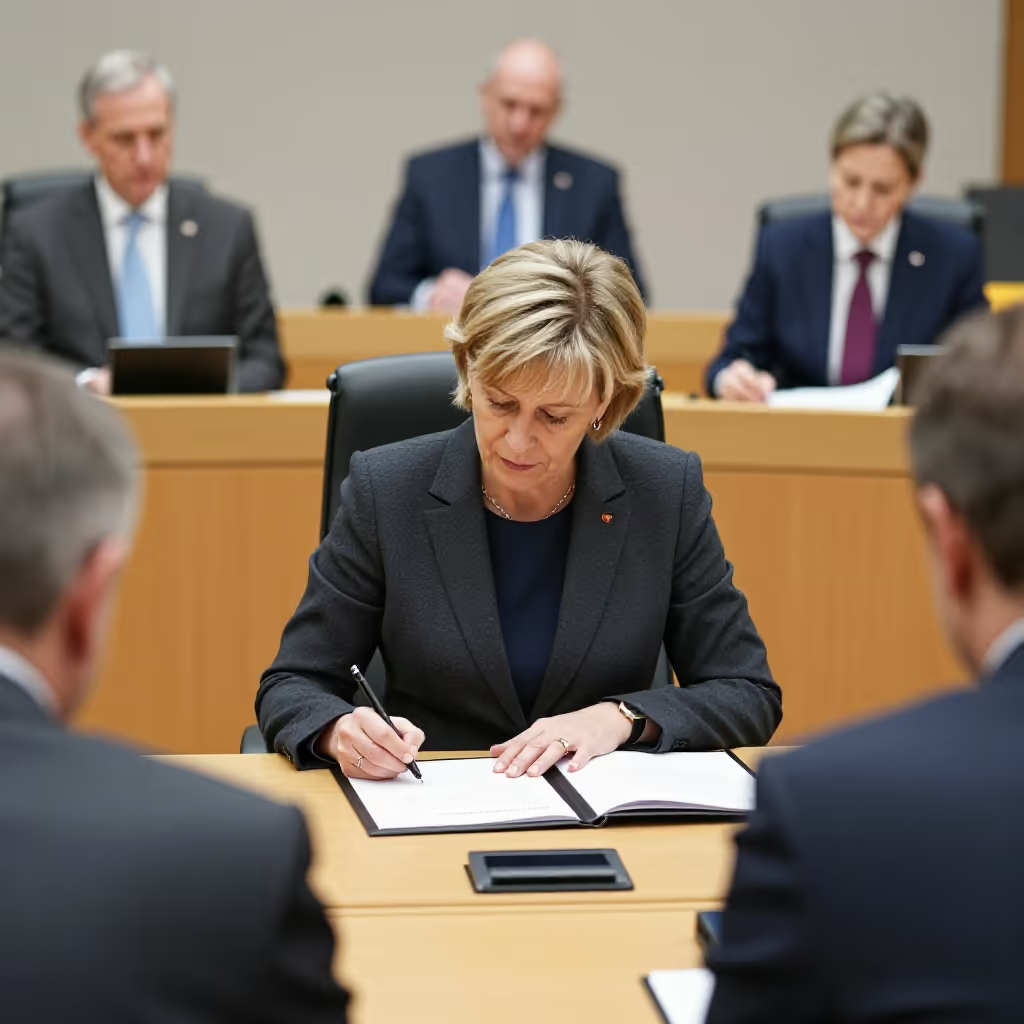
in one's capacity as
In a particular function, role, or position that someone holds. This expression is mostly used in formal contexts.
In seiner Eigenschaft als Vereinsvorsitzender eröffnete er die Versammlung.
In his capacity as club chairperson, he opened the meeting.
The word is made up of 'eigen' (own) and the suffix '-schaft' (-ship/-ness). It therefore describes something that is 'eigen' (inherent) to a person or object, meaning that it belongs to them or it.
Ehrlichkeit ist eine wichtige Eigenschaft für eine Freundschaft.
Honesty is an important characteristic for a friendship.
Common verbs are 'eine Eigenschaft haben' (to have a characteristic) or 'besitzen' (to possess). Adjectives that often come before it are 'positiv' (positive), 'negativ' (negative), 'gut' (good), 'schlecht' (bad), or 'charakteristisch' (characteristic).
Dieses Material hat die Eigenschaft, sehr leicht und trotzdem stabil zu sein.
This material has the characteristic of being very light and yet stable.
This meaning is used almost exclusively in the fixed expression 'in seiner/ihrer Eigenschaft als ...' (in his/her capacity as ...). It expresses that someone is acting in a particular official role or function.
In ihrer Eigenschaft als Ärztin riet sie ihm, sich auszuruhen.
In her capacity as a doctor, she advised him to rest.
The expression 'in seiner/ihrer Eigenschaft als' (in his/her capacity as) is very formal. You mainly find it in written language, in official speeches, or in legal contexts.
Der Bürgermeister begrüßte die Gäste in seiner Eigenschaft als Gastgeber.
The mayor welcomed the guests in his capacity as host.
role / roll
“Die Rolle” and “in seiner/ihrer Eigenschaft als” can both describe a person’s function or position. “Die Rolle” is neutral and common in everyday language and emphasizes the context, while “in seiner/ihrer Eigenschaft als” is a formal expression. The expression is appropriate in official texts; otherwise, “Rolle” is usually used.

In ihrer Eigenschaft als Vorsitzende begrüßt sie die Gäste.
In her capacity as chair, she welcomes the guests.
In ihrer Rolle als Vorsitzende begrüßt sie die Gäste.
In her role as chair, she welcomes the guests.