

entspringen
to spring
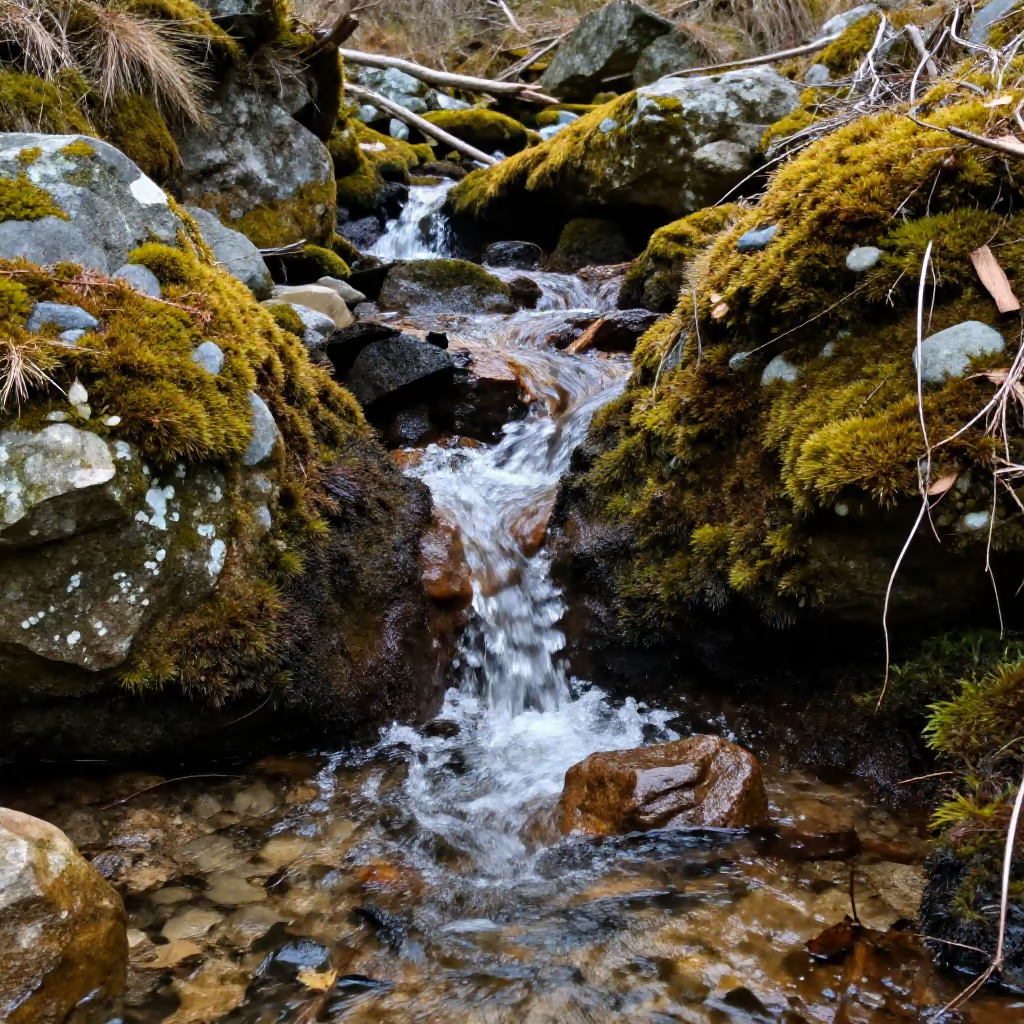
To emerge from the ground at a particular place as the source of a river or stream.
EXAMPLE
Der Rhein entspringt in den Schweizer Alpen.
The Rhine springs from the Swiss Alps.
to originate / to spring
Loading your saved state.
to spring
To emerge from the ground at a particular place as the source of a river or stream.
Der Rhein entspringt in den Schweizer Alpen.
The Rhine springs from the Swiss Alps.

to originate
In a figurative sense: to arise from something or have its origin in an idea, a situation, or a feeling.
Diese Idee entsprang einer langen Diskussion im Team.
This idea originated from a long discussion within the team.

to escape
(elevated, becoming archaic) To get away quickly in order to escape a danger or an unpleasant situation; to flee.
Er hoffte, der Gefahr noch rechtzeitig zu entspringen.
He hoped to escape the danger in time.
'Entspringen' (to originate / to spring) is an inseparable verb. The prefix 'ent-' remains firmly attached to the stem 'springen' in all sentence forms.
Man weiß nicht genau, wo dieser Fluss entspringt.
People don't know exactly where this river springs from.
The perfect tense of 'entspringen' (to originate / to spring) is always formed with the auxiliary verb 'sein' (to be). The verb describes an origin or a movement out of something.
Die Donau ist im Schwarzwald entsprungen.
The Danube has sprung from the Black Forest.
In the most common meanings (source of a river, origin of an idea), the origin is indicated with the preposition 'aus' and the dative.
Der Bach entspringt aus einer kleinen Quelle im Wald.
The stream springs from a small source in the forest.
When 'entspringen' (to spring) refers to geographical places (mountains, springs), the literal meaning is intended. If it refers to abstract nouns like 'Idee' (idea), 'Fantasie' (imagination), 'Notwendigkeit' (necessity), or 'Gefühl' (feeling), the figurative meaning is intended.
Der Amazonas entspringt in den Anden.
The Amazon springs from the Andes.
The meaning 'fliehen' (to flee/escape) is outdated and is now used only in elevated or literary language. It is very rare in normal usage.
Der Ritter konnte dem Kerker unbemerkt entspringen.
The knight was able to escape the dungeon unnoticed.
In the meaning 'fliehen' (to flee/escape), the thing one is fleeing from is in the dative. One escapes 'der Gefahr' (the danger) or 'dem Gefängnis' (the prison).
Er war froh, dieser unangenehmen Situation entsprungen zu sein.
He was glad to have escaped this unpleasant situation.
to originate
Stammen and entspringen can both name the origin of a problem, idea, or feeling. Stammen is a neutral statement of origin. Entspringen presents the origin metaphorically as a source, which makes it sound stronger or more elevated. Stammen is usually the better choice for a factual statement, while entspringen conveys this figurative nuance.

Seine Zweifel entspringen einer tiefen Angst vor neuen Enttäuschungen.
His doubts spring from a deep fear of further disappointments.
Seine Zweifel stammen aus früheren schlechten Erfahrungen.
His doubts stem from earlier bad experiences.