


erledigen
to take care of
To bring a task, job, or duty to an end or complete it.
EXAMPLE
Ich muss heute noch einige wichtige E-Mails erledigen.
I still have to take care of some important emails today.
to take care of / to finish
Loading your saved state.
to take care of
To bring a task, job, or duty to an end or complete it.
Ich muss heute noch einige wichtige E-Mails erledigen.
I still have to take care of some important emails today.

to take care of itself
A problem or matter resolves itself without you having to do anything about it.
Warte einfach ab, die Frage wird sich von selbst erledigen.
Just wait and see; the question will take care of itself.

to finish off
Colloquial for killing or defeating someone.
Der Auftragskiller sollte sein Ziel schnell und unauffällig erledigen.
The hitman was supposed to finish off his target quickly and discreetly.

to be wiped out
Colloquial for being completely exhausted or tired.
Nach der langen Wanderung war ich total erledigt.
After the long hike, I was totally wiped out.
The prefix 'er-' is inseparable. This means it remains firmly attached to the verb in all sentence forms and is not placed at the end of the sentence.
Sie erledigt ihre Hausaufgaben immer sofort.
She always takes care of her homework right away.
The verb consists of the prefix 'er-', which often indicates a result, and the stem 'ledig', which means 'free'. So 'erledigen' (to take care of/complete) literally means to make something 'free' or 'finished'.
Sobald ich diese Aufgabe erledigt habe, habe ich frei.
As soon as I have taken care of this task, I am free.
In everyday life, 'erledigen' (to take care of/complete) is often combined with tasks and duties. Typical phrases are 'Arbeit erledigen' (to get work done), 'Aufgaben erledigen' (to complete tasks), 'Einkäufe erledigen' (to do shopping), or 'Besorgungen erledigen' (to run errands).
Am Samstag muss ich noch ein paar Besorgungen in der Stadt erledigen.
On Saturday, I still have to run a few errands in town.
The reflexive form 'sich erledigen' (to take care of itself) means that a problem disappears on its own. The subject of the sentence is always the matter or problem, not a person.
Das Problem mit dem Drucker hat sich von selbst erledigt.
The problem with the printer took care of itself.
In the form 'erledigt sein' (to be wiped out), the past participle is used like an adjective and means 'completely exhausted'. This use is very common in colloquial language.
Nach dem langen Arbeitstag bin ich total erledigt.
After the long workday, I am totally wiped out.
to do / make
Both verbs can refer to a task. „Machen“ describes the activity in general and does not necessarily say whether it is finished; „erledigen“ emphasizes that the task is completed in full. „Machen“ fits work that is still in progress, while „erledigen“ is appropriate when completion is certain.
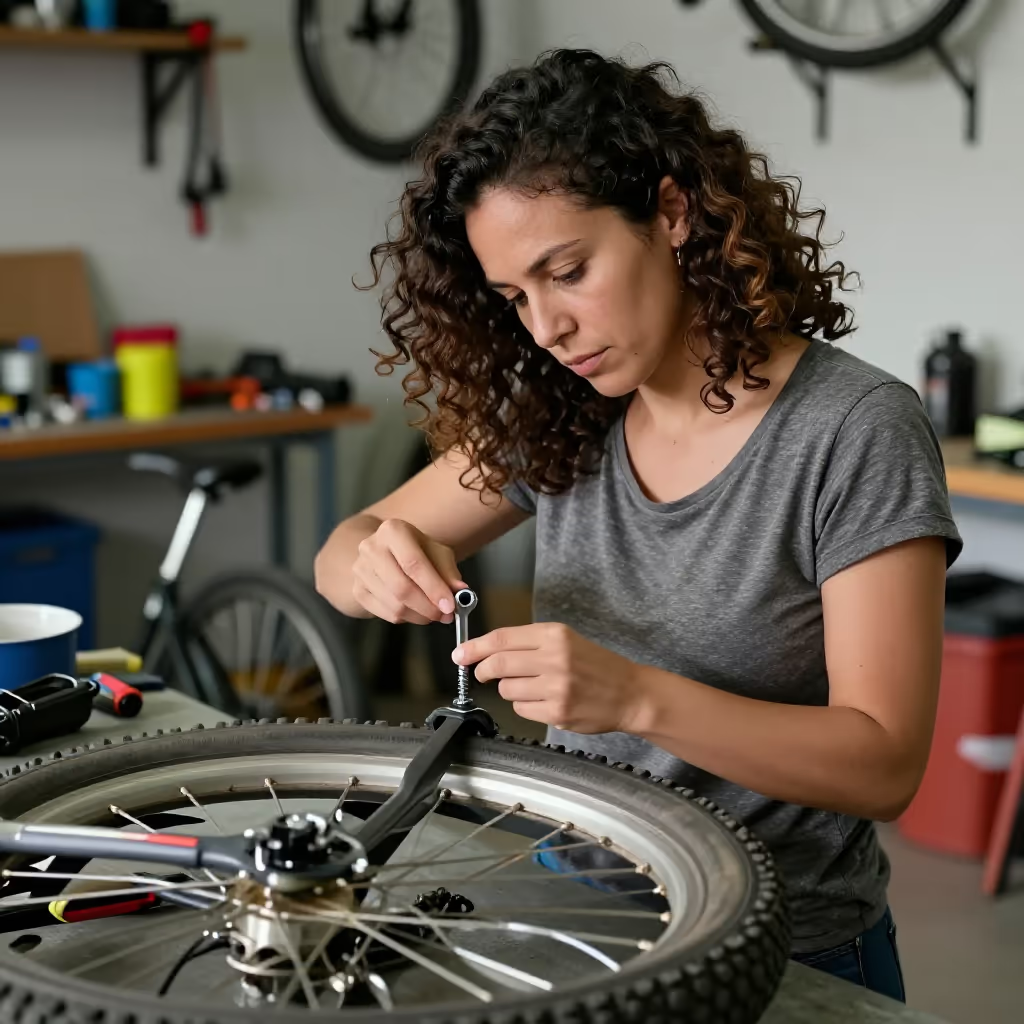
Ich erledige die Aufgabe noch vor dem Termin.
I’ll finish the task before the deadline.
Ich mache die Aufgabe gerade am Schreibtisch.
I’m doing the task at my desk right now.