


der Fall
case
A specific situation, circumstance, or concrete occurrence.
EXAMPLE
Das ist ein seltener Fall, der nicht oft vorkommt.
That is a rare case that does not occur often.
case / fall
Loading your saved state.
case
A specific situation, circumstance, or concrete occurrence.
Das ist ein seltener Fall, der nicht oft vorkommt.
That is a rare case that does not occur often.

case
A matter investigated by the police or a court, usually a crime.
Der Kommissar hat den Fall in nur zwei Tagen gelöst.
The detective solved the case in just two days.

definitely / definitely not
A fixed expression meaning 'absolutely' or 'under no circumstances'.
Du musst auf jeden Fall pünktlich sein.
You absolutely have to be on time.

fall
Downward movement caused by gravity; a fall.
Der Fall von der Leiter war zum Glück nicht so schlimm.
The fall from the ladder was fortunately not that bad.

case
In grammar, one of the inflectional forms (case) of nouns, pronouns, and adjectives.
Im Deutschen gibt es vier Fälle: Nominativ, Genitiv, Dativ und Akkusativ.
In German there are four cases: nominative, genitive, dative, and accusative.

in case
A conjunction that introduces a condition or precaution; in case.
Nimm einen Schirm mit, für den Fall, dass es regnet.
Take an umbrella with you in case it rains.
'Der Fall' does not mean the season autumn/fall. The English word 'fall' (autumn) is called 'der Herbst' in German.
Im Herbst werden die Blätter bunt.
In autumn, the leaves turn colorful.
The noun 'der Fall' is closely related to the verb 'fallen' (to fall). The literal meaning 'Sturz' (fall) as in 'der Fall von der Leiter' (the fall from the ladder) comes directly from this. Other meanings are metaphorical, such as a situation that 'zufällt' (falls to someone / comes someone's way).
Pass auf, dass du auf der nassen Treppe nicht fällst.
Be careful not to fall on the wet stairs.
The many meanings of 'Fall' can be recognized from context. If it is about the police or a crime, it refers to a criminal case. In the context of grammar, it means case. If it is about physical movement, it means a fall.
Der Detektiv übernahm einen neuen Fall.
The detective took on a new case.
The expressions 'auf jeden Fall' (definitely / in any case) and 'auf keinen Fall' (definitely not / under no circumstances) are fixed expressions. They function like adverbs and mean 'absolutely' or 'under no circumstances'.
Ich werde auf jeden Fall zur Party kommen.
I will definitely come to the party.
When 'auf jeden Fall' (definitely / in any case) or 'auf keinen Fall' (definitely not / under no circumstances) appears at the beginning of a sentence (position 1), the conjugated verb follows directly afterward in position 2.
Auf jeden Fall müssen wir heute noch einkaufen.
In any case, we still have to go shopping today.
The expression 'für den Fall, dass' (in case) introduces a subordinate clause. Therefore, the conjugated verb comes at the end of the clause.
Ich gebe dir meine Nummer, für den Fall, dass du Hilfe brauchst.
I'll give you my number in case you need help.
In a legal or police context, 'Fall' is often combined with verbs such as 'einen Fall lösen' (to solve a case), 'einen Fall untersuchen' (to investigate a case), or 'in einem Fall ermitteln' (to investigate in a case).
Die Polizei konnte den komplizierten Fall schnell lösen.
The police were able to solve the complicated case quickly.
thing / matter
Der Fall and die Sache can both be investigated or dealt with as legal matters. Der Fall focuses more on the specific incident under investigation, while die Sache refers more to the legal or formal matter that an authority is dealing with.
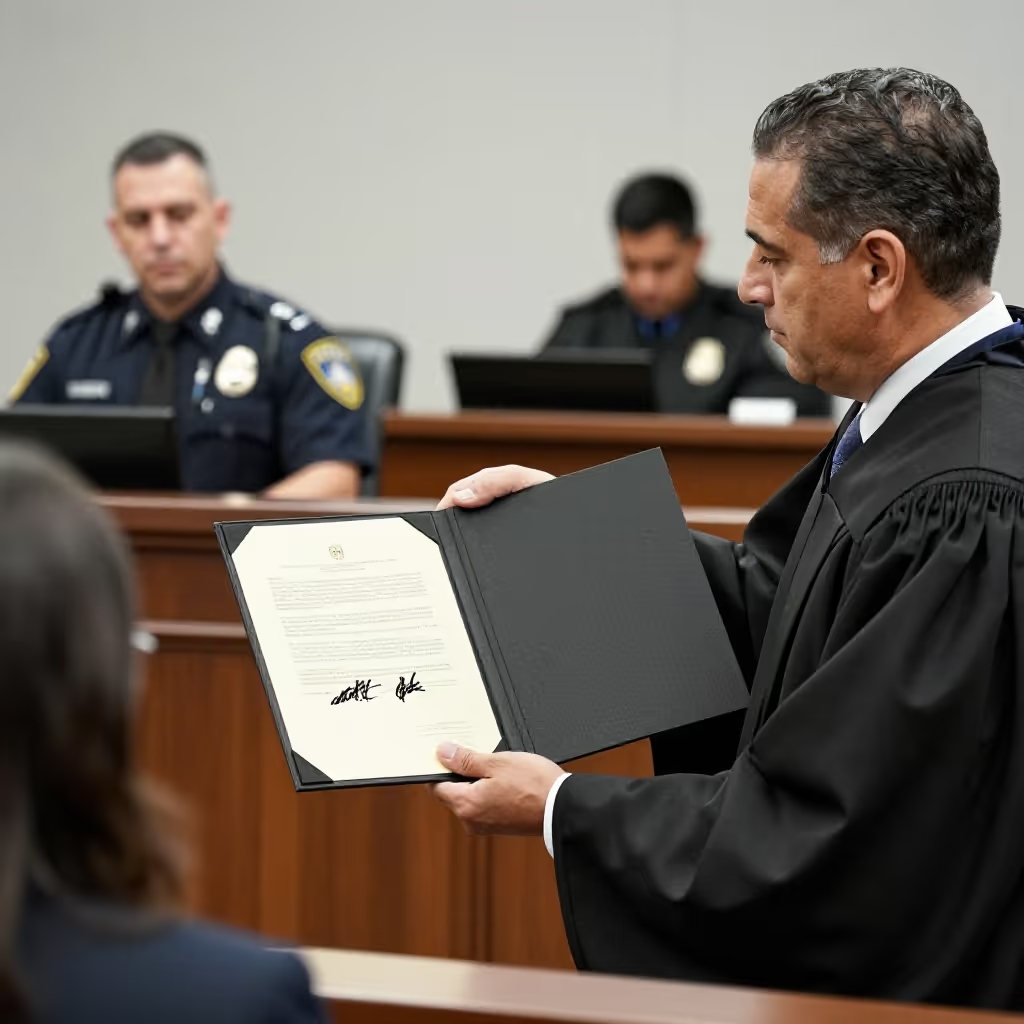
Die Polizei untersucht den Fall seit mehreren Monaten.
The police have been investigating the case for several months.
Das Gericht wird die Sache im nächsten Monat behandeln.
The court will deal with the matter next month.