


die Sache
thing
An unspecified object or thing.
EXAMPLE
Was ist das für eine komische Sache auf dem Tisch?
What is that strange thing on the table?
thing / matter
Loading your saved state.
thing
An unspecified object or thing.
Was ist das für eine komische Sache auf dem Tisch?
What is that strange thing on the table?

matter / issue
A matter, topic, or problem that is dealt with or discussed.
Das ist eine komplizierte Sache, die wir klären müssen.
That is a complicated matter that we need to sort out.

things / belongings
Usually used in the plural for personal items or possessions.
Pack bitte deine Sachen, wir fahren gleich los.
Please pack your things; we're leaving soon.

to get to the point
To stop talking around a topic and begin with the most important part.
Hör auf mit dem Smalltalk und komm endlich zur Sache!
Stop with the small talk and finally get to the point!
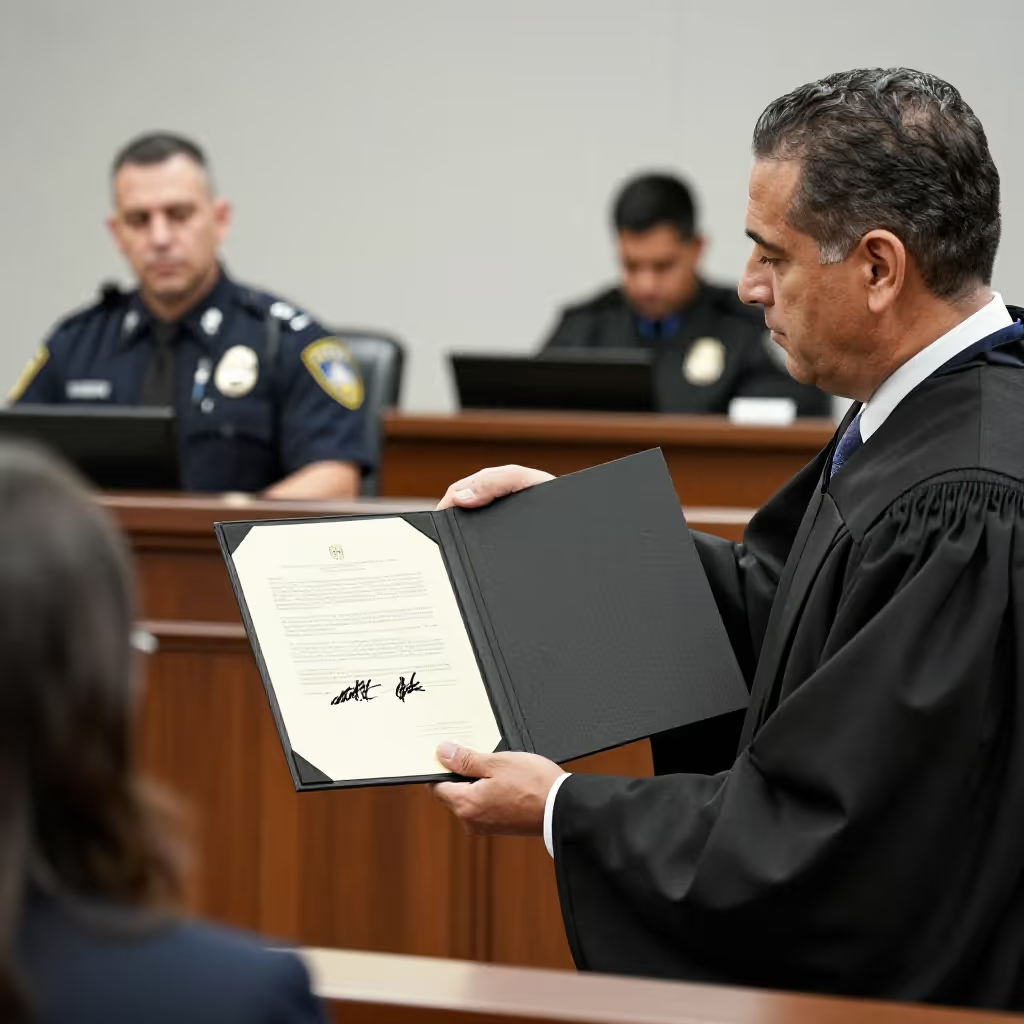
case / matter
A case or subject of a legal or formal investigation.
In dieser Sache hat das Gericht noch kein Urteil gefällt.
In this matter, the court has not yet reached a verdict.

to do a good job
To carry out a task or activity competently and successfully.
Mach dir keine Sorgen, sie ist sehr zuverlässig und wird ihre Sache gut machen.
Don't worry, she is very reliable and will do a good job.

not to be someone's thing
To express that something does not match one's interests, abilities, or responsibilities.
Gartenarbeit ist wirklich nicht meine Sache.
Gardening is really not my thing.
The meaning of 'Sache' (thing/matter) often changes with number. In the singular ('die Sache'), it usually means a single object or a matter. In the plural ('die Sachen'), it very often refers to personal belongings or luggage.
Das ist eine private Sache, über die ich nicht sprechen möchte.
That is a private matter that I don't want to talk about.
To distinguish between 'Gegenstand' (object) and 'Angelegenheit' (matter), pay attention to the context. If it is about a concrete, touchable object, it is a thing. If a problem or topic is being discussed, it is a matter.
Nimm diese klebrige Sache vom Sofa weg!
Take that sticky thing off the sofa!
When 'Sache' (matter) describes a matter or issue, it is often combined with adjectives that express an evaluation. Typical examples are: 'eine klare Sache' (a clear-cut matter), 'eine schwierige Sache' (a difficult matter), 'eine ernste Sache' (a serious matter), or 'eine tolle Sache' (a great thing).
Der Sieg der Mannschaft war am Ende eine klare Sache.
In the end, the team's victory was a clear-cut matter.
The idiom 'zur Sache kommen' (to get to the point) is a fixed unit. It is used to ask someone to say the most important thing and stop digressing.
Wir haben nicht viel Zeit, also lasst uns direkt zur Sache kommen.
We don't have much time, so let's get straight to the point.
The meaning 'Fall' (case) is found almost exclusively in legal or very formal contexts. Signal words here are 'Gericht' (court), 'Anwalt' (lawyer), 'Akte' (file), or 'Verfahren' (proceedings).
Der Anwalt prüft die Dokumente in dieser Sache sehr genau.
The lawyer is examining the documents in this matter very carefully.
In the expression 'seine Sache gut machen' (to do a good job), the possessive pronoun is adapted to the person. So you also say 'ich mache meine Sache gut' (I do a good job) or 'ihr macht eure Sache gut' (you all do a good job).
Der neue Mitarbeiter ist sehr motiviert und macht seine Sache wirklich gut.
The new employee is very motivated and is really doing a good job.
The phrase 'nicht jemandes Sache sein' (not to be someone's thing) is a fixed expression. The possessive pronoun ('meine', 'deine', 'seine', etc.) is adapted to the person you are talking about.
Ich helfe dir gern beim Kochen, aber Abwaschen ist nicht so meine Sache.
I'm happy to help you with cooking, but doing the dishes isn't really my thing.
question
Frage and Sache can both refer to a matter that still needs to be clarified. Frage highlights a specific open point for which an answer or decision is being sought; Sache refers to the matter more broadly. Frage is appropriate for a clearly formulated point requiring clarification, while Sache is more suitable for the topic as a whole.

Die Sache mit den Kosten müssen wir morgen in Ruhe besprechen.
We need to discuss the matter of the costs calmly tomorrow.
Die Frage, wer die Kosten übernimmt, müssen wir morgen klären.
We need to clarify the question of who will cover the costs tomorrow.