


sicher
sure
Being convinced of something; without doubt.
EXAMPLE
Ich bin mir sicher, dass ich die Tür abgeschlossen habe.
I'm sure that I locked the door.
sure / safe
Loading your saved state.
sure
Being convinced of something; without doubt.
Ich bin mir sicher, dass ich die Tür abgeschlossen habe.
I'm sure that I locked the door.

safe
Protected from danger or harm; not at risk.
In diesem Haus sind wir vor dem Sturm sicher.
In this house, we are safe from the storm.

surely
Used as an adverb to express a high probability or certainty; certainly, surely.
Er kommt sicher gleich zurück.
He'll surely be back in a moment.
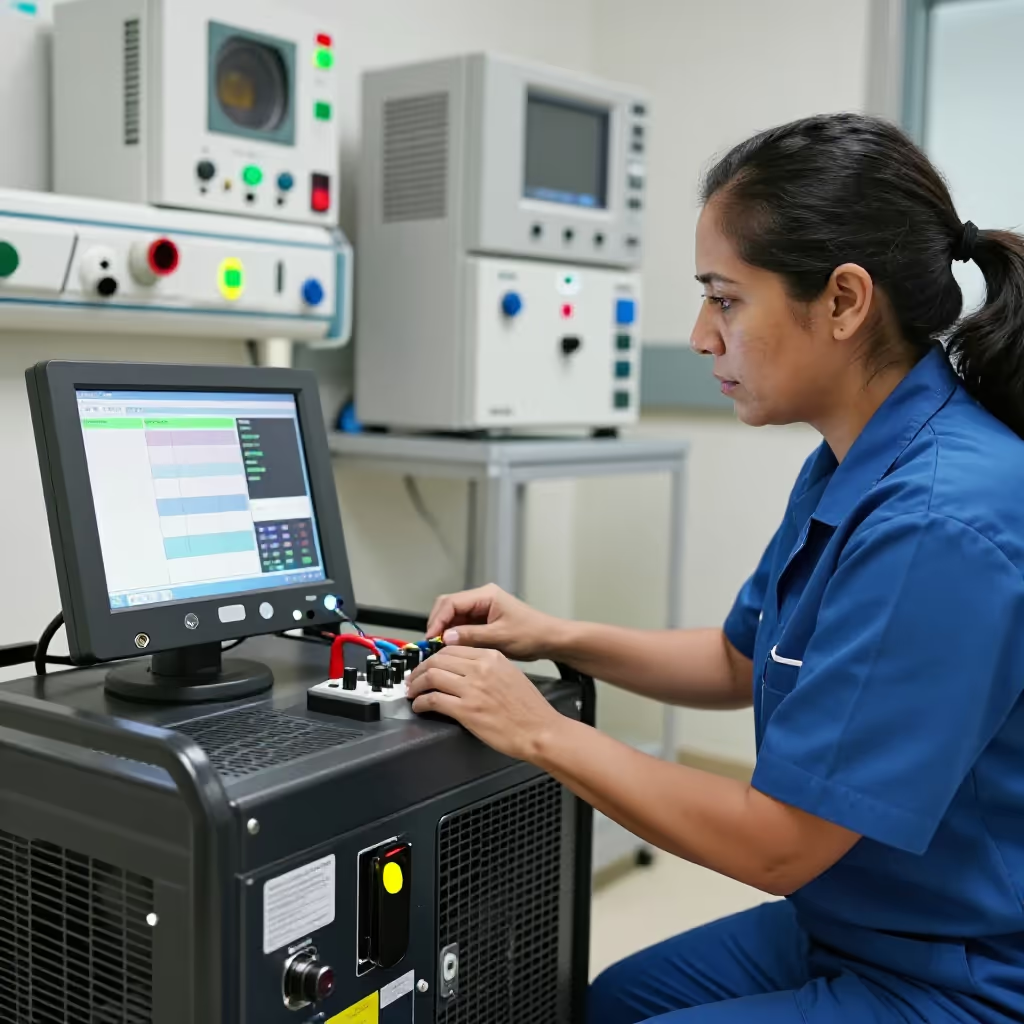
reliable / sure
Reliable, error-free, or guaranteed to work.
Das ist eine sichere Methode, um das Problem zu lösen.
That is a reliable method for solving the problem.
The adjective 'sicher' (sure/safe) is the basis for the noun 'die Sicherheit' (certainty/safety/security). This noun can mean both certainty and protection from danger, just like the adjective.
Die Sicherheit der Gäste hat für uns oberste Priorität.
The safety of the guests is our top priority.
When you want to express that you are convinced of something, you use the structure 'sich (Dativ) sicher sein' (to be sure). The reflexive pronoun in the dative is very important here.
Bist du dir sicher, dass du den Herd ausgemacht hast?
Are you sure that you turned off the stove?
To express what someone or something is protected from, the preposition 'vor' (from) is used with the dative.
Hier im Keller sind wir vor dem Gewitter sicher.
Here in the basement, we are safe from the thunderstorm.
As an adverb, 'sicher' (surely/certainly) expresses a high probability. It usually appears in the middle of the sentence and does not change the word order.
Keine Sorge, der Bus kommt sicher in ein paar Minuten.
Don't worry, the bus will surely come in a few minutes.
certain / specific
Sicher and bestimmt can both express a firm expectation or a high degree of certainty. „Bestimmt“ often sounds more like a personal conviction or prediction, while „sicher“ can also neutrally describe a high degree of certainty. „Bestimmt“ often fits a clear personal prediction, but both words remain possible.

Nach seiner Nachricht kommt er morgen sicher zur Besprechung.
According to his message, he is surely coming to the meeting tomorrow.
Er hat es fest versprochen, deshalb kommt er morgen bestimmt zur Besprechung.
He promised it firmly, so he is definitely coming to the meeting tomorrow.