


frieren
to be cold
To feel a strong sensation of cold in one's own body.
EXAMPLE
Ich friere, kannst du bitte das Fenster schließen?
I'm cold; could you please close the window?
to be cold / freeze
Loading your saved state.
to be cold
To feel a strong sensation of cold in one's own body.
Ich friere, kannst du bitte das Fenster schließen?
I'm cold; could you please close the window?

to freeze
The change of water or another liquid into a solid state (ice) due to cold.
Letzte Nacht war es so kalt, dass der kleine Teich komplett gefroren ist.
Last night it was so cold that the small pond froze completely.
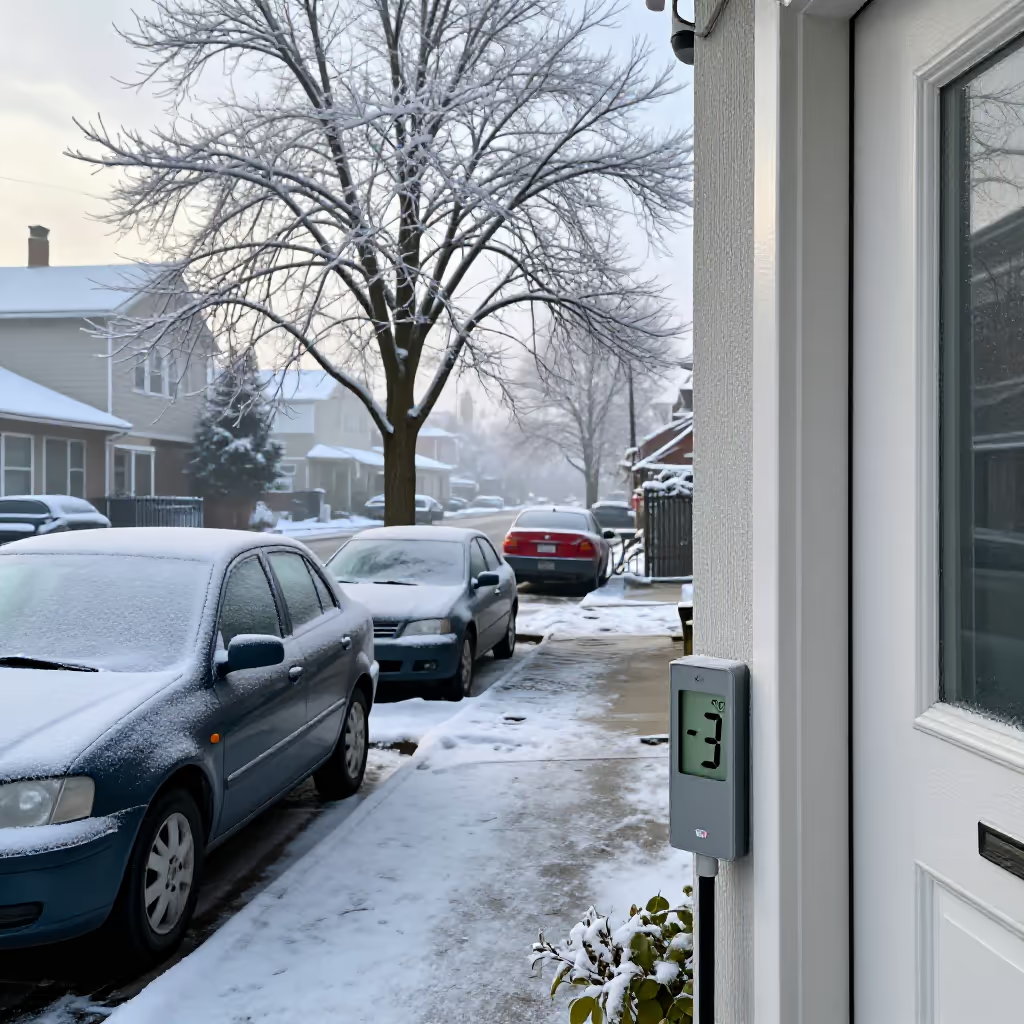
to be freezing
An impersonal expression meaning that the outside temperature is below freezing point (0°C).
Zieh dich warm an, es friert heute Morgen.
Dress warmly; it's freezing this morning.
The auxiliary verb depends on the meaning. When a person feels cold, the perfect tense is formed with 'haben' (to have). When something turns into ice, 'sein' (to be) is used.
Obwohl ich eine dicke Jacke trug, habe ich schrecklich gefroren.
Although I was wearing a thick jacket, I was terribly cold.
You can recognize the meaning of 'frieren' (to be cold / freeze) from the subject of the sentence. If the subject is a person, they are feeling cold. If the subject is a liquid or something containing water, it is turning into ice.
Das Kind friert, weil es ohne Mütze draußen spielt.
The child is cold because it is playing outside without a hat.
The past participle 'gefroren' (frozen) is very often used as an adjective. It describes the solid state of water or also frozen foods.
Vorsicht, die Stufen sind gefroren!
Careful, the steps are frozen!
If you want to say that a specific body part is cold, you can use the person as the subject or use the construction 'an' + dative.
Meine Hände frieren schon wieder.
My hands are cold again.
To express that the outside temperature is below 0°C, the impersonal construction 'es friert' (it is freezing) is used. The 'es' is a fixed, formal subject here.
Nachts hat es gefroren, deshalb sind die Straßen glatt.
It froze during the night, so the roads are slippery.
cold
Both words can express that a person feels cold. Frieren is a verb and directly names this physical sensation. Kalt uses an impersonal construction with the dative: Einer Person ist kalt, not that a person is kalt.

Ohne Jacke friere ich an der Bushaltestelle.
I’m freezing at the bus stop without a jacket.
Ohne Jacke ist mir an der Bushaltestelle kalt.
I’m cold at the bus stop without a jacket.