


gucken
to look
A colloquial expression for 'schauen' (to look) or 'sehen' (to see); to consciously direct your eyes toward something in order to perceive it.
EXAMPLE
Guck mal, da fliegt ein seltener Vogel!
Look, there’s a rare bird flying!
to look / watch
Loading your saved state.
to look
A colloquial expression for 'schauen' (to look) or 'sehen' (to see); to consciously direct your eyes toward something in order to perceive it.
Guck mal, da fliegt ein seltener Vogel!
Look, there’s a rare bird flying!
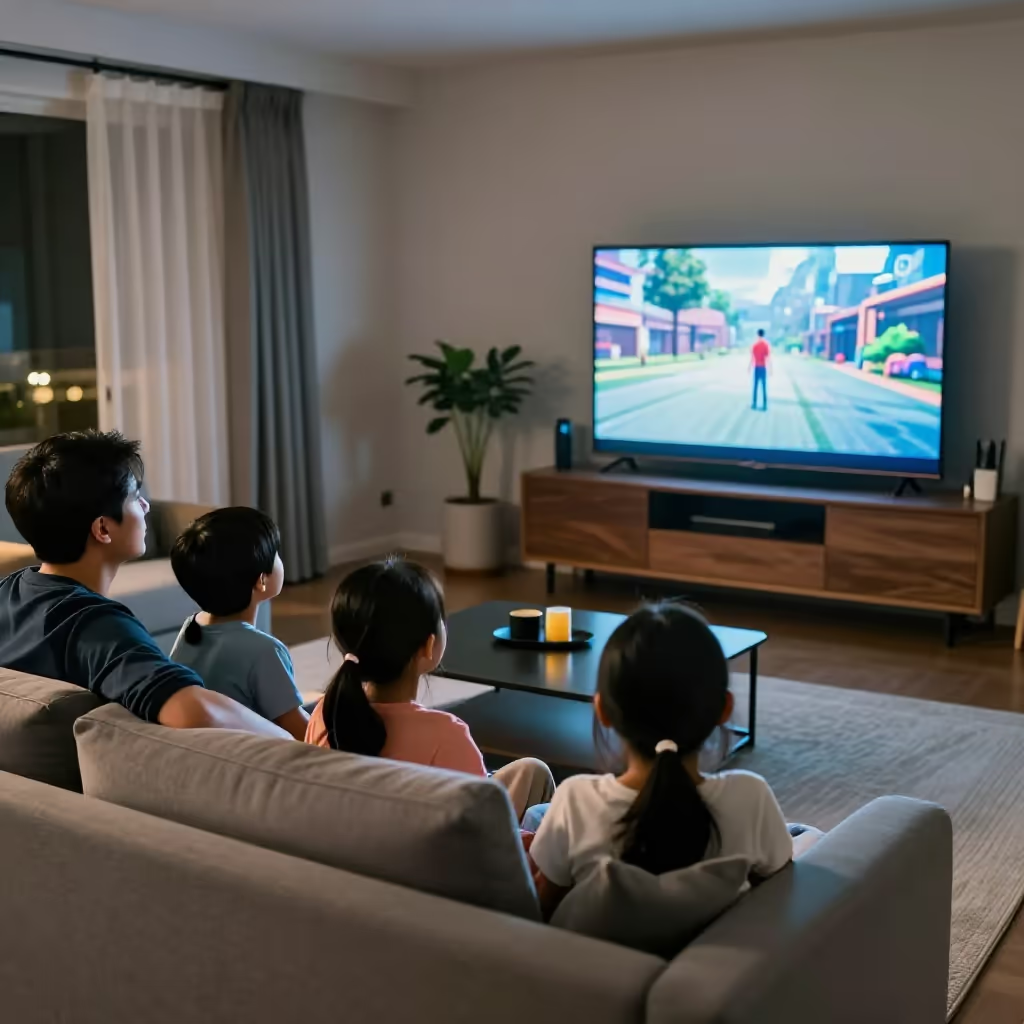
to watch
Colloquial for watching a performance, especially a film, TV show, or play.
Wollen wir heute Abend einen Film gucken?
Do we want to watch a movie tonight?

to look
Colloquial for making a particular facial expression.
Warum guckst du so traurig?
Why do you look so sad?

we’ll see
A colloquial expression that conveys a wait-and-see attitude and means that you have to check something or wait before making a decision.
Ob ich zur Party komme, weiß ich noch nicht, mal gucken.
I don’t know yet whether I’m coming to the party—we’ll see.
'Gucken' (to look/watch) is a colloquial word. In formal situations, emails, or official texts, you should use 'schauen' (to look) or 'sehen' (to see) instead.
Kannst du mal gucken, ob die Post schon da ist?
Can you check whether the mail is here yet?
The verb 'gucken' (to look/watch) is especially common in northern and central Germany. In southern Germany, Austria, and Switzerland, 'schauen' (to look) is used more often, even in colloquial speech.
In Berlin hört man oft: „Kiek ma!“ (Guck mal!).
In Berlin, you often hear: 'Kiek ma!' ('Guck mal!' = Look!).
When it comes to media consumption, 'gucken' (to watch) is often connected directly with the medium. Typical expressions are 'Fernsehen gucken' (to watch TV), 'einen Film gucken' (to watch a movie), or 'eine Serie gucken' (to watch a series).
Lass uns am Wochenende alle Folgen der neuen Serie gucken.
Let’s watch all the episodes of the new series this weekend.
To describe a facial expression, 'gucken' (to look) is combined with an adjective or adverb. Common examples are 'traurig gucken' (to look sad), 'böse gucken' (to look angry), or 'überrascht gucken' (to look surprised).
Guck nicht so skeptisch, es wird schon alles gut gehen!
Don’t look so skeptical; everything will be fine!
The expression 'mal gucken' (we’ll see) is often used as a stand-alone answer to express that you haven’t decided yet or want to wait and see how the situation develops. It signals non-commitment.
„Kommst du morgen mit ins Kino?“ – „Ich weiß noch nicht, mal gucken.“
'Are you coming to the movies tomorrow?' – 'I don’t know yet, we’ll see.'
to see
Sehen and gucken can both refer to watching a film. Sehen is neutral in everyday and standard language, while gucken sounds colloquial. Gucken is suitable in a casual conversation; in a more formal announcement, sehen is more likely.

Im Gruppenchat schreibt Ben, dass die Klasse morgen einen Film gucken wird.
In the group chat, Ben writes that the class will watch a film tomorrow.
Die Lehrerin kündigt an, dass die Klasse morgen einen Film sehen wird.
The teacher announces that the class will watch a film tomorrow.