


locken
to lure
To make a person or animal come to a certain place or do a certain thing by means of a tempting offer.
EXAMPLE
Die Werbung soll neue Kunden in das Geschäft locken.
The advertisement is meant to lure new customers into the store.
to lure / to curl
Loading your saved state.
to lure
To make a person or animal come to a certain place or do a certain thing by means of a tempting offer.
Die Werbung soll neue Kunden in das Geschäft locken.
The advertisement is meant to lure new customers into the store.
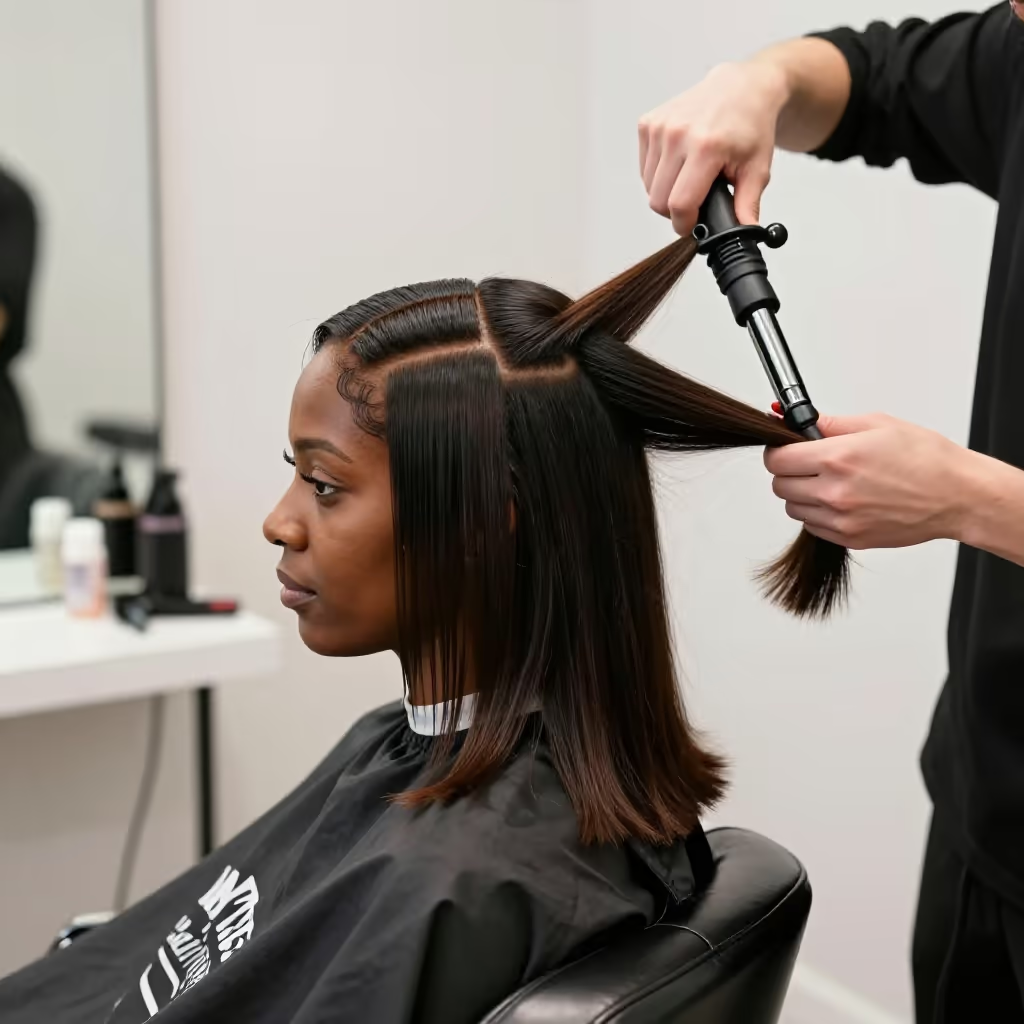
to curl
To shape straight hair into waves or curls, usually with the help of heat or curlers.
Die Friseurin hat ihr für die Feier die Haare wunderschön gelockt.
The hairdresser curled her hair beautifully for the celebration.
The meaning of 'locken' (to lure / to curl) depends on the object. If the object is 'Haare' (hair), it means 'in Locken legen' (to curl). If the object is a person or an animal, it means 'anlocken' (to attract/lure) or 'ködern' (to bait).
Sie lockt sich jeden Morgen die Haare.
She curls her hair every morning.
In the meaning of 'anlocken' (to lure/attract), it is often followed by a preposition indicating direction. The pattern is: jemanden (accusative) + where to + locken. Typical prepositions are 'in' (into), 'auf' (onto/to), or 'nach' (to).
Das Festival lockt jedes Jahr Tausende Besucher in die Stadt.
Every year, the festival lures thousands of visitors into the city.
When it is about curling hair, a reflexive construction with the dative is often used: 'sich die Haare locken' (to have one's hair curled / to curl one's hair). The person whose hair is being curled is in the dative.
Ich lasse mir vom Friseur die Haare locken.
I'm having the hairdresser curl my hair.
The verb 'locken' (to curl) in this meaning is directly related to the noun 'die Locke' (a single curl) and the adjective 'lockig' (curly, with lots of curls).
Sie hat von Natur aus wunderschöne Locken.
She has naturally beautiful curls.
to wave
Both verbs can be used when talking about an advantage. locken emphasizes that an offer moves someone to a place or action; winken presents the advantage as a possible gain or positive consequence. Use locken for the attraction and winken for what lies ahead for someone.

Der günstige Preis lockt viele Kunden in den neuen Laden.
The low price draws many customers into the new store.
Den Gewinnern winkt ein attraktiver Preis.
An attractive prize awaits the winners.