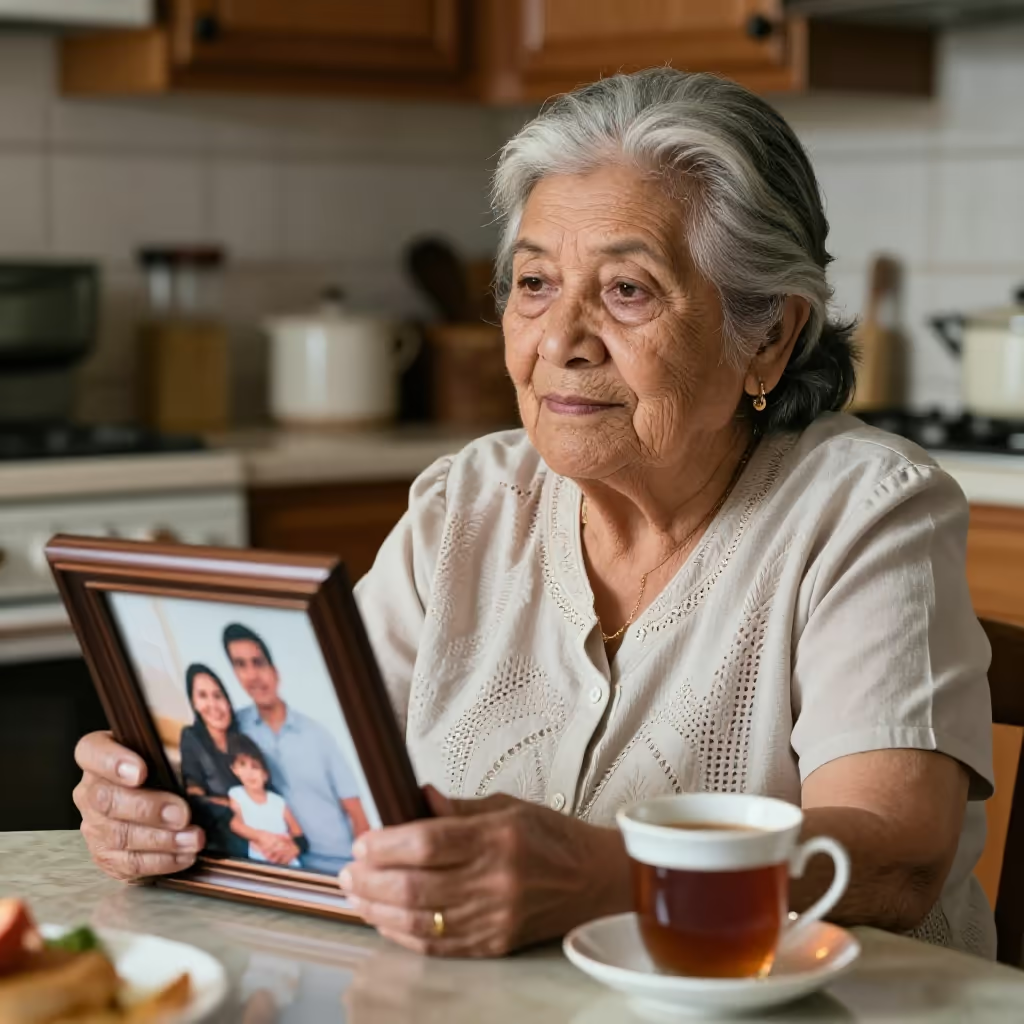
To occupy oneself mentally and intensively with a matter, problem, or question for a certain amount of time. It is a separable verb.
example
Ich muss über dein Angebot erst einmal nachdenken.
I need to think about your offer first.

Usage tips
Separable verb
'Nachdenken' (to think) is a separable verb. In a main clause, the prefix 'nach' comes at the end; in a subordinate clause, the verb stays together; and in the infinitive with 'zu', 'zu' comes between 'nach' and 'denken'.
EXAMPLE
Denk bitte über meinen Vorschlag nach.
Please think about my suggestion.
Word structure
The verb is made up of the prefix 'nach' and the verb 'denken' (to think). Its literal meaning is to think 'after' a thought or matter, that is, to reflect.
EXAMPLE
Eine gute Entscheidung erfordert Zeit zum Nachdenken.
A good decision requires time to think.
Fixed preposition
When you think about a specific topic, the preposition 'über' (about) with the accusative is always used. The structure is: über etwas (accusative) nachdenken.
EXAMPLE
Sie denkt oft über ihre Zukunft nach.
She often thinks about her future.
Context clue
When 'nachdenken' is used without an object with 'über', it means to be generally lost in thought. If, on the other hand, 'über' + topic appears with it, it is about a specific problem.
EXAMPLE
Stör ihn nicht, er denkt gerade nach.
Don’t disturb him; he’s thinking right now.
Compare with
near_synonym
nachdenken vs fragen
to ask
'sich fragen' and 'nachdenken' both describe something that happens in the mind. 'sich fragen' means that you have a specific inner question or want to know something. 'nachdenken' is more general and often more intensive: you spend some time mentally engaging with a topic, a problem, or a decision. So you can think about a question with 'nachdenken', but 'sich fragen' more strongly names the uncertainty or the specific question.
nachdenken
Clara denkt wegen der Arbeit lange über ihre Reisepläne nach.
Because of work, Clara thinks for a long time about her travel plans.
fragen
Im Supermarkt frage ich mich, ob wir noch genug Brot zu Hause haben.
At the supermarket, I wonder whether we still have enough bread at home.