

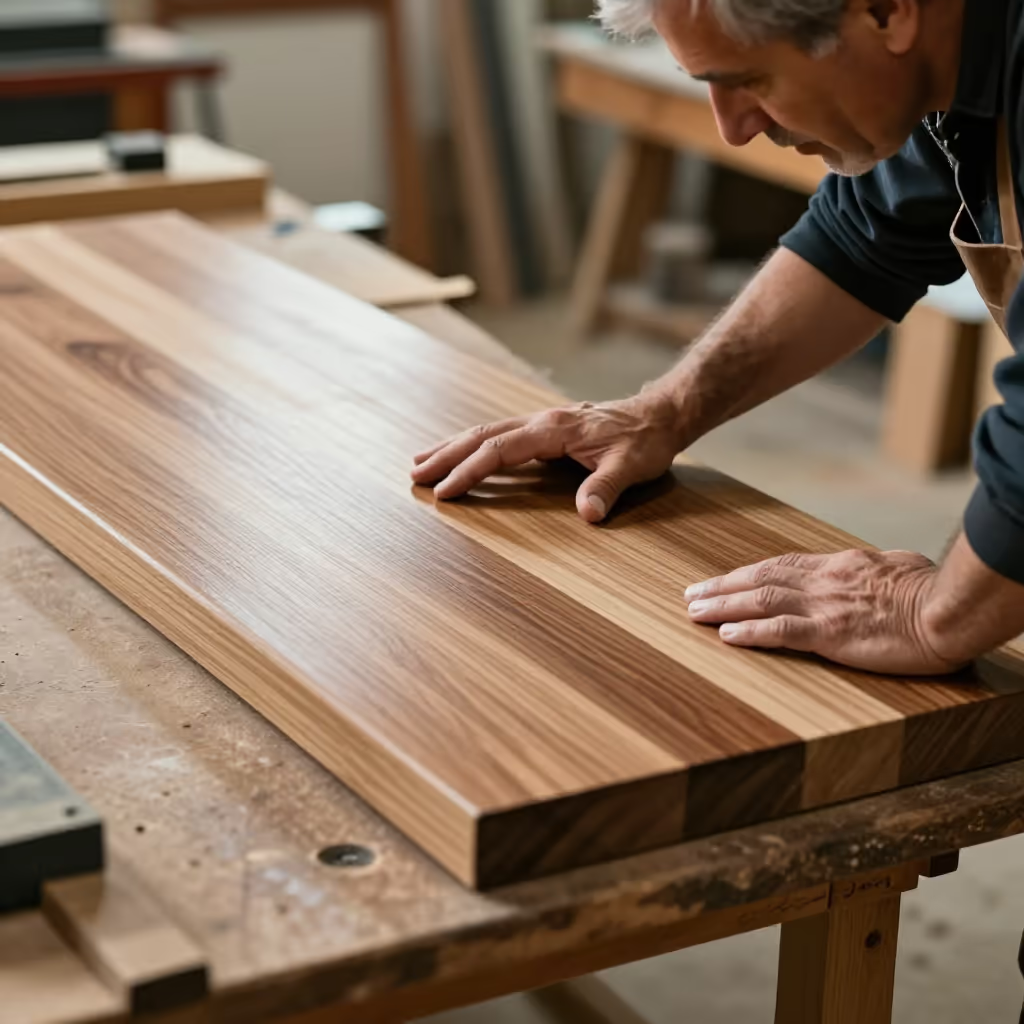
die Oberfläche
surface
The outermost, visible, or upper layer of an object, body, or liquid.
EXAMPLE
Die Oberfläche des Sees war spiegelglatt.
The surface of the lake was as smooth as glass.
surface
Loading your saved state.
surface
The outermost, visible, or upper layer of an object, body, or liquid.
Die Oberfläche des Sees war spiegelglatt.
The surface of the lake was as smooth as glass.

surface
The outward appearance or superficial aspects of a situation, without going into deeper connections.
Bleib nicht an der Oberfläche, sondern versuche, das Problem wirklich zu verstehen.
Don't stay on the surface; try to really understand the problem.

interface
In computer science, the interface between human and machine, especially the graphical user interface (GUI).
Die neue Version der App hat eine komplett überarbeitete Oberfläche.
The new version of the app has a completely redesigned interface.
'Oberfläche' (surface) is a compound noun made up of 'ober-' (upper/above) and 'die Fläche' (area/surface). So it literally describes the uppermost or outermost surface of something.
Die Oberfläche des Tisches war mit einer dünnen Staubschicht bedeckt.
The surface of the table was covered with a thin layer of dust.
The meaning of 'Oberfläche' (surface/interface) depends heavily on the topic. With physical objects, it means the outer layer. In discussions about problems, it means the superficial appearance. In the context of computers, it means the user interface.
Die Oberfläche des Mondes ist von Kratern übersät.
The surface of the moon is covered with craters.
In the physical sense, 'Oberfläche' (surface) is often combined with adjectives like 'glatt' (smooth), 'rau' (rough), 'hart' (hard), or 'weich' (soft). The preposition 'an' is often used to describe a position or movement.
Das U-Boot kam langsam an die Oberfläche.
The submarine slowly came to the surface.
In the figurative meaning, there are the fixed expressions 'an der Oberfläche bleiben' (to stay on the surface) and 'nur an der Oberfläche kratzen' (to only scratch the surface). This means that a topic is not analyzed deeply enough.
Seine Analyse kratzt leider nur an der Oberfläche des Problems.
Unfortunately, his analysis only scratches the surface of the problem.
In computer science, 'Oberfläche' (interface) is often the short form of 'Benutzeroberfläche' (user interface). It refers to the design that you see on the screen and interact with.
Die neue App hat eine sehr intuitive grafische Oberfläche.
The new app has a very intuitive graphical interface.
page / side
With a flat plate, Seite and Oberfläche can refer to the same visible area. Seite classifies the area as one of two opposing surfaces, while Oberfläche emphasizes its outer characteristics or finish. Use Seite for the location, and Oberfläche for the appearance or condition.

Die Oberfläche der Platte wurde glatt poliert.
The surface of the plate was polished smooth.
Auf der oberen Seite der Platte liegt eine dünne Glasscheibe.
A thin sheet of glass is resting on the top side of the plate.