

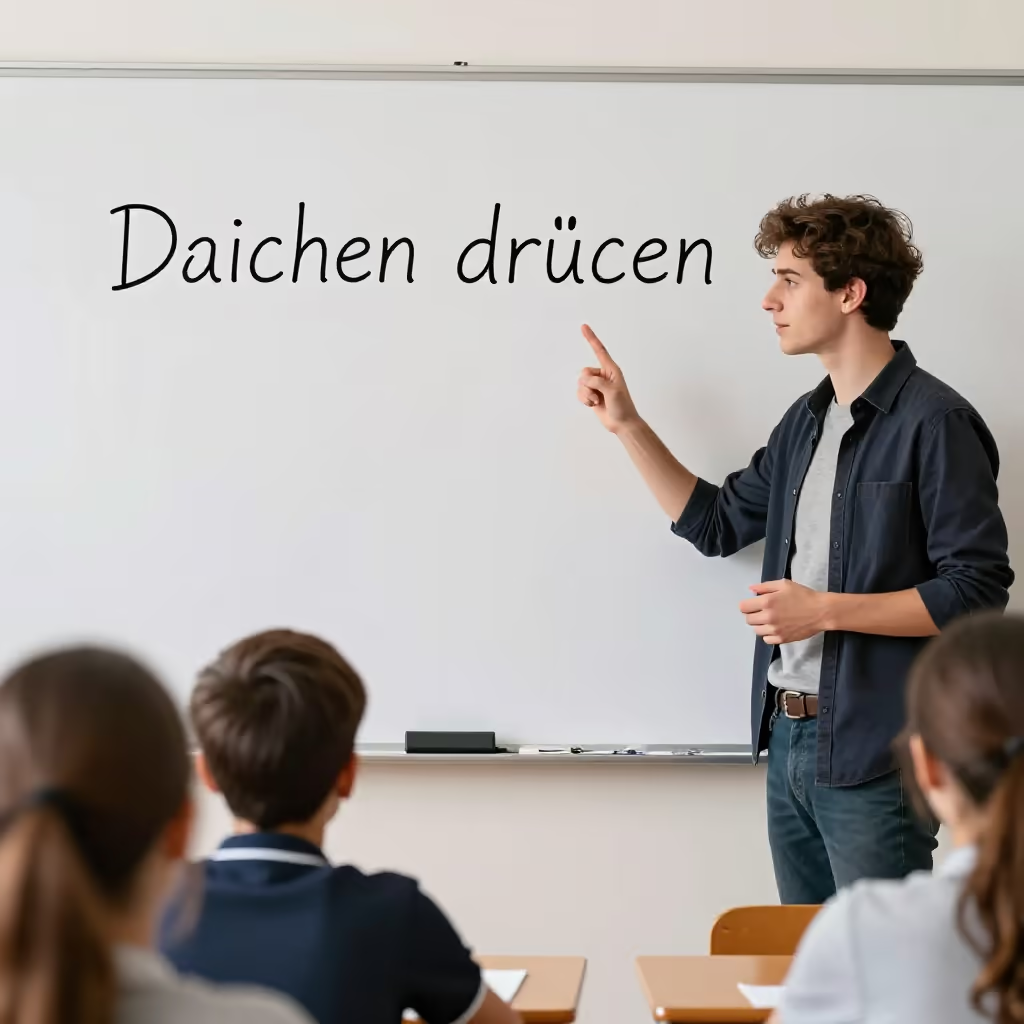
A fixed linguistic expression or figurative phrase whose overall meaning cannot be derived directly from the individual words; an idiom or proverb.
example
„Den Nagel auf den Kopf treffen“ ist eine gebräuchliche Redensart, wenn jemand etwas sehr genau beschreibt.
'To hit the nail on the head' is a common idiom when someone describes something very precisely.

Usage tips
Word composition
The word is made up of 'Reden' (speech/talking) and 'Art' (kind/type). A 'Redensart' is therefore literally a special 'way of speaking'.
EXAMPLE
Er verwendet gerne alte Redensarten, die kaum noch jemand kennt.
He likes using old idioms that hardly anyone knows anymore.
Typical collocations
Common adjectives used with 'Redensart' (idiom) are 'fest' (fixed), 'gebräuchlich' (common), 'bekannt' (well-known), or 'alt' (old).
EXAMPLE
„Ins Gras beißen“ ist eine bekannte Redensart für „sterben“.
'To bite the dust' is a well-known idiom for 'to die'.
Use in a sentence
'Redensart' (idiom) is often combined with verbs such as 'kennen' (to know), 'verwenden' (to use), or 'benutzen' (to use).
EXAMPLE
Kennst du die Redensart „Tomaten auf den Augen haben“?
Do you know the idiom 'to have tomatoes on your eyes'?
Compare with
near_synonym · confusable
Redensart vs Ausdruck
expression / printout
'der Ausdruck' and 'die Redensart' can both mean a linguistic phrase. 'der Ausdruck' is more general: it can be a single word, a normal phrase, or a specific formulation. 'die Redensart' is more specific: it is usually fixed, often figurative, and its meaning is not always clear directly from the individual words. Learners may confuse the words because a Redensart is also an Ausdruck. But not every Ausdruck is a Redensart. For normal formulations, 'Ausdruck' fits; for fixed figurative phrases, 'Redensart' fits.
Redensart
Maria versteht die Redensart nicht, weil sie die Wörter zu wörtlich nimmt.
Maria does not understand the idiom because she takes the words too literally.
Ausdruck
Im Büro fragt sie nach dem passenden Ausdruck für eine höfliche Absage.
At the office, she asks for the right expression for a polite refusal.